
— AI Data Infrastructure for Robotics
Real-world training data for robots that need to act.
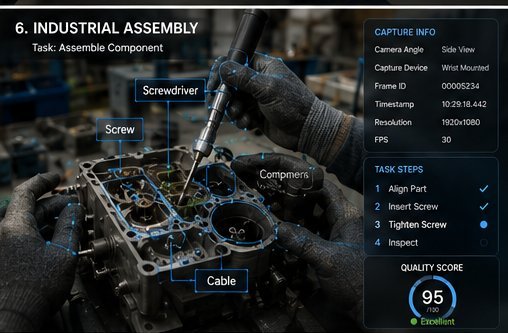
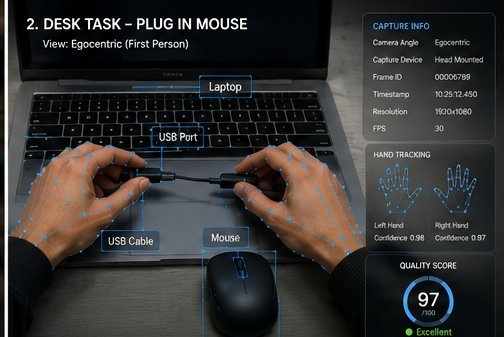 Ego · Plug-In
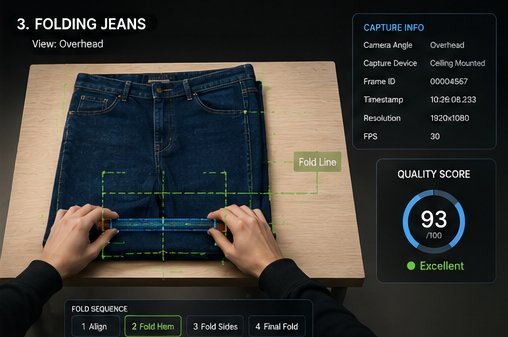 Overhead · Folding
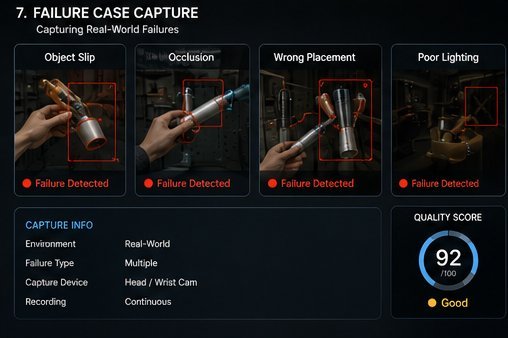 Failure Cases
Built for robotics teams that need data from real environments
— The Problem
Robots do not learn from clean theory. They learn from messy reality.
Physical AI systems fail when training data does not reflect real-world variation. Lighting changes. Objects move. Humans adapt. Hands block cameras. Edge cases appear after deployment. dexset captures the data robots actually need to improve.
Synthetic data is not enough
Simulation helps, but real-world deployment needs datasets that include variation, friction, and unpredictable human behavior.
Robotics data is hard to collect
Teams need the right camera angles, task definitions, object variation, environment diversity, and capture consistency.
Raw video is not training data
Robotics teams need structured annotations, metadata, quality checks, and delivery formats that fit their ML pipelines.
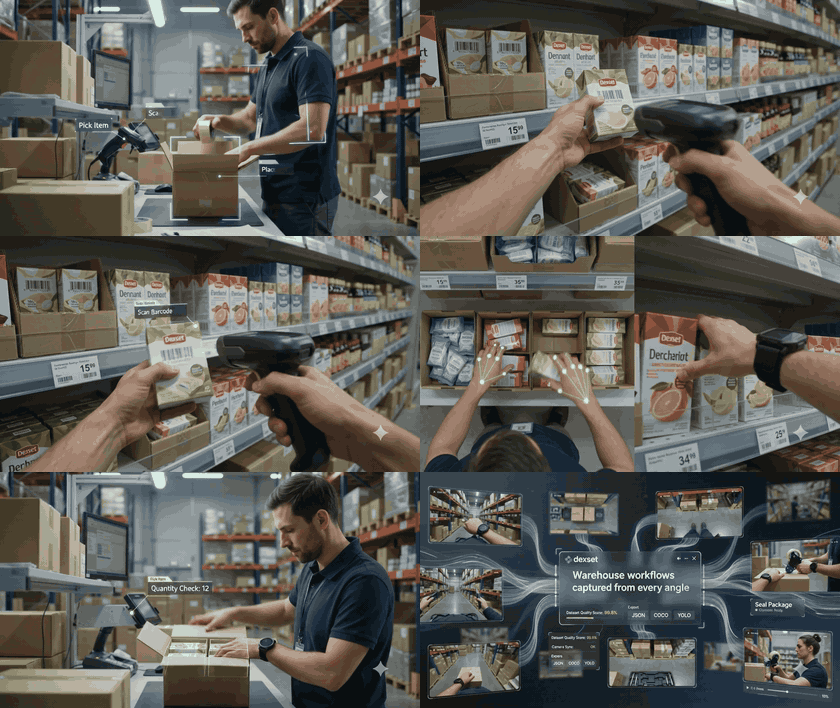
Real-world task capture · A person picking and packing — the demonstrations robots learn from.
— Platform Workflow
From real-world task capture to ML-ready datasets.
STEP 01
Define the Task
Clarify the task, environment, objects, capture angles, success criteria, and dataset requirements.
STEP 02
Capture Real-World Data
Collect egocentric, exocentric, multi-view, sensor, and teleoperation data across relevant environments.
STEP 03
Annotate Interactions
Label objects, actions, poses, failures, sequences, grasp points, scenes, and task outcomes.
STEP 04
Validate Quality
Score datasets for completeness, consistency, coverage, variation, and model-readiness.
STEP 05
Deliver to Pipeline
Export data in formats compatible with computer vision, robotics, and ML workflows.
— Data Services
Everything needed to build robotics training datasets.
Real-World Video Collection
Capture task-specific video data from commercial, industrial, residential, and controlled environments.
Egocentric Data Capture
Collect first-person task demonstrations using wearable, wrist-mounted, or operator-view capture setups.
Multi-View Capture
Record synchronized exocentric and egocentric views for better spatial and contextual understanding.
Human-Object Interaction Datasets
Capture hands, tools, objects, surfaces, sequences, and outcomes across real workflows.
Dataset Annotation
Label objects, actions, poses, bounding boxes, segmentation masks, keyframes, events, and task states.
Multi-Format Delivery
Deliver datasets in COCO, YOLO, Pascal VOC, JSON, CSV, or custom schemas based on ML pipeline needs.
— Dataset Types
Datasets for the tasks robots struggle with most.
Manipulation Data
Pick, place, grasp, rotate, open, close, stack, sort, plug, fold, and assemble.
Dexterity Data
Fine motor tasks involving hands, tools, cables, packages, small objects, and irregular surfaces.
Warehouse Task Data
Picking, packing, stocking, scanning, sorting, pallet movement, bin interaction, and inventory handling.
Navigation Data
Scene understanding, obstacle interaction, route context, spatial layouts, and movement patterns.
Human-Object Interaction
How people use objects in real environments, with variation across grip, posture, sequence, and intent.
Failure Case Data
The scenarios where robots break down: occlusions, misgrips, slips, poor lighting, clutter, ambiguity.
Teleoperation Data
Data from remote or on-site robot operation to support continuous learning and deployment.
Multi-Modal Data
Video, image, metadata, sensor streams, task labels, and environment context in structured datasets.
— Platform Visual Story
One workflow from capture brief to dataset delivery.
Task name
carton_pick_v3
Environment
Warehouse, aisle 4–9
Objects
Cartons, totes, labels
Cameras
Ego + 2× exo
Required actions
Pick, scan, place
Success criteria
Placed in tote, label up
Dataset volume
120 hrs
Ego camera
Head-mounted, 4K/60
Exo camera
2× tripod, synced
Wrist view
Right wrist, 1080p
Sensor stream
IMU (optional)
Operator notes
Per-session log
Environment tags
Lighting, layout, shift
Video clips
8,420 clips
Frame samples
1.9M frames
Metadata
Per-clip JSON
Time sync
±2 ms drift
Capture ID
DX-2481-EU
Task sequence
12-step max
Object labels
46 classes
Action labels
pick / place / scan
Bounding boxes
2D, tracked
Segmentation
Instance masks
Keypoints
21-pt hand pose
Failure markers
Mis-grip, occlusion
Coverage score
94 / 100
Annotation confidence
0.97 mean
Variation score
High
Completeness
99.2%
Error flags
14 resolved
Review status
Approved
COCO
✓ available
YOLO
✓ available
Pascal VOC
✓ available
JSON / CSV
✓ available
Custom schema
On request
API delivery
Versioned, signed
— Industries
Designed for the physical AI use cases moving fastest.
Humanoid Robotics
Task demonstrations for general-purpose robots learning everyday manipulation, navigation, and human-assistance workflows.
Warehouse & Logistics
Datasets for picking, packing, sorting, scanning, shelving, and movement across logistics environments.
Industrial Automation
Workflow data for inspection, assembly, quality checks, machine interaction, and safety monitoring.
Service Robotics
Human-assistance, hospitality, cleaning, delivery, and indoor navigation datasets.
Autonomous Vehicles
Scene understanding, object detection, edge-case capture, and environment-specific perception datasets.
Agriculture Robotics
Crop monitoring, field navigation, object recognition, harvesting support, and environment variation datasets.
Healthcare Robotics
Controlled task data for assistive robotics, device interaction, mobility support, and clinical environment workflows.
Retail Robotics
Shelf scanning, product recognition, inventory checks, restocking workflows, and store navigation datasets.
— Dataset Quality
Training data is only useful when it is consistent, traceable, and complete.
Coverage
Capture enough variation across objects, environments, people, lighting, camera angles, and task sequences.
Precision
Use clear labels, consistent annotation standards, and task-specific metadata.
Traceability
Maintain source, capture, task, environment, and annotation records for every dataset.
Delivery Readiness
Format datasets for direct use in model training, evaluation, simulation, and deployment pipelines.
— Why dexset
Why robotics teams use dexset
Real-world data, not lab-only capture
Capture the messy physical variation robots face after deployment.
Built for robot learning workflows
Structure datasets around tasks, objects, actions, environments, and outcomes.
Custom capture for specific use cases
Define the exact data your model needs instead of settling for generic datasets.
Annotation that understands physical tasks
Label interactions, sequences, poses, failures, and outcomes with task context.
Data that fits your ML pipeline
Deliver datasets in preferred formats, schemas, and structures.
Continuous improvement through teleoperations
Support post-deployment learning by capturing new edge cases and operator data.
— Compliance & Trust
Compliant by design, across every dataset.
From first consent form to final delivery, dexset workflows are built to meet data protection, security, and labor standards across the regions where we capture and the regions where our customers operate.
Informed consent
Every participant is briefed and signs a release before capture begins. Consent records attach to each clip, and withdrawal requests are honored across all delivered versions.
Privacy protection
Face blurring, anonymization, and exclusion zones are applied wherever required. We minimize personal data by design and never collect more than the task brief demands.
Data security
Footage is encrypted in transit and at rest, with role-based access controls, signed delivery URLs, and per-recipient transfer records on every dataset.
Regional compliance
Capture and delivery workflows are designed to align with GDPR and UK GDPR, CCPA/CPRA, PIPL, APPI, and LGPD requirements, with regional data-residency options where needed.
Traceability & audit
Source, consent, capture, environment, and annotation records persist for every dataset, supporting audits that run from raw footage to the exported training file.
Responsible sourcing
Capture operators, demonstrators, and annotators are fairly paid and work under documented, safe conditions — quality data should never come from exploitative labor.
— What Teams Say
Trusted by robotics teams.
★★★★★
“dexset captured 400 hours of bin-picking demonstrations across three warehouses. The failure taxonomy alone cut our triage time in half.”
Lena Ortiz
Head of Robot Learning, AI Robotics Company
★★★★★
“We sent one task brief and got back a dataset that loaded into our pipeline on the first try. Custom schema, zero rework.”
Marcus Chen
ML Infrastructure Lead, Independent Robotics Vendor
★★★★★
“The egocentric hand-pose labels are the best we have evaluated. Our grasp success rate improved 18% after one fine-tuning round.”
Priya Raman
Manipulation Lead, AI Robotics Company
— FAQ
Frequently asked questions.
What does dexset actually deliver?
dexset delivers ML-ready robotics training datasets: real-world video captured to your task brief, annotated with objects, actions, poses, task states, and failures, validated for coverage and consistency, and exported in COCO, YOLO, Pascal VOC, JSON, CSV, or a custom schema mapped to your pipeline.
How is dexset different from a generic annotation vendor?
Generic vendors label footage you already have. dexset runs the full loop: task definition, real-world capture with trained operators, robotics-specific annotation, quality scoring, and delivery. Labels carry physical context — grasp points, task states, failure markers — that general-purpose labeling teams routinely miss.
Do you replace synthetic or simulation data?
No — we complement it. Simulation is excellent for scale and rare-state coverage, but deployment requires real-world variation: lighting, clutter, occlusion, and human behavior. Most teams use dexset data to fine-tune, validate sim-to-real transfer, and build held-out evaluation sets.
How long does a typical dataset project take?
A pilot of under ten hours of captured data typically ships in two to three weeks, including annotation and quality review. Larger programs run as recurring batches, so your first training-ready data arrives early rather than at the end of the engagement.
Who owns the data dexset collects for us?
You do. Custom-captured datasets are delivered under exclusive ownership or exclusive license terms agreed before capture begins. Every clip carries source, consent, and capture records, so provenance is auditable from raw footage through to the exported training file.
— Get Started
Need real-world data for your robotics model?
Tell us what your robot needs to learn. dexset can help define, capture, annotate, validate, and deliver the dataset behind it.