
— Data Services · Egocentric Capture
First-person task data from the operator's point of view.
Egocentric video shows a task the way the actor experiences it: hands in frame, objects at working distance, attention aligned with action. dexset captures it with wearable, wrist-mounted, and operator-view rigs.
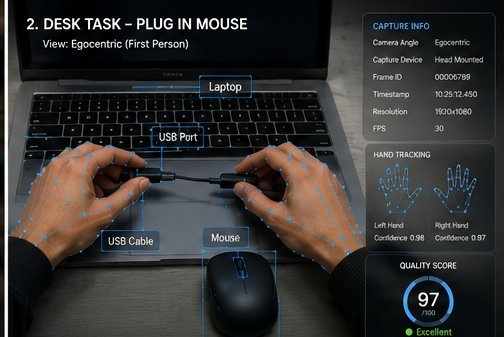
Egocentric capture · Desk task
— Capabilities
What egocentric capture includes.
Head-mounted capture
Stabilized first-person video that keeps the workspace and both hands in frame through full task sequences.
Wrist-mounted views
Close-range hand-object detail for grasping, insertion, and fine manipulation that head cameras miss.
Gaze-aligned framing
Framing protocols that keep the active object centered, so models learn where attention goes during a task.
Hand visibility protocols
Capture standards that minimize self-occlusion and keep fingers, grips, and contact points labelable.
Sync with exocentric views
Timecode-locked alignment with third-person cameras for multi-view training and 3D supervision.
Operator and session metadata
Per-session notes, environment tags, and capture IDs attached to every clip for traceability.
— In Scope
Tasks commonly captured egocentrically.
— Compliance & Trust
Compliant by design, across every dataset.
From first consent form to final delivery, dexset workflows are built to meet data protection, security, and labor standards across the regions where we capture and the regions where our customers operate.
Informed consent
Every participant is briefed and signs a release before capture begins. Consent records attach to each clip, and withdrawal requests are honored across all delivered versions.
Privacy protection
Face blurring, anonymization, and exclusion zones are applied wherever required. We minimize personal data by design and never collect more than the task brief demands.
Data security
Footage is encrypted in transit and at rest, with role-based access controls, signed delivery URLs, and per-recipient transfer records on every dataset.
Regional compliance
Capture and delivery workflows are designed to align with GDPR and UK GDPR, CCPA/CPRA, PIPL, APPI, and LGPD requirements, with regional data-residency options where needed.
Traceability & audit
Source, consent, capture, environment, and annotation records persist for every dataset, supporting audits that run from raw footage to the exported training file.
Responsible sourcing
Capture operators, demonstrators, and annotators are fairly paid and work under documented, safe conditions — quality data should never come from exploitative labor.
— What Teams Say
Trusted by robotics teams.
★★★★★
“The egocentric hand-pose labels are the best we have evaluated. Our grasp success rate improved 18% after one fine-tuning round.”
Priya Raman
Manipulation Lead, AI Robotics Company
★★★★★
“Coverage scoring meant we knew exactly what variation we were missing before training, not after burning a GPU budget on it.”
Sofia Almeida
Perception Engineer, AI Robotics Company
★★★★★
“We sent one task brief and got back a dataset that loaded into our pipeline on the first try. Custom schema, zero rework.”
Marcus Chen
ML Infrastructure Lead, Independent Robotics Vendor
— FAQ
Frequently asked questions.
Why does egocentric data matter for robot learning?
First-person video aligns the camera with the actor’s attention and working distance — hands, objects, and contact points stay in frame the way a robot’s own sensors would see them, making it the most directly transferable demonstration view for manipulation models.
What hardware do you use for egocentric capture?
Head-mounted stabilized cameras for full-task context and wrist-mounted units for close-range hand-object detail, typically at 1080p–4K and 30–60 FPS, with timecode sync to any exocentric rigs in the same session.
How do you deal with self-occlusion?
Capture protocols position tasks and framing to minimize hands blocking the action, wrist views recover detail head cameras lose, and annotation tracks pose through brief occlusions — with occluded segments explicitly flagged rather than guessed.
Can egocentric streams be synced with third-person views?
Yes. Frame-level timecode locking keeps egocentric and exocentric streams aligned within tight drift tolerances, supporting multi-view training and 3D supervision from the same session.
Need first-person task data?
Describe the task and we will design the wearable capture setup around it.