— Platform
dexset helps teams move from data requirement to real-world capture, annotation, validation, and ML-ready dataset delivery.
— Architecture
01
02
03
04
05
06
07
08
— Delivery Console
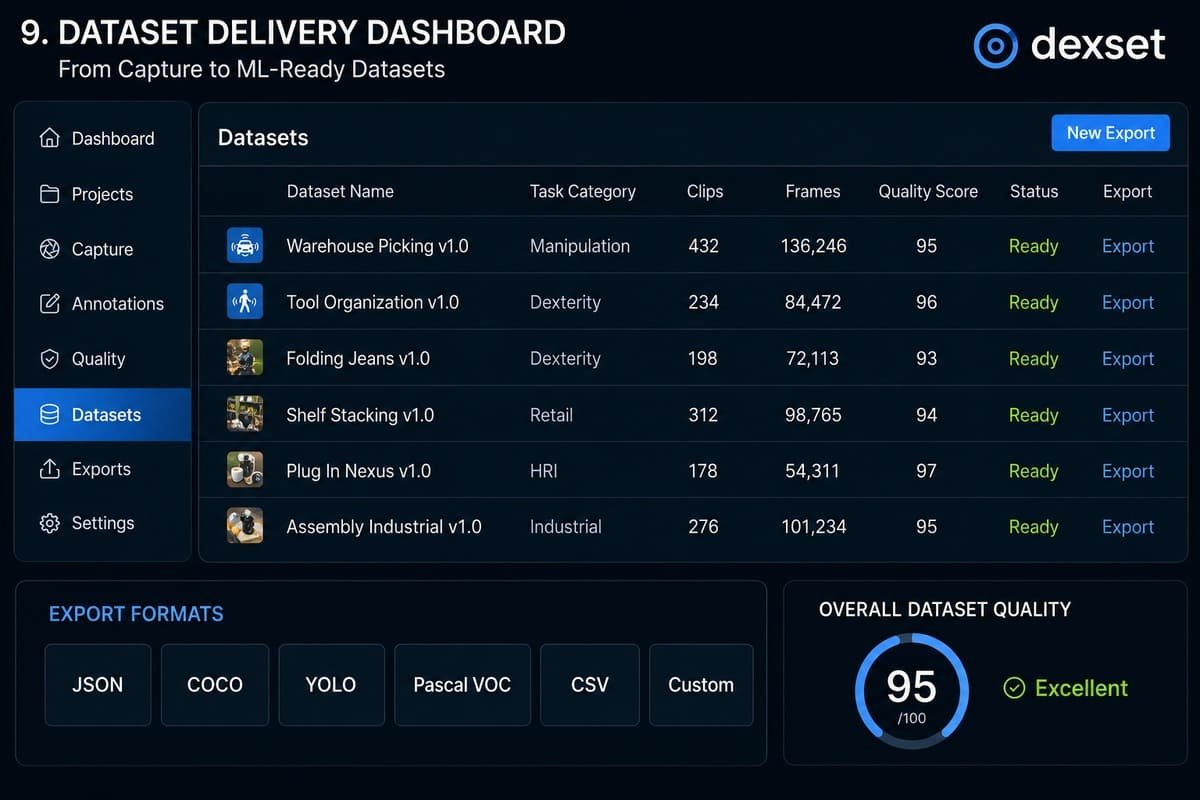
Dataset delivery dashboard · JSON / COCO / YOLO / Pascal VOC / CSV / Custom
— Capabilities
Structured briefs covering objects, environments, angles, actions, and success criteria.
Trained operators and capture setups across commercial, industrial, and residential environments.
Multimodal organization across video, frames, sensors, metadata, and task sequences.
Robotics-specific labeling pipelines with multi-pass human review.
Coverage, precision, completeness, and variation scoring on every batch.
Versioned, signed dataset delivery in the schema your pipeline expects.
Intervention capture that turns deployment into a continuous data source.
Source, capture, task, environment, and annotation records for every dataset.
Physical-task context applied at every quality gate, not just spot checks.
— Compliance & Trust
From first consent form to final delivery, dexset workflows are built to meet data protection, security, and labor standards across the regions where we capture and the regions where our customers operate.
Every participant is briefed and signs a release before capture begins. Consent records attach to each clip, and withdrawal requests are honored across all delivered versions.
Face blurring, anonymization, and exclusion zones are applied wherever required. We minimize personal data by design and never collect more than the task brief demands.
Footage is encrypted in transit and at rest, with role-based access controls, signed delivery URLs, and per-recipient transfer records on every dataset.
Capture and delivery workflows are designed to align with GDPR and UK GDPR, CCPA/CPRA, PIPL, APPI, and LGPD requirements, with regional data-residency options where needed.
Source, consent, capture, environment, and annotation records persist for every dataset, supporting audits that run from raw footage to the exported training file.
Capture operators, demonstrators, and annotators are fairly paid and work under documented, safe conditions — quality data should never come from exploitative labor.
— What Teams Say
★★★★★
“We sent one task brief and got back a dataset that loaded into our pipeline on the first try. Custom schema, zero rework.”
Marcus Chen
ML Infrastructure Lead, Independent Robotics Vendor
★★★★★
“Coverage scoring meant we knew exactly what variation we were missing before training, not after burning a GPU budget on it.”
Sofia Almeida
Perception Engineer, AI Robotics Company
★★★★★
“From brief to delivered COCO export in three weeks. Generic annotation vendors quoted us three months for lower quality.”
David Park
Founding Engineer, Independent Robotics Vendor
— FAQ
The platform runs the full data lifecycle: structured task briefs, capture operations, multimodal data organization, robotics-specific annotation, quality validation, and versioned delivery through APIs — plus a teleoperation feedback loop that turns deployment interventions into new training data.

Yes. The delivery console shows every dataset with clip counts, frame counts, quality scores, review status, and available export formats, so your team can track capture and annotation progress in one view rather than waiting for end-of-project handoffs.
Every batch is scored for coverage, annotation confidence, variation, and completeness before release. Error flags are resolved in human review, and datasets only reach delivery status once they pass the thresholds agreed in your task brief.
Yes. Datasets are delivered through versioned, signed APIs or direct cloud-storage transfer, with schema mapping defined once and applied to every release. Webhooks can notify your pipeline when a new batch passes review.
Bring one workflow your robot needs to learn. We will show you how it becomes a dataset.