
— Data Services · Human Task Demonstrations
Real people completing real tasks, captured for robot learning.
Demonstration data is only useful when it is designed: the right tasks, the right variation, the right repetition counts, and labels that mark success and failure. dexset runs demonstration programs end to end.
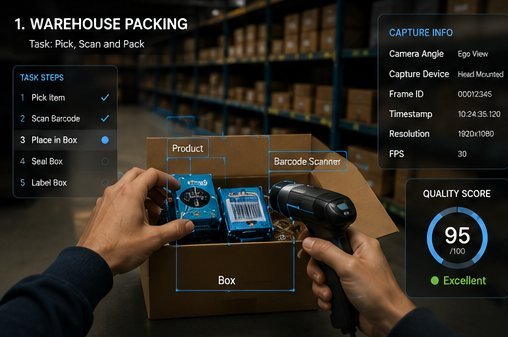
Human demonstration · Warehouse packing
— Capabilities
How demonstration programs run.
Demonstration design
Translate your model requirements into task scripts: objects, sequences, environments, and success criteria.
Trained demonstrators
Operators briefed on capture protocols who perform naturally instead of performing for the camera.
Controlled variation
Planned diversity across objects, grips, speeds, layouts, and people — variation by design, not by accident.
Repetition planning
Repetition counts set per task to reach the coverage your training objective actually needs.
Success and failure labeling
Every demonstration tagged with outcome, so failed attempts become usable negative examples.
Sequence structure
Multi-step tasks segmented into sub-actions with temporal labels for sequence-level learning.
— In Scope
Demonstration categories.
— Compliance & Trust
Compliant by design, across every dataset.
From first consent form to final delivery, dexset workflows are built to meet data protection, security, and labor standards across the regions where we capture and the regions where our customers operate.
Informed consent
Every participant is briefed and signs a release before capture begins. Consent records attach to each clip, and withdrawal requests are honored across all delivered versions.
Privacy protection
Face blurring, anonymization, and exclusion zones are applied wherever required. We minimize personal data by design and never collect more than the task brief demands.
Data security
Footage is encrypted in transit and at rest, with role-based access controls, signed delivery URLs, and per-recipient transfer records on every dataset.
Regional compliance
Capture and delivery workflows are designed to align with GDPR and UK GDPR, CCPA/CPRA, PIPL, APPI, and LGPD requirements, with regional data-residency options where needed.
Traceability & audit
Source, consent, capture, environment, and annotation records persist for every dataset, supporting audits that run from raw footage to the exported training file.
Responsible sourcing
Capture operators, demonstrators, and annotators are fairly paid and work under documented, safe conditions — quality data should never come from exploitative labor.
— What Teams Say
Trusted by robotics teams.
★★★★★
“The egocentric hand-pose labels are the best we have evaluated. Our grasp success rate improved 18% after one fine-tuning round.”
Priya Raman
Manipulation Lead, AI Robotics Company
★★★★★
“Coverage scoring meant we knew exactly what variation we were missing before training, not after burning a GPU budget on it.”
Sofia Almeida
Perception Engineer, AI Robotics Company
★★★★★
“We sent one task brief and got back a dataset that loaded into our pipeline on the first try. Custom schema, zero rework.”
Marcus Chen
ML Infrastructure Lead, Independent Robotics Vendor
— FAQ
Frequently asked questions.
Who performs the demonstrations?
Trained demonstrators briefed on capture protocols, your own staff working under our protocols, or a mix. The choice depends on the natural variation you want and any facility or compliance constraints.
How do you design a demonstration program?
We translate your model requirement into task scripts: objects, sub-actions, environments, camera setups, repetition counts, and success criteria. The script is reviewed with your team before the first session runs.
Are failed attempts kept in the dataset?
Yes, deliberately. Every demonstration is tagged with its outcome, so failed and recovered attempts become labeled negative and recovery examples instead of being discarded.
How much repetition does a task need?
It depends on the variation axes that matter — objects, grips, layouts, people. Pilots establish a baseline, and coverage scoring then shows whether additional repetitions add information or just volume.
What should your robot watch humans do?
Send us the task list. We come back with a demonstration plan and sample clips.