
— Use Case · Dexterity Training
Fine-motor data for hands, tools, and small objects.
Dexterity is where robotics is hardest: cables, fasteners, fabric, and small parts demand precision that coarse datasets cannot teach. dexset captures fine-motor tasks with the close-range views and dense labels they require.
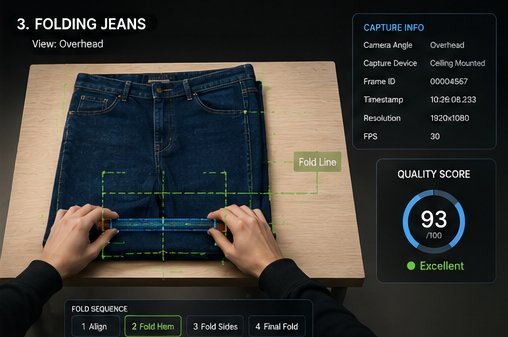
Fine-motor task · Overhead folding
— Capabilities
What dexterity datasets include.
Close-range hand capture
Wrist-mounted and macro views that keep fingertips, contact points, and small objects in sharp detail.
Dense hand pose labels
21-point hand keypoints tracked through contact, occlusion, and in-hand manipulation.
Cable and connector tasks
Plug insertion, cable routing, and connector mating across connector types and tolerances.
Fastening and assembly
Screws, clips, snaps, and threaded parts handled through complete fastening sequences.
Deformable handling
Folding, draping, and manipulating fabric, bags, and flexible packaging.
Force-relevant annotation
Labels for grip adjustments, re-grasps, and slip events that signal force dynamics on video.
— In Scope
Fine-motor tasks captured.
— Compliance & Trust
Compliant by design, across every dataset.
From first consent form to final delivery, dexset workflows are built to meet data protection, security, and labor standards across the regions where we capture and the regions where our customers operate.
Informed consent
Every participant is briefed and signs a release before capture begins. Consent records attach to each clip, and withdrawal requests are honored across all delivered versions.
Privacy protection
Face blurring, anonymization, and exclusion zones are applied wherever required. We minimize personal data by design and never collect more than the task brief demands.
Data security
Footage is encrypted in transit and at rest, with role-based access controls, signed delivery URLs, and per-recipient transfer records on every dataset.
Regional compliance
Capture and delivery workflows are designed to align with GDPR and UK GDPR, CCPA/CPRA, PIPL, APPI, and LGPD requirements, with regional data-residency options where needed.
Traceability & audit
Source, consent, capture, environment, and annotation records persist for every dataset, supporting audits that run from raw footage to the exported training file.
Responsible sourcing
Capture operators, demonstrators, and annotators are fairly paid and work under documented, safe conditions — quality data should never come from exploitative labor.
— What Teams Say
Trusted by robotics teams.
★★★★★
“The egocentric hand-pose labels are the best we have evaluated. Our grasp success rate improved 18% after one fine-tuning round.”
Priya Raman
Manipulation Lead, AI Robotics Company
★★★★★
“Coverage scoring meant we knew exactly what variation we were missing before training, not after burning a GPU budget on it.”
Sofia Almeida
Perception Engineer, AI Robotics Company
★★★★★
“We sent one task brief and got back a dataset that loaded into our pipeline on the first try. Custom schema, zero rework.”
Marcus Chen
ML Infrastructure Lead, Independent Robotics Vendor
— FAQ
Frequently asked questions.
What counts as a dexterity task?
Fine-motor work where tolerance is tight and contact is rich: cable and connector insertion, screwing and fastening, folding fabric, threading, small-object sorting, in-hand rotation, and precision placement.
How do you capture fingertip-level detail?
Wrist-mounted and macro camera views keep fingertips, contact points, and small objects sharp, while head-mounted views preserve task context — all timecode-synced in the same session.
Can video convey force information?
Indirectly, and we label for it: grip adjustments, re-grasps, and slip events are annotated as observable proxies for force dynamics, giving models the signals video can actually carry.
Do you cover deformable objects?
Yes. Folding, draping, and manipulating fabric, bags, and flexible packaging are core dexterity categories, captured with fold-line and state annotations like the overhead folding example above.
Training a dexterous manipulator?
Tell us the task and tolerance. We design the close-range capture around it.