
Comparing Exocentric & Multi-View Data Approaches for Robot Learning: Pros, Cons & Costs
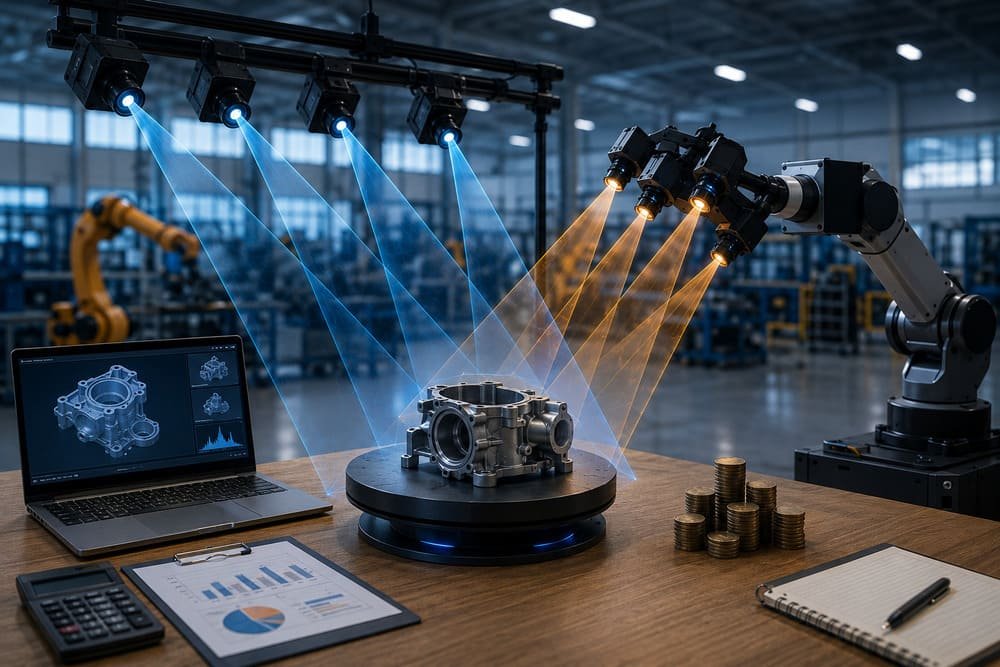
A buyer on a scoping call last month put the field’s confusion into one sentence: everyone tells him to collect multi-view data, and nobody will tell him which multi-view. He was right to push. “Multi-view” describes at least five distinct capture strategies with different rig costs, different failure modes, and different value per training hour, and the honest answer, the thesis of this post, is that the right configuration is determined by your task list and training strategy, not by your budget or by whichever public dataset you read about first. Choosing the wrong one is not a small mistake. A team that builds a six-camera arc when their tasks needed a wrist camera and one tripod has burned rig budget, tripled their storage bill, and slowed capture throughput for nothing.
The confusion is understandable. Public datasets each embody one choice without explaining the alternatives: DROID picked two external stereo cameras plus wrist, Ego-Exo4D picked glasses plus stationary exo arrays, and Open X-Embodiment inherited whatever its 22 source labs happened to mount. The papers report what was captured, not the decision tree.
This post is that decision tree. We compare the five approaches we quote and build most often at DexSet, with honest pros, cons, and cost ranges from our own rigs, and end with a matrix mapping task types to configurations. For the underlying camera specs, calibration toolchain, and sync engineering, see the pillar guide: The Complete Guide to Exocentric & Multi-View Data for Robot Learning.
Key Takeaways – Five capture approaches dominate: single exo + wrist, DROID-style (2 exo + wrist), ego+exo paired human capture, dense arrays (4-8 cameras), and sim-rendered multi-view. – DROID-style is the default for tabletop manipulation and VLA training data: $4,500 to $7,000 rig, $26 to $38 per operated hour in our benchmarks. – Ego+exo paired capture is the only approach that supports human-video pretraining with cross-view transfer; it costs more in sync engineering than in cameras. – Sim-rendered views are nearly free per view but inherit the sim-to-real gap; they complement real capture, they do not replace it.
The Five Approaches, Defined
A capture approach is the combination of camera count, camera placement, actor type (robot or human), and sync method used to record training episodes. The five that cover almost every real program:
- Single exocentric + wrist. One fixed external camera plus a wrist camera on the robot. The minimum viable multi-view setup.
- DROID-style: two exocentric stereo + wrist. Two external stereo cameras (ZED 2i class) at distinct poses plus a wrist camera, calibrated extrinsics, as used across DROID’s 76,000 episodes (arXiv:2403.12945).
- Ego + exo paired human capture. Glasses or head-mounted camera on a human demonstrator plus stationary exocentric cameras, the Ego-Exo4D pattern (arXiv:2311.18259).
- Dense array (4-8 cameras). Hardware-triggered ring or arc around the workspace for reconstruction-grade coverage.
- Sim-rendered multi-view. Arbitrary virtual cameras rendered from simulation, optionally mixed with real data.
Master Comparison Table
| Approach | Rig Build | Capture Cost / Hr | Sync Difficulty | Occlusion Coverage | Human-Video Pretraining | Main Risk |
|---|---|---|---|---|---|---|
| Single exo + wrist | $2,500 to $4,000 | $20 to $28 | Low | Partial | No | Blind spots remain |
| DROID-style (2 exo + wrist) | $4,500 to $7,000 | $26 to $38 | Moderate | Good | No | Calibration upkeep |
| Ego + exo paired | $6,000 to $9,500 | $32 to $44 | High (moving ego cam) | Good | Yes | Ego-exo time alignment |
| Dense array (4-8 cams) | $9,000 to $12,000 | $40 to $50 | High (trigger/genlock) | Excellent | No | Storage, diminishing returns |
| Sim-rendered multi-view | Compute only | ~$1 to $5 equivalent | None | Perfect | Limited | Sim-to-real gap |
Rig and capture figures are DexSet benchmarks, including session calibration checks and QA; sim figures are rough GPU-time equivalents.
Where Each Approach Wins and Loses
Single exo + wrist earns its place as a starting point. Pros: cheapest real multi-view, simple calibration (one extrinsic pair), enough to break the wrist-only occlusion ceiling for many tasks. Cons: one blocked view and you are back to single-view; no view redundancy for QA cross-checks. We recommend it for prototyping and single-task policies, and we recommend planning the mount points for camera two on day one.
DROID-style is the workhorse, and not by accident. Two external views mean occlusion of one is usually covered by the other; three total views give the RoboMimic-style observation flexibility that lets ML teams ablate view combinations later (arXiv:2108.03298). Cons: per-session calibration verification becomes mandatory, because three cameras drift three ways. In our operations the added QA overhead is roughly 5 percent of session time. This is what we quote when a VLA team asks for a default.
Ego + exo paired solves a different problem: it is the only configuration that produces the ego-exo correspondences needed to pretrain on human demonstration video and transfer to robot viewpoints, the exact gap Ego-Exo4D was built to close. Pros: human demonstrators are fast and cheap per episode; the data doubles as a bridge to large human-video corpora. Cons: the ego camera moves, so extrinsics to the world frame change every frame and must be recovered via SLAM or the glasses’ own tracking; time alignment between glasses and fixed cameras is the hardest sync problem on this list. Choose it when your training strategy explicitly includes human video.
Dense arrays buy near-complete coverage and reconstruction-grade geometry for humanoid whole-body work and world-model data. The cons compound quietly: hardware triggering or genlock is effectively mandatory, storage runs 3 to 4 TB per capture day at 1080p30 in our pipelines, and, in every ablation we have run on single-arm manipulation, cameras five through eight never moved the success metric. Buy this coverage for reconstruction, not for policy learning on tabletop tasks.
Sim-rendered multi-view costs almost nothing per additional view, which is genuinely useful for view-invariance augmentation and architecture prototyping. But every rendered view inherits the simulator’s gap in contact dynamics, materials, and lighting. Teams in the Open X-Embodiment consortium (arXiv:2310.08864) mix sim and real rather than substituting one for the other, and that matches our experience: sim views stretch a real multi-view dataset, they do not replace it.
Decision Matrix: Match the Approach to the Program
| Your Situation | Recommended Approach |
|---|---|
| Prototyping one task, tight budget | Single exo + wrist, mounts pre-planned for a second exo |
| Training VLA / manipulation foundation data at scale | DROID-style (2 exo + wrist) |
| Pretraining on human demonstrations or video | Ego + exo paired |
| Humanoid whole-body, reconstruction, world models | Dense array, hardware-triggered |
| Need view diversity beyond rig budget | DROID-style real capture + sim-rendered augmentation |
One category the table cannot capture: switching costs. Moving from single-exo to DROID-style mid-program is cheap if the mount points and calibration workflow were planned for it, and painful if they were not, because your existing episodes and your new episodes will differ in geometry and your training pipeline has to reconcile them. Moving from robot-only capture to ego+exo is a bigger jump; it changes your demonstrator pool, your sync architecture, and your annotation scheme at once. Teams that expect to make either move should write the target configuration into their schema now, even if the extra cameras arrive next quarter.
Two cross-cutting rules. First, whatever you choose, log extrinsics and sync metadata into every episode; the approach you pick today is the aggregation problem someone inherits in two years. Second, ablate before you scale: run 20 hours in the candidate configuration, train, and let the success metric pick the rig.
Turn the Matrix Into a Procurement Rubric
If you are scoping a capture program or comparing vendors, download the Multi-View Rig RFP Scorecard. It turns this decision matrix into weighted evaluation questions on calibration verification, sync tolerances, and deliverable formats, the same rubric we hold our own rigs to.
Frequently Asked Questions
What is the cheapest way to get multi-view robot data?
A single external camera plus a wrist camera, at roughly $2,500 to $4,000 for the rig and $20 to $28 per operated capture hour in DexSet benchmarks. It breaks the wrist-only occlusion ceiling for many tasks but leaves blind spots a second external view would cover.
Is a DROID-style rig worth the extra cost?
For VLA training data and tabletop manipulation at scale, usually yes: the second external view covers occlusions the first misses and enables view ablations later. The premium over single-exo is about $2,000 to $3,000 in rig cost and $6 to $10 per hour.
Can simulation replace real multi-view capture?
No. Rendered views are nearly free and useful for view-invariance augmentation, but they inherit the simulator’s gaps in contact dynamics, materials, and lighting. Production programs mix sim views with real calibrated capture rather than substituting.
When do I need ego and exo views paired?
When your training plan includes learning from human demonstration video. Paired capture, as in Ego-Exo4D, provides the cross-view correspondences needed to transfer first-person human priors to third-person robot viewpoints.
How many cameras are too many?
Task-dependent, but in our single-arm manipulation ablations, cameras beyond the third stopped moving policy success while adding roughly 25 percent storage and QA cost per view. Dense arrays of 4 to 8 cameras are justified for reconstruction and whole-body humanoid work, not tabletop policies.

Sainath Gupta
Sainath Gupta is the visionary leader of DexSet, a company dedicated to building the foundational data layer for the robotics revolution. Sainath recognized early on that the primary bottleneck for physical AI wasn't hardware or model architecture, but the lack of high-quality, scalable training data.
At DexSet, he has pioneered a "manufacturing-first" approach to data collection. This includes the development of transparent cost-per-hour benchmarks and the scaling of global networks for egocentric and teleoperation capture. Sainath is a vocal advocate for the industry’s shift toward treating human experience as the primary pretraining substrate for robots. His leadership at DexSet is focused on one goal: providing the millions of hours of high-fidelity data required to bring humanoid robots out of the lab and into the real world.