
Teleoperation Approaches Compared: ALOHA, GELLO, VR, SpaceMouse, and UMI
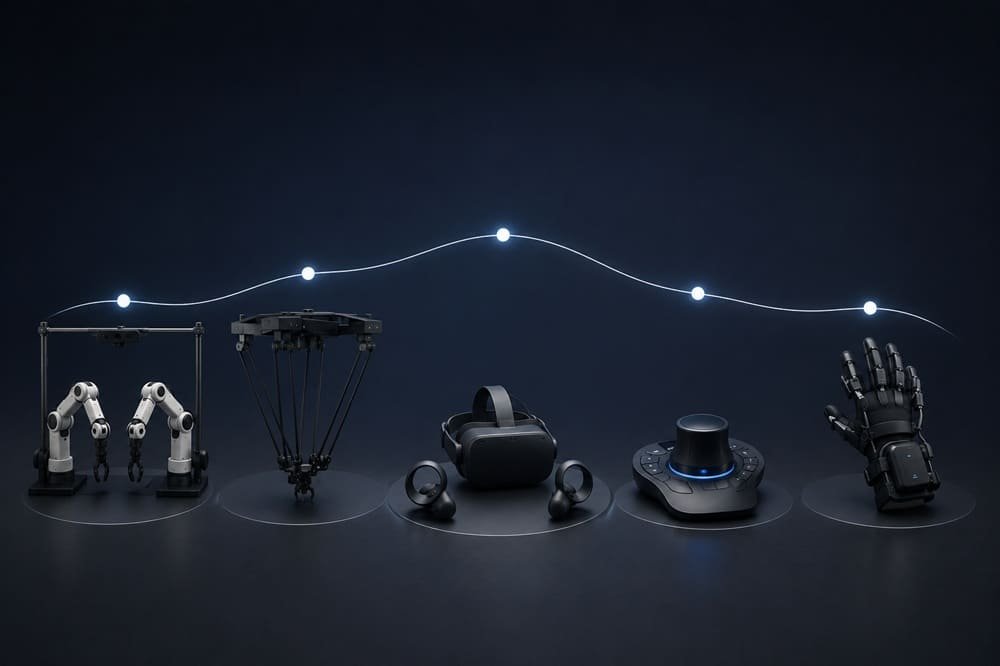
Budget first. Task second. That ordering, common as it is, ruins more teleoperation datasets than any hardware defect we have debugged. Rig selection is where programs are quietly won or lost, months before anyone trains a policy: pick a rig mismatched to your task family and you pay twice, once in operator throughput, again in data quality that caps policy performance no matter how many episodes you buy.
Our thesis in this post is the reversal of that ordering: choose the rig by task family, and let budget break ties. The mismatch happens because rigs get chosen by price or by whatever the last paper used, not by task requirements. A SpaceMouse is a fine tool that will still ruin a bimanual insertion dataset. A $20k ALOHA station is superb hardware that is overkill for single-arm pick-and-place.
This post compares the five approaches we run in production, with costs, throughput observations, and the failure modes that only show up after a few thousand episodes. Hardware claims cite the primary papers; throughput and maintenance numbers are ours.
Key Takeaways – Leader-follower rigs (ALOHA ~$20k, Mobile ALOHA ~$32k) give the highest control fidelity for fine bimanual work (arxiv.org/abs/2304.13705, arxiv.org/abs/2401.02117). – GELLO delivers most of that fidelity for roughly $300 per leader arm if you already own the robots (arxiv.org/abs/2309.13037). – VR teleop scales: DROID collected 76,000 episodes with a Quest 2 controller (arxiv.org/abs/2403.12945); Open-TeleVision extends it to humanoids (arxiv.org/abs/2407.01512). – UMI collects without a robot for under $1,500 per device (arxiv.org/abs/2402.10329). – Match rig to task family first, budget second. The decision matrix below is the shortcut.
Leader-Follower Arms: ALOHA and Kin
A leader-follower rig pairs a small passive “leader” arm that the operator moves by hand with a “follower” robot that mirrors leader joint positions at 50 Hz. Direct joint mapping skips inverse kinematics entirely, so operators feel the robot’s kinematics through their hands and singularities never surprise them. Stanford’s ALOHA, roughly $20k for the full bimanual cell, set the reference design, and its ACT results (80 to 90 percent success on fine tasks from ~50 demos) remain the standard proof that rig fidelity converts to policy performance. Mobile ALOHA adds a base for about $32k total.
In production the strengths hold: fastest operator ramp of any rig we run (days, not weeks) and the best fine-manipulation data. The costs are per-station capital and embodiment lock-in; the data transfers cleanly only to matching kinematics.
GELLO: Fidelity at a Tenth of the Price
GELLO is a low-cost leader arm built from Dynamixel hobby servos and 3D-printed links, kinematically scaled to match a specific follower robot, at roughly $300 per arm. If you already own Franka, UR, or xArm followers, GELLO adds leader-follower control for the price of a decent office chair, and our throughput on GELLO stations matches full ALOHA cells within noise on most tasks.
The honest downside is maintenance. Printed parts wear, servos strip, and each new follower model needs a scaled leader design. Budget a part-time technician per six to eight stations. Still the best throughput-per-dollar in the field, in our experience.
VR Teleoperation: Quest 3 and Open-TeleVision-Style Rigs
VR teleoperation maps headset and controller (or hand-tracking) poses to robot end-effector targets through an IK solver, trading joint-level fidelity for cheap, portable, immersive control. The scaling evidence is strong: DROID’s 76,000 episodes across 564 scenes came from Quest 2 controllers on Franka arms. For humanoids, Open-TeleVision streams an active stereo head camera into the headset so the operator sees what the robot sees, which is currently the most practical way to teleoperate whole upper-body humanoid tasks.
Watch for two production issues. IK artifacts near joint limits put subtle discontinuities into action streams that policies later reproduce. And a minority of operators fatigue quickly in-headset; we schedule VR operators in 45-minute blocks for that reason. Ramp runs one to two weeks, slower than leader-follower.
SpaceMouse: The Prototyping Workhorse
A SpaceMouse is a 6-DoF desktop puck ($150 to $450) that commands end-effector twist, and it is the right tool for lab prototyping and simple single-arm tasks rather than production collection. Throughput on contact-rich work is the worst of the five approaches; decoupled rotation and translation control never becomes intuitive for dexterous tasks. We keep one on every debug bench and none on the collection floor.
UMI: Demonstrations Without a Robot
UMI (Universal Manipulation Interface) is a handheld gripper with a wrist-mounted fisheye camera that records demonstrations directly from human hand motion, recovering poses via SLAM, no robot in the loop. Device cost is under $1,500, collection can happen anywhere, and it is the only approach that produces data before your robot ships. The trade-offs: pose quality depends on SLAM conditions, and the human-to-robot embodiment gap means UMI data usually supplements rather than replaces on-robot teleop.
Cost and Throughput Comparison
The table below combines published hardware costs with our observed operator throughput at maturity (usable episodes per hour on a moderate bimanual or single-arm task).
| Rig | Hardware cost | Trained throughput (eps/hr) | Operator ramp | Fine bimanual quality | Maintenance load |
|---|---|---|---|---|---|
| ALOHA leader-follower | ~$20k (~$32k mobile) | 30 to 40 | 2 to 5 days | Excellent | Low |
| GELLO + your robot | ~$300 per leader arm | 28 to 38 | 2 to 5 days | Very good | Medium (printed parts) |
| VR (Quest 3 class) | $500 to $3,500 + robot | 20 to 32 | 1 to 2 weeks | Good, IK-limited | Low |
| SpaceMouse | $150 to $450 + robot | 8 to 15 | Never fully ramps on dexterous work | Poor | Low |
| UMI handheld | <$1,500 per device | 35 to 50 (no resets on robot) | 1 to 3 days | N/A (robot-free) | Low, SLAM-sensitive |
The Costs the Spec Sheets Leave Out
Total cost of ownership for a teleoperation rig includes calibration time, maintenance labor, and operator fatigue effects that never appear on a purchase order. Three examples from our own floors. GELLO stations cost us about two technician-hours per station per week in printed-part replacement and servo checks; cheap hardware, recurring labor. VR rigs cost almost nothing to maintain but lose 10 to 15 percent of scheduled operator time to session-length limits we impose for headset fatigue, and IK edge cases add a QA review burden that leader-follower rigs simply do not generate. ALOHA-class stations are the opposite trade: high capital, low ongoing attention, and the fastest path to trained-operator throughput. When you model a year of operation rather than a purchase, the gap between a $300 leader and a $20k cell narrows considerably; it rarely closes, but the ranking can flip for programs where technician time is scarcer than capital.
One more line item: re-rigging. Task families evolve, and a rig locked to one workspace geometry gets rebuilt more often than anyone forecasts. Budget a rebuild per station per quarter in active programs and you will be close.
Decision Matrix: Which Rig for Which Program
Choose by task family first: fine bimanual manipulation demands leader-follower (ALOHA if funded, GELLO if you own arms); humanoid and mobile manipulation demands VR with active head cameras; broad in-the-wild diversity or pre-hardware collection points to UMI; and SpaceMouse stays in the lab. Mixed programs are normal. Our own floors run GELLO for depth on core tasks and UMI for breadth across scenes, which is the pairing we recommend most often to VLA teams.
Full rig economics, QA thresholds, and the pipeline from demos to policy live in the complete teleoperation data collection guide.
Frequently Asked Questions
Is GELLO as good as ALOHA for data collection?
For most tasks, close enough that the price difference decides it. GELLO gives joint-level leader-follower control at ~$300 per arm versus ~$20k for a full ALOHA cell, with similar operator throughput in our experience. ALOHA wins on build quality and out-of-box reliability.
Can you collect production robot data with a Quest headset?
Yes. DROID collected 76,000 episodes using Quest 2 controllers driving Franka arms across 13 institutions. Plan for IK artifact QA checks and shorter operator sessions to manage headset fatigue.
What does a teleoperation rig cost in 2026?
From roughly $300 (GELLO leader, robot excluded) to ~$20k (ALOHA bimanual cell) to ~$32k (Mobile ALOHA). VR setups run $500 to $3,500 plus the robot; UMI handheld devices come in under $1,500.
Is a SpaceMouse good enough for imitation learning data?
For simple single-arm pick-and-place and prototyping, yes. For contact-rich or bimanual tasks, no; throughput and trajectory quality lag every alternative, and policies inherit the hesitant motion.
Should I use UMI instead of robot teleoperation?
Use it alongside, not instead. UMI excels at cheap scene diversity and pre-hardware collection, but the embodiment gap means on-robot teleop still anchors most production training sets.
Next step: want episodes from three different rig types to compare in your own training stack?
Download sample data or book a rig consultation with our systems team.

Sainath Gupta
Sainath Gupta is the visionary leader of DexSet, a company dedicated to building the foundational data layer for the robotics revolution. Sainath recognized early on that the primary bottleneck for physical AI wasn't hardware or model architecture, but the lack of high-quality, scalable training data.
At DexSet, he has pioneered a "manufacturing-first" approach to data collection. This includes the development of transparent cost-per-hour benchmarks and the scaling of global networks for egocentric and teleoperation capture. Sainath is a vocal advocate for the industry’s shift toward treating human experience as the primary pretraining substrate for robots. His leadership at DexSet is focused on one goal: providing the millions of hours of high-fidelity data required to bring humanoid robots out of the lab and into the real world.