
Case Study: How We Scaled Data Capture Hardware for Embodied AI for a VLA Model
Two numbers sat in the same planning deck: 40 captured hours a week, and 8,000 hours due in five months. Both were accurate, and they could not both survive. Hitting 8,000 hours in roughly 22 weeks means averaging about 370 delivered hours a week, nine times what the floor was producing; at the actual run rate, the dataset would have arrived roughly four years late, well after the funding milestone it was supposed to unblock. This is the point where a VLA foundation model team brought the problem to us.
The gap was not effort, and that is the thesis of this case study: scaling capture is an architecture problem (sync, formats, parallel cheap seats), not an effort or premium-hardware problem. Their two-person capture team worked hard on good hardware, a single ALOHA-class station and a Vision Pro teleop pilot. The gap was architecture: no sync strategy across devices, no shared episode format, and a fleet plan that scaled capex faster than throughput. This is the most common shape of the scaling problem we see, so we are publishing the anonymized playbook.
This post walks through the three phases of the engagement: the audit, the hardware re-spec, and the scale-out, with the real throughput and cost numbers at each stage. If you are sizing a capture floor for VLA fine-tuning, the tables below are the ones we wish every team had before their first purchase order.
DexSet operates egocentric, teleoperation, and exocentric capture lines in production; this engagement ran on our floors with the client’s task list and QA criteria. Per our client agreements, the team is anonymized (“a VLA foundation model team”) and all numbers are rounded operational figures.
Key Takeaways – A VLA foundation model team needed 8,000 hours of manipulation data in five months; their in-house rate was 40 hours a week. We reached a sustained 400 hours a week by week nine. – The fix was mostly architectural: hardware sync, one episode format (LeRobot-compatible HDF5), and parallel cheap seats instead of premium single rigs. – Fleet mix at full scale: 6 GELLO-equipped arm cells, 3 ALOHA-class bimanual stations, 12 Quest 3 teleop seats, 20 UMI-style grippers, and one 6-camera D455 evaluation studio. – Delivered cost settled at $31-42 per teleop hour across task families, inside our standard $28-60 benchmark range.
Phase 1: The Audit (Weeks 1-2)
A capture audit is a measured baseline of usable hours per seat per shift, and it always starts by separating captured hours from delivered hours. The client’s 40 weekly hours were captured hours; after QA, delivered hours were closer to 26. Two findings explained most of the loss.
First, synchronization. The Vision Pro pilot streamed hand pose to the robot over Wi-Fi with no shared clock, and QA was rejecting roughly a quarter of episodes for observation-action misalignment beyond their 25 ms tolerance. Second, format debt: the ALOHA station wrote its own HDF5 layout, the Vision Pro stack wrote JSON pose logs plus video, and an engineer spent about a day a week converting between them.
Neither problem is exotic. Both are invisible until you measure delivered hours instead of captured hours.
Phase 2: The Hardware Re-Spec (Weeks 3-5)
A hardware re-spec is a redesign of the fleet around delivered cost per hour rather than device quality, and ours cut the premium hardware first. The Vision Pro seats moved to evaluation-only duty. For fleet teleop we standardized on Quest 3 headsets at roughly $500 per seat: seven times cheaper per seat, no measurable difference in demonstrations per operator-hour on the client’s pick, place, and insertion task families, and cheap enough to hold 20 percent spares.
For arm-based capture we kept the existing ALOHA-class station (fine bimanual tasks justified it) and added GELLO leader arms (arxiv.org/abs/2309.13037) at about $300 per arm on follower robots the client already owned. For task families that did not need force or proprioception fidelity, we added UMI-style handheld grippers (arxiv.org/abs/2402.10329) at roughly $400 per unit, with a budgeted SLAM QA pass.
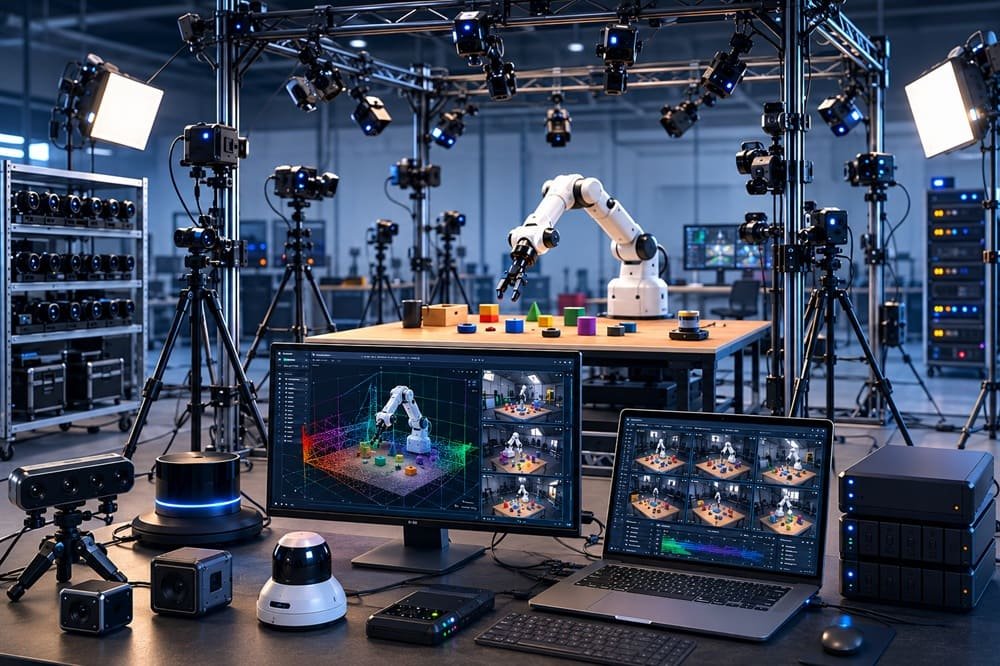
The last addition was a six-camera RealSense D455 evaluation studio, hardware-synced through the D455’s trigger pin, wrapped around one teleop cell. Every evaluation episode was therefore captured ego and exo simultaneously, which the client’s research team used to test viewpoint generalization in the style of Ego-Exo4D (arxiv.org/abs/2311.18259). The studio cost about $2,700 in cameras and roughly the same again in truss, sync wiring, lighting, and NVMe ingest, a ratio worth budgeting for in advance.
Every line wrote one format: LeRobot-compatible episodes (github.com/huggingface/lerobot) with per-frame timestamps from a shared NTP-disciplined clock and a hardware sync signal on the camera side. The conversion engineer got their day back.
Phase 3: Scale-Out (Weeks 6-9)
Scale-out is the replication of a proven seat design in parallel, and it only works after yield per seat is stable. We added seats in weekly increments, holding the QA gate constant, until the floor hit the target run rate.
| Metric | Baseline (client in-house) | Week 5 (re-spec live) | Week 9 (full scale) |
|---|---|---|---|
| Captured hours / week | 40 | 130 | ~460 |
| Delivered hours / week (post-QA) | 26 | 110 | ~400 |
| QA rejection rate | ~35% | 15% | 10-12% |
| Active seats | 3 | 14 | 42 |
| Fleet capex (cumulative) | ~$32k | ~$68k | ~$118k |
| Delivered cost per teleop hour | not tracked | $46 | $31-42 |
Two numbers deserve emphasis. The rejection rate fell from 35 percent to under 12 percent before most of the new seats arrived; sync and format fixes, not hardware volume, did that. And full-scale fleet capex, about $118k for 42 seats, is less than many teams spend on four premium bimanual cells. Cheap synchronized seats, bought after the yield problem was solved, are what made the 8,000-hour target arrive on schedule.
The non-hardware work mattered too, and it is easy to undercount. Operator onboarding became a two-day curriculum with a certification task instead of an afternoon of shadowing, which pulled new-seat ramp time down from three weeks to one. The QA gate ran four automated checks (sync residual, calibration freshness, trajectory smoothness, format validity) plus human review on a 10 percent sample, and its thresholds never moved during scale-out. Holding the gate constant is what made the weekly delivered-hours number trustworthy enough to plan a training schedule against.
What We Would Do Differently
Honest retrospectives are rarer than case studies, so here is ours. We would have moved the UMI-style gripper line earlier in the schedule; its SLAM post-processing pipeline took three weeks to tune, and starting it in week 3 instead of week 6 would have added several hundred delivered hours. We also underestimated storage: the exo studio’s terabyte-per-shift output forced a mid-project NVMe retrofit that a day of arithmetic would have predicted. Neither mistake threatened the deadline. Both are now checklist items in every new engagement.
What Generalizes From This Engagement
The transferable lessons are hardware-selection rules, and they match the decision matrix in our full guide to data capture hardware for embodied AI:
- Measure delivered hours, not captured hours. The 14-hour weekly gap at baseline was invisible in the client’s dashboards.
- Fix sync before buying anything. A 25 ms alignment tolerance is unreachable over ad-hoc Wi-Fi streaming without a shared clock.
- Premium headsets are evaluation tools, not fleet tools. Quest 3 matched Vision Pro on demonstrations per operator-hour for standard manipulation families.
- Match rig fidelity to task family. ALOHA-class cells for fine bimanual work, GELLO for arm tasks on owned robots, UMI for volume, one format across all of them.
- Scale last. Every seat added before yield stabilizes multiplies your rejection rate.
Frequently Asked Questions
How long does it take to scale a robot data capture operation?
In this engagement, nine weeks from audit to a sustained 400 delivered hours per week. The first five weeks fixed synchronization, formats, and seat design; scaling seats was the fast part.
How much did the capture hardware cost at full scale?
About $118,000 in cumulative fleet capex for 42 seats: 12 Quest 3 teleop seats, 6 GELLO arm cells, 3 ALOHA-class stations, 20 UMI-style grippers, and a 6-camera RealSense D455 evaluation studio.
What QA rejection rate is normal for teleoperation data?
On a well-synchronized floor we hold 10 to 12 percent. Rates above 25 percent almost always trace to clock misalignment or ergonomic problems, not operator error.
Did the VLA team really not need Vision Pros?
Not for fleet capture. On pick, place, and insertion tasks, ~$500 Quest 3 seats matched the $3,499 Vision Pro on demonstrations per operator-hour. The Vision Pros stayed in service for gaze-labeled evaluation episodes, where their eye tracking earns the price.
Can we run this playbook in-house instead of using a vendor?
Yes; the phases (audit, re-spec, scale-out) and rules above are the playbook. The vendor case is throughput on demand without capex and hiring, which mattered here because of the five-month deadline.
Facing a similar deadline?
[Book a Demo] and we will run the throughput math on your task list, or start with the full guide to data capture hardware for embodied AI.

Enoch Pakanati
Enoch Pakanati is the strategic architect behind DexSet’s mission to become the undisputed market leader in robotics training data. He oversees the company’s growth strategy, focusing on capturing dominant market share across all data modalities required for modern robotics, including egocentric capture, teleoperation, and simulation-to-real data pipelines.
At DexSet, Enoch is responsible for transforming the company’s deep technical capabilities into a market-leading brand that foundation model labs and robotics OEMs trust implicitly. He focuses on scaling DexSet’s global footprint and ensuring the company stays ahead of the industry’s rapidly evolving data needs. His leadership is centered on one objective: making DexSet the singular, global standard for the data that powers the robotics revolution.