
Comparing Privacy, Consent & Compliance Approaches in Human Data Collection: Pros, Cons & Costs
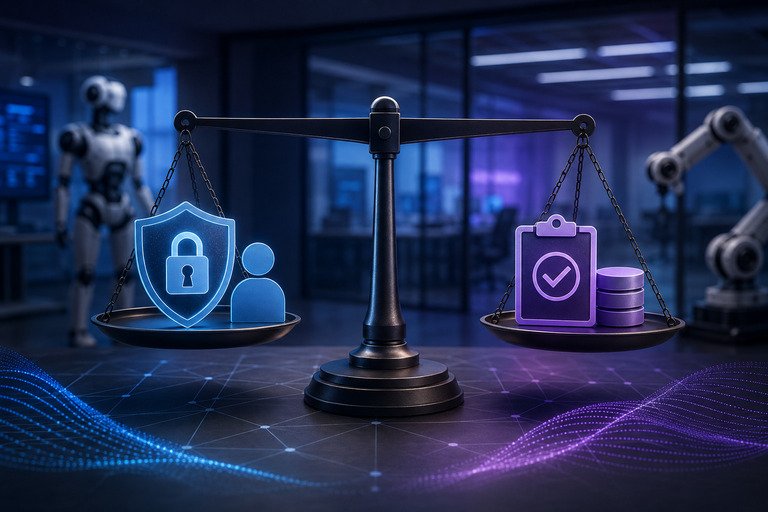
consent_basis: unknown is the most expensive field value in robotics data. We keep seeing it, or the blank space where it should be, in the dataset documentation teams send us for review: meticulous specs for cameras, calibration, and frame rates, and silence about the humans in the frame. Behind that blank sits a decision the team made without naming it: where the human data comes from, and who carries the privacy risk attached to it. Some scrape public video and hope. Some capture in-house with employees. Some crowdsource. Some buy managed consented collection. Some try to skip humans entirely with simulation.
The decision is hard because the trade-offs pull in different directions. The cheapest data per hour carries the worst legal posture. The safest data costs the most up front. And the risk is deferred: a consent defect discovered during a customer’s due-diligence, or an Illinois BIPA demand letter, arrives long after the training run finished. Teams optimize for the cost they can see this quarter and inherit the cost they cannot.
Our thesis: sourcing is a risk-allocation decision before it is a procurement decision, because whoever holds the consent relationship with the people in frame holds the risk. This post compares the five realistic approaches on the axes that matter: consent posture, cost per hour, scalability, and what fails first. We run managed consented collection at DexSet, so read our position with that in mind; the comparison table is honest about where our approach is not the right answer.
Key Takeaways – There are five realistic sourcing approaches: scraped public video, in-house employee capture, crowdsourced capture, managed consented collection, and synthetic or simulated data. – Scraped video has the lowest sticker price and the worst consent posture: no lawful basis for biometric-adjacent processing, no bystander handling, no deletion capability. – In-house capture has clean logistics but a consent trap most teams miss: employee consent is presumptively suspect under GDPR because of the power imbalance. – Managed consented collection runs roughly $30 to $75 per delivered hour including compliance overhead in our experience, and is the only approach that ships with a transferable consent chain. – Synthetic data avoids human subjects entirely but cannot yet replace real human demonstrations for contact-rich manipulation; most serious programs blend it with consented real data.
What Are the Approaches to Sourcing Human Data for Robot Training?
An approach, in this context, is a combination of who performs the demonstrations, who records them, and who holds the consent relationship with the humans in frame. That third element is the one that determines your compliance posture, and it is the one teams evaluate last. The five approaches below cover essentially every program we have seen in the wild.
Approach 1: Scraping Public Video
Scraping means training on video created by other people for other purposes, typically from the public web. Its appeal is obvious: enormous volume at near-zero marginal cost, and it worked for language models. Its problem is that the people in those videos never consented to biometric-adjacent processing for commercial robot training. There is no lawful basis to point to under GDPR Article 6 for most of it, no written release of the kind BIPA requires for face geometry or voiceprints, no bystander handling, and no way to honor a deletion request you cannot even route to a person. Web video also lacks the action labels, depth, and proprioception robot learning actually needs, so the legal risk buys you weakly useful data. As a pretraining supplement under counsel’s guidance, teams use it. As a foundation for a commercial data asset, we consider it uninsurable, and that is an opinion we hold with some confidence.
Approach 2: In-House Capture With Employees
In-house capture means your own staff performs and records demonstrations in your own facility. Logistics are clean, iteration is fast, and task specification is exactly what your model needs. The consent trap is structural: under GDPR, consent must be freely given, and regulators treat employee consent as presumptively problematic because refusing the boss is not a free choice. You need carefully constructed consent, genuine opt-outs with no job consequences, and usually a different lawful basis analysis altogether. The second limit is diversity: twenty engineers in one lab produce narrow embodiment, narrow environments, and narrow demographics, which shows up as bias in exactly the way EU AI Act Article 10 data governance reviews look for. In-house capture is excellent for pilots and task prototyping. It is a poor sole source for a foundation model corpus.
Approach 3: Crowdsourced Capture
Crowdsourcing means distributing capture to a large pool of gig participants recording in their own homes. It scales environment diversity beautifully, which is its genuine strength. The compliance load explodes at the edges: hundreds of uncontrolled locations mean hundreds of scene-sweep problems (family members, children, roommates, visible mail and screens), consent documents signed without briefing, and jurisdiction sprawl where you discover after the fact that a slice of your corpus came from Illinois without BIPA-standard written releases. Redaction cost lands at the top of our observed range, $6 to $10 or more per hour, because scenes are unswept and bystander density is unknown. Crowdsourcing can work with heavy tooling: in-app consent flows, automated pre-upload PII screening, and per-jurisdiction participant gating. Budget for that tooling or do not crowdsource.
Approach 4: Managed Consented Collection
Managed consented collection means a specialist operator runs recruiting, jurisdiction-correct consent, controlled or swept locations, capture, redaction, and audit trail as one accountable pipeline. This is DexSet’s model, so weigh our interest accordingly. The pros: consent is documented to the explicit GDPR standard and the BIPA written-release standard where relevant, bystanders are handled at the scene rather than in post, redaction runs inline at $3 to $10 per hour, and every episode links to a consent ID, which is what makes buyer due-diligence and deletion requests answerable. The consent chain transfers to the buyer as evidence, not as assurances. The cons are real: higher sticker price per hour, vendor dependency, and less task-iteration speed than an in-house rig down the hall. If your data will be audited, licensed, or fed into an EU AI Act-documented model, this posture is what your counsel will ask for anyway.
Approach 5: Synthetic and Simulated Data
Synthetic data means demonstrations generated in simulation or by generative models rather than recorded from humans, and it is the only approach with no human subjects at all. No consent, no bystanders, no redaction. For some pretraining stages and for dangerous or rare scenarios it is invaluable. The limit is the sim-to-real gap for contact-rich manipulation: deformables, friction, cluttered homes, and the long tail of human behavior remain hard to synthesize convincingly, which is why the field’s strongest results (the ALOHA line of work, Open X-Embodiment scale efforts) still lean on real demonstrations. Practical programs treat synthetic data as a multiplier on a consented real corpus, not a substitute for one.
Five Approaches Compared on Cost, Consent Posture, and Scale
| Approach | Typical cost per usable hour | Consent posture | Scalability | What fails first |
|---|---|---|---|---|
| Scraped public video | Near zero marginal | None; no lawful basis for biometric processing, no deletion path | Effectively unlimited volume, low relevance | Buyer due-diligence or regulator inquiry |
| In-house employees | $30 to $80 fully loaded (staff time, facility) | Suspect under GDPR (power imbalance) unless engineered carefully | Low; bounded by headcount and one facility | Diversity and bias review |
| Crowdsourced | $15 to $40 capture, plus $6 to $10+ redaction and tooling | Variable; jurisdiction sprawl and unbriefed signatures | High environment diversity | Scene control and BIPA-grade paperwork |
| Managed consented (our model) | $30 to $75 delivered, compliance included | Explicit, documented, transferable consent chain | High with a standing participant pool | Sticker price in early budget reviews |
| Synthetic / sim | Compute-bound, low marginal | Not applicable; no human subjects | Unlimited | Sim-to-real transfer on contact-rich tasks |
Cost figures are our first-hand benchmark ranges and will vary with task complexity, rig type, and jurisdiction mix.
How to Choose
The choice is a risk-allocation decision before it is a procurement decision. If the model is a research prototype that will never be commercialized, in-house capture plus synthetic data covers most needs. If the corpus becomes a commercial asset, gets licensed, or feeds a model with EU AI Act documentation duties, the consent chain stops being optional and the realistic choices narrow to managed consented collection, or crowdsourcing with serious consent tooling, usually blended with synthetic data for scale. Whatever you choose, apply the ten due-diligence questions from our pillar guide to your own program, not just to vendors: The Complete Guide to Privacy, Consent & Compliance in Human Data Collection.
This article is informational, not legal advice. Consult counsel for decisions about your own data program.
Next Step
Comparing vendors right now? Start with the complete privacy, consent and compliance guide, then book a demo to see what a transferable consent chain looks like on real episodes.
Frequently Asked Questions
What is the cheapest way to collect human data for robot training?
Scraped public video has the lowest sticker price, but it carries no consent for biometric-adjacent processing and no deletion capability, so its true cost surfaces at due-diligence or enforcement. Among consented approaches, crowdsourcing has the lowest capture cost but the highest redaction and tooling overhead.
Why is employee consent a problem for in-house data collection?
Under GDPR, consent must be freely given, and the employer-employee power imbalance makes employee consent presumptively questionable. In-house programs need genuine opt-outs without job consequences and careful lawful basis analysis.
How much does managed consented collection cost?
In our experience, roughly $30 to $75 per delivered hour depending on rig, task complexity, and jurisdiction mix, with consent workflow and PII redaction ($3 to $10 per hour) included rather than billed as surprises.
Can synthetic data replace consented human data?
Not yet for contact-rich manipulation. Simulation struggles with deformables, friction, and the long tail of real environments, so strong programs use synthetic data to multiply a consented real corpus rather than replace it.
Which approach do buyers and auditors prefer?
Buyers’ counsel consistently favors data with a transferable consent chain: signed consent records, scene sweep logs, redaction QA, and episode-level audit trails, because it makes their own GDPR and EU AI Act documentation possible.

Sainath Gupta
Sainath Gupta is the visionary leader of DexSet, a company dedicated to building the foundational data layer for the robotics revolution. Sainath recognized early on that the primary bottleneck for physical AI wasn't hardware or model architecture, but the lack of high-quality, scalable training data.
At DexSet, he has pioneered a "manufacturing-first" approach to data collection. This includes the development of transparent cost-per-hour benchmarks and the scaling of global networks for egocentric and teleoperation capture. Sainath is a vocal advocate for the industry’s shift toward treating human experience as the primary pretraining substrate for robots. His leadership at DexSet is focused on one goal: providing the millions of hours of high-fidelity data required to bring humanoid robots out of the lab and into the real world.