
5 Hidden Challenges Robotics Teams Will Hit in 2027 Data Planning (and How to Solve Them)
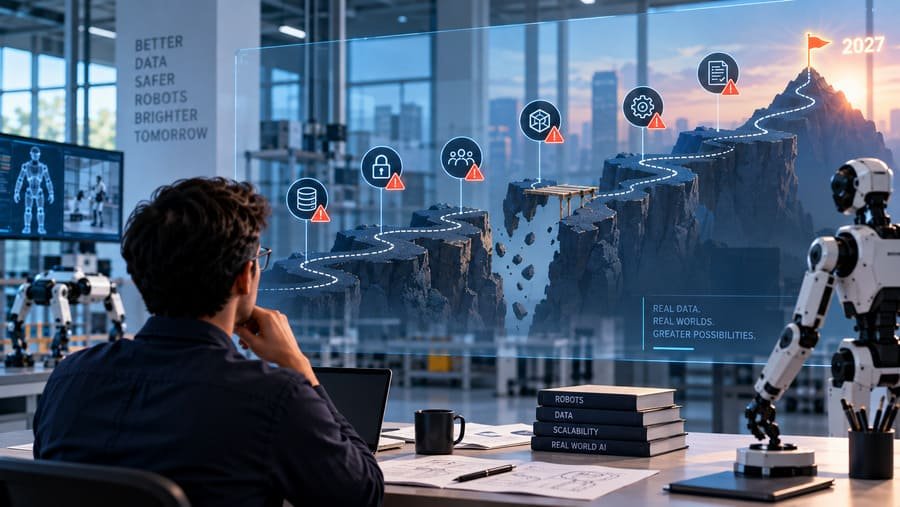
Here is a prediction we hold at roughly 80 percent confidence: at least one well-funded robotics program will lose a quarter of 2027 to a data problem that never appeared on any budget line. The visible parts of a 2027 data plan are easy: modalities, hours, prices, a vendor shortlist. Teams get those roughly right, because the information is public and the mistakes are obvious. What sinks programs are the challenges that surface in month six as a legal email, a failed acceptance batch, or a training corpus that turns out to duplicate what Open X-Embodiment gives away free.
These challenges stay hidden for a structural reason, and it is this post’s thesis: 2027 data plans fail in the seams between teams, not in the line items. Provenance sits between data ops and legal. Quality criteria sit between data ops and the world-model group. Pricing units sit between procurement and engineering. Nobody owns the seam, so nobody budgets for it, and the plan looks complete right up until it is not.
This post names the five seam problems we expect to bite hardest in 2027 planning cycles, with the fix for each. They come from our own delivery programs and from the near-misses we have watched customers survive. The market-level context, including the trend tables these fixes assume, is in our annual report, The State of Robotics Training Data 2027.
Where a claim is our judgment about 2027 rather than an observed fact, we flag it as opinion. Several of these predictions will be tested within a year, which is fine by us.
Key Takeaways – The five hidden challenges: provenance debt on existing corpora, the world-model QA gap, pricing-unit mismatch in contracts, duplicating free public coverage, and tactile integration overhead. – Provenance cannot be added retroactively. Audit your existing corpus now; episode-keyed consent records are the 2027 procurement gate (our prediction, flagged as opinion). – Footage that passes imitation-learning QA fails world-model criteria roughly a third of the time in our pipeline. Buy against the stricter gate if world models are on your roadmap. – Raw-hour quotes hide 15 to 30 percent rejection. Convert every quote to expected cost per usable hour before comparing vendors. – Check public datasets (Open X-Embodiment, DROID, Ego4D, EgoExo4D) before buying; paid data should cover what free data cannot.
Challenge 1: Provenance Debt on the Data You Already Own
Provenance debt is the gap between the consent and licensing documentation your existing corpus has and the documentation 2027 procurement and regulation will demand. It is the most dangerous item on this list because it is invisible until an audit, and it cannot be fixed retroactively: you cannot re-consent a stranger who walked through an egocentric recording two years ago.
The pressure source is concrete. The EU AI Act entered into force in August 2024, with obligations phasing in through 2027 (Regulation (EU) 2024/1689), and data governance requirements flow down to training corpora. We watched a customer’s legal team audit 38,000 hours of egocentric video mid-program; episode-keyed consent records turned it into a five-day exercise. The counterfactual, a corpus with no per-episode records, would have been unusable for EU deployment.
The fix: audit now, in three passes. Inventory which corpora contain identifiable people. Grade each against episode-keyed consent as the target standard. Then triage: keep, restrict to non-EU use, or retire. For all new capture, make episode-keyed consent a contractual requirement. Our prediction, flagged as opinion: by late 2027, corpora that fail this grading lose most of their resale and deployment value.
Challenge 2: The World-Model QA Gap
The world-model QA gap is the difference between footage good enough for imitation learning and footage good enough for training a model to predict future frames. Policy learning tolerates compression artifacts, exposure swings, and the odd dropped frame. A world model, trained on reconstruction, treats every one of those defects as physics to be learned.
In our pipeline, roughly a third of footage that passes imitation-learning QA fails world-model acceptance criteria: stable exposure, calibrated stereo, sustained frame rates above 30 fps, continuous temporal coverage without cuts. The hidden cost lands on teams that buy video in 2026 for policy pretraining and discover in 2027 that their world-model group can use only two thirds of it.
The fix: if world models are anywhere on your 18-month roadmap, buy against the stricter gate now. The capture-side premium for world-model-grade video runs 20 to 40 percent on our benchmarks, far cheaper than re-collecting. Require per-clip quality manifests so the corpus can be partitioned by grade later instead of re-reviewed.
Challenge 3: Pricing-Unit Mismatch
Pricing-unit mismatch is comparing vendor quotes denominated in different units, usually raw hours against usable hours, as if they were the same number. A $30 raw-hour quote with a 30 percent rejection rate is a $43 usable-hour price before you count the engineer time spent triaging rejects. Procurement teams optimizing the headline number routinely pick the more expensive vendor.
This challenge gets worse in 2027 precisely because the market is mid-transition. Our report predicts usable-hour pricing becomes the default by year end (opinion, flagged), which means 2027 is the year both units coexist and comparisons are most error-prone.
The fix is a conversion, not a negotiation:
- Ask every vendor for their measured rejection rate under your acceptance rubric, not theirs.
- Compute expected cost per usable hour: raw price divided by (1 minus rejection rate).
- Add your internal triage cost for rejected batches; we suggest 10 to 15 percent of the raw line if the vendor does not run a QA gate.
- Compare only the converted numbers, and put the rubric in the contract as an appendix.
Challenge 4: Buying Coverage the Public Baseline Already Gives You
Coverage duplication is paying for data that materially overlaps free public datasets. It is the quietest waste in robotics data budgets because the purchase looks productive: hours arrive, dashboards fill, and nobody checks the overlap.
The public baseline is now substantial. Open X-Embodiment offers over one million trajectories across 22 embodiments (arXiv:2310.08864); DROID adds 76,000 teleoperated episodes across 564 scenes (arXiv:2403.12945); Ego4D and EgoExo4D provide thousands of hours of human video (arXiv:2110.07058; arXiv:2311.18259). Generic single-arm tabletop manipulation is the most-duplicated purchase we see, and cross-embodiment transfer results keep expanding how much of the public corpus is useful to any given robot.
The fix: run a coverage audit before every RFP. Map your task families and scene types against the public datasets, in LeRobot format where available for easy inspection (github.com/huggingface/lerobot). Spend paid budget where the public baseline is thin: your specific task long-tail, contact-rich manipulation, paired ego-exo capture in your deployment domains, and recovery-from-failure demonstrations, which almost no public dataset labels well.
Challenge 5: Tactile Integration Overhead
Tactile integration overhead is everything a tactile data line costs beyond the per-hour price: sensor calibration drift, synchronization with vision streams, immature labeling conventions, and the absence of public pretraining corpora to lean on. Teams that budget tactile at catalog price, $55 to $95 per usable hour on our 2026 benchmarks, typically underestimate total cost by 30 to 50 percent in their first program. That estimate is our operational experience.
The trap is timing. Our report predicts tactile moves onto standard manipulation spec sheets by late 2027 (opinion, flagged), so 2027 planners face a choice between paying the immaturity tax now or paying the catch-up tax later. Both are real costs; only one shows up in this year’s budget.
The fix: buy tactile narrow and deep rather than broad and shallow. Pick the one or two task families where your failure analysis shows contact ambiguity, insertion and cable routing being the usual suspects, and fund a complete slice: sensors, sync validation, labeling conventions, and a policy ablation to prove value before scaling. Cap it at 5 to 10 percent of budget until the ablation clears.
The Common Thread
Each of these challenges lives in a seam between teams, and the shared fix is ownership: someone accountable for provenance, for acceptance criteria across model types, for unit-consistent pricing, for public-coverage audits, and for tactile total cost. In most organizations that someone is the data operations lead, and 2027 is the year the role stops being optional. The full trend analysis behind these five calls, including modality demand and price trajectory tables, is in The State of Robotics Training Data 2027.
Next Step
Next step: score your current 2027 draft plan against these five challenges, then Download the 2027 Data Program Scorecard from the report, or Book a Demo to review your plan with our operations team.
Frequently Asked Questions
What are the biggest hidden challenges in robotics data planning for 2027?
Five recur: provenance debt on existing corpora, the world-model QA gap, pricing-unit mismatch between raw and usable hours, duplicating free public dataset coverage, and tactile integration overhead beyond catalog prices.
Can consent provenance be added to an existing dataset?
Effectively no. Consent must be captured at recording time and keyed to episodes. Corpora containing identifiable people without per-episode consent records face growing restrictions under EU AI Act obligations phasing in through 2027.
Why does world-model training reject footage that worked for imitation learning?
World models learn by predicting future frames, so compression artifacts, exposure swings, and dropped frames become training signal. Roughly a third of imitation-learning-grade footage fails world-model criteria in DexSet’s pipeline.
How do I compare raw-hour and usable-hour data quotes?
Divide the raw-hour price by one minus the vendor’s rejection rate under your acceptance rubric, then add internal triage costs, typically 10 to 15 percent if the vendor runs no QA gate. Compare only the converted numbers.
How much budget should go to tactile data in 2027?
Cap it at 5 to 10 percent, aimed at task families where failure analysis shows contact ambiguity. Budget 30 to 50 percent above catalog price for integration overhead until your first policy ablation proves value.

Sainath Gupta
Sainath Gupta is the visionary leader of DexSet, a company dedicated to building the foundational data layer for the robotics revolution. Sainath recognized early on that the primary bottleneck for physical AI wasn't hardware or model architecture, but the lack of high-quality, scalable training data.
At DexSet, he has pioneered a "manufacturing-first" approach to data collection. This includes the development of transparent cost-per-hour benchmarks and the scaling of global networks for egocentric and teleoperation capture. Sainath is a vocal advocate for the industry’s shift toward treating human experience as the primary pretraining substrate for robots. His leadership at DexSet is focused on one goal: providing the millions of hours of high-fidelity data required to bring humanoid robots out of the lab and into the real world.