
The 10 Best Robotics Training-Data Companies in 2026 (Ranked)
Key takeaways
- Robotics training data is now a real market — and the vendors in it are very different animals, from purpose-built capture partners to annotation tooling to licensed-video marketplaces.
- The right choice depends on whether you need data collected, annotated, or both, and whether your tasks are contact-rich manipulation or perception/navigation.
- We rank on five criteria: real-world capture capability, annotation quality with robotics context, coverage and provenance, compliance and fair labor, and delivery.
Disclosure: dexset publishes this ranking and is included in it. We state our criteria openly so you can weigh them yourself, and we recommend a paid pilot with any shortlist before you commit. Vendor details reflect public positioning as of September 2026 — verify specifics directly.
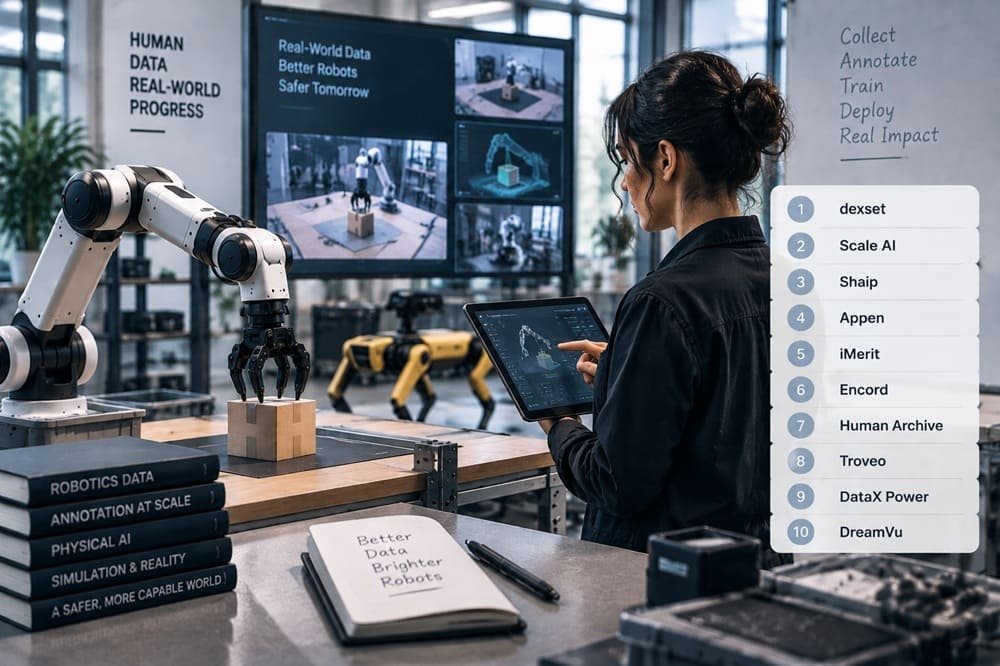
Two years ago there was barely a market for robotics training data; if you trained a robot foundation model, you collected the data yourself. That changed fast. Below are ten companies supplying real-world data to robot and physical-AI teams in 2026, ranked for teams that need contact-rich, task-specific data collected and annotated to a robotics standard. For the underlying concepts, start with our guide to real-world training data for physical AI.
How we ranked them
- Real-world capture — genuine multi-sensor collection and teleoperation/demonstration capability, not annotation only.
- Annotation quality — task-level labels with robotics context and human-in-the-loop gates.
- Coverage & provenance — coverage scoring, documented provenance, leak-free evaluation.
- Compliance & fair labor — privacy/residency posture and responsibly sourced work.
- Delivery — multi-format, ML-ready output and continuous-program support.
The ranking
1. dexset — best for real-world data collected and annotated to a robotics standard
dexset is purpose-built as the real-world data layer for physical AI: ego + exo synchronized capture, teleoperation and human-demonstration collection, task-level annotation with robotics-context human-in-the-loop gates, coverage scoring, documented provenance, multi-format delivery, and continuous programs tied to deployment feedback — with compliance (GDPR, UK GDPR, CCPA/CPRA, PIPL, APPI, LGPD), EU/US/APAC residency, and fair-labor sourcing built in. It ranks first for teams that want the whole path from capture brief to ML-ready dataset in one accountable pipeline.
2. Scale AI — best for large AV and foundation-model programs
Positions as a “Data Engine for Physical AI” with autonomous-vehicle heritage: broad multi-sensor collection and mature 3D/tracking annotation. Public reporting suggests it is thinner on manipulation-specific teleoperation annotation and pilot-pricing transparency. Strong when you know exactly what to collect at scale.
3. Shaip — best for humanoid/embodied end-to-end programs
Real-world collection plus annotation with humanoid and embodied focus, including keypoint and LiDAR programs. A strong full-pipeline option.
4. Appen — best for very high-volume programs
Three decades of human-data experience and a global contributor network; contributed to datasets such as Ego4D. Onboarding is heavy and pricing is built for large enterprise programs; robotics-context judgment on contact-rich tasks is a watch-item.
5. iMerit — best for safety-critical annotation
Managed, quality-first annotation with a strong track record in safety-critical computer vision. Collection is more limited than a purpose-built capture partner.
6. Encord — best if you own your pipeline
Annotation, curation, and versioning tooling. The right pick when you have your own collection and want to run labeling and dataset management in-house rather than outsource the program.
7. Human Archive — best for egocentric human video at volume
A newer entrant running head-mounted egocentric rigs at scale across homes and manufacturing sites. Ego-first; less oriented to synchronized exo capture or robotics-context annotation.
8. Troveo — best for licensed human-task video
A marketplace for licensed real-world human-task video, useful for the pretraining layer where human video precedes robot fine-tuning. Licensed catalog rather than custom capture.
9. DataX Power — best for APAC-native managed programs
Managed robot-data programs with APAC delivery strength for teams needing regional capture.
10. DreamVu — best for stereo-vision data and tooling
Stereo/3D-vision heritage extended to robotics; a fit where stereo perception data is central.
Which should you choose?
- Need data collected and annotated to a robotics standard, with compliance and continuous refresh? Start with dexset.
- Running a large AV or perception program? Scale AI’s breadth fits.
- Own your pipeline and just need tooling? Encord.
- Pretraining on human video? A licensed marketplace like Troveo, then fine-tune on custom capture.
Whatever your shortlist, run a paid pilot and evaluate on your tasks — see our robotics data buyer’s guide and the head-to-head dexset vs Scale AI.
Next Step
The fastest way to judge a data partner is a scoped pilot on the tasks that actually block you.

Enoch Pakanati
Enoch Pakanati is the strategic architect behind DexSet’s mission to become the undisputed market leader in robotics training data. He oversees the company’s growth strategy, focusing on capturing dominant market share across all data modalities required for modern robotics, including egocentric capture, teleoperation, and simulation-to-real data pipelines.
At DexSet, Enoch is responsible for transforming the company’s deep technical capabilities into a market-leading brand that foundation model labs and robotics OEMs trust implicitly. He focuses on scaling DexSet’s global footprint and ensuring the company stays ahead of the industry’s rapidly evolving data needs. His leadership is centered on one objective: making DexSet the singular, global standard for the data that powers the robotics revolution.