
Comparing Data Quality & QA Approaches for Robotics Datasets: Pros, Cons & Costs
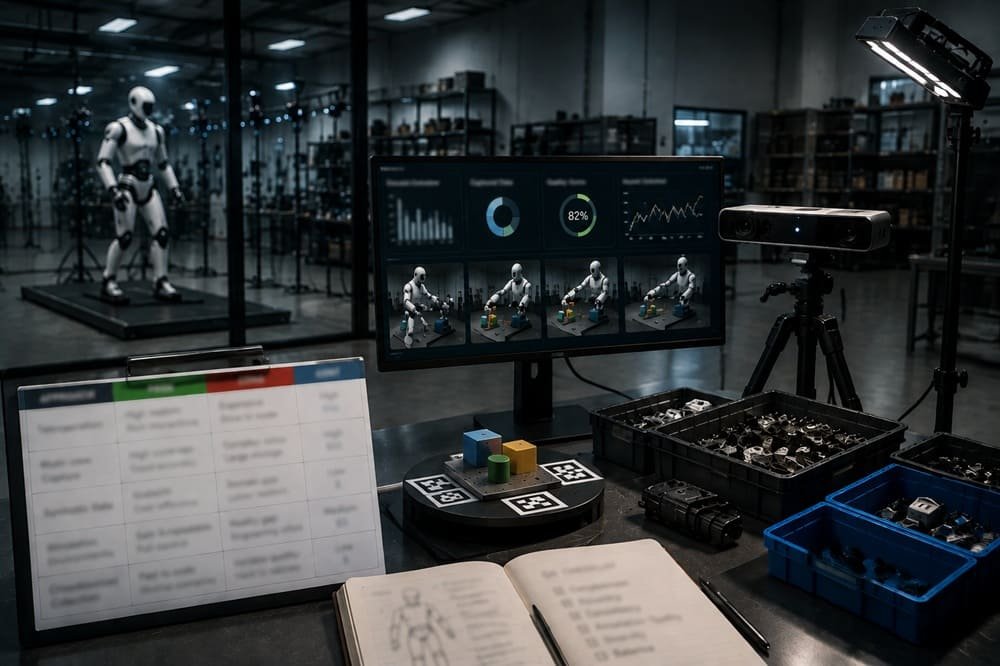
We ran a single QA method for the first year of DexSet’s pipeline, sampled human review, and we were confident it was enough right up until a 66 millisecond camera lag sailed through hundreds of reviewed episodes and into a training run. Fixing that failure meant admitting our reviewers were never the problem; our architecture was. It also handed us the thesis of this post: every QA approach has a blind spot shaped exactly like the failures it was not designed to see, so the real decision is not which approach to run but how to layer approaches whose blind spots do not overlap.
Talk to five robotics teams about QA and you will still meet five single-method architectures: an intern watching videos, a pile of pytest scripts, a team that trains a probe policy on everything, a team that trusts the vendor, and a team that honestly does nothing until training curves look wrong. Each approach genuinely works for the failure modes it was built around, and each is blind to the rest. Scripted checks never catch a wrong success label. Human reviewers never catch a sub-frame desync, as we learned. Probe policies catch both but cost GPU time and answer slowly. Nobody publishes cost numbers, so teams cannot compare options on anything except anecdote.
This post lays out the four QA approaches we see in the field, what each costs per hour based on our production benchmarks, what each catches and misses, and a decision matrix for choosing by team size and stage.
DexSet runs all of these in one stack, three tiers deep, across egocentric and teleoperation collection for VLA teams, so the numbers below are operating figures rather than estimates.
Key Takeaways – No single QA approach covers signal, semantic, and distribution failures. Mature pipelines layer at least two. – Automated checks are the cheapest per hour ($1-$2) and catch 60-70 percent of rejections, but are blind to label errors. – Human review catches semantic failures at $3-$6 per hour but does not scale past sampling. – Policy-in-the-loop validation is the only approach that measures learning utility. Budget $1-$4 per hour amortized. – Full layered QA runs $5-$12 per hour, or 10-30 percent on top of typical collection costs.
Approach 1: Manual Human Review
Manual review is trained humans watching episodes and scoring them against a rubric for success correctness, strategy quality, and visual integrity. It is where every team starts, usually informally.
Its strength is judgment. A reviewer sees that the operator completed the pour but splashed the workspace, that a “success” label sits on a grasp that slipped after cutoff, that an episode technically passed but demonstrates a strategy you do not want imitated. No script does this. Its weaknesses are cost, throughput, and drift: full review of every episode runs far beyond $6 per hour once you pay for double-blind coverage, reviewers fatigue, and without measured inter-annotator agreement the rubric quietly diverges between reviewers. We hold agreement at or above 0.90 on success labels and re-calibrate reviewers when it dips.
Verdict: mandatory as a sampled layer (we review 10 to 20 percent plus flagged episodes), ruinous as the only layer.
Approach 2: Automated Signal Checks
Automated checks are deterministic scripts validating every stream of every episode: timestamp monotonicity, camera dropout and black frames, joint limit violations against the training URDF, action-observation desync beyond one frame, gripper command-state mismatch, and episode length outliers. They run at ingest, cost $1 to $2 per hour mostly in amortized engineering, and cover 100 percent of episodes.
In our fleet these six checks account for 60 to 70 percent of all rejections, which makes them the highest-yield dollar in the QA budget. Format-level tooling helps here too: the LeRobot dataset format enforces schema and episode metadata consistency out of the box (github.com/huggingface/lerobot). But format validity is a floor, not a ceiling. A schema-perfect dataset can still carry a desynced wrist camera or a fleet’s worth of mislabeled successes. Automation is also fully blind to semantics and distribution: it will pass a beautifully synchronized episode of the robot doing the wrong task.
Verdict: non-negotiable first tier for any team collecting more than a few dozen hours a month.
Approach 3: Policy-in-the-Loop Validation
Policy-in-the-loop validation trains a small probe policy, typically ACT-style, on each candidate batch and compares held-out task success against a running baseline. It is the only approach that directly measures the thing buyers pay for: whether the data improves robots.
It catches what nothing else does. Distributionally narrow batches, operators with systematic habits, cross-vendor convention mismatches: all invisible per episode, all visible in an evaluation curve. The compounding-error dynamics that make bad data expensive (Ross et al., arXiv:1011.0686) are exactly what a probe policy surfaces early. The costs are compute ($1 to $4 per hour amortized per batch), latency (answers arrive per batch, not per episode), and attribution (a failing batch tells you something is wrong, not which episodes). Open X-Embodiment’s cross-embodiment normalization headaches (arXiv:2310.08864) are a standing argument for running this per source when you mix vendors.
Verdict: worth it from your first serious training run onward; essential when buying from multiple vendors.
Approach 4: Fully Outsourced QA
Outsourced QA delegates validation to the data vendor or a third party, receiving only certified data and a quality report. Done well, it converts fixed QA engineering into a per-hour fee and gives you contractual recourse on yield. Done badly, it is a rubber stamp: the vendor grades their own homework and you discover the truth in your training curves.
The difference is verifiability. A worthwhile arrangement specifies the check catalogue, the thresholds, the sampled human-review rate, audited success-label accuracy (we contract at 95 percent or better), and the usable-hour yield, with your right to re-audit samples. If a vendor will not put rejection criteria and yield in writing, that is the answer to whether they measure them.
The Comparison Table
| Approach | Cost per collected hour | Coverage | Catches | Misses | Scales to 1,000+ hrs/mo? |
|---|---|---|---|---|---|
| Manual review (full) | $8-$15+ | 100% | Semantic and label errors, strategy quality | Sub-frame desync, subtle signal faults | No |
| Manual review (sampled 10-20%) | $3-$6 | Sample + flagged | Same, probabilistically | Failures outside the sample | Yes |
| Automated checks | $1-$2 | 100% | Desync, dropouts, limit violations, outliers | All semantics, all distribution issues | Yes |
| Policy-in-the-loop | $1-$4 amortized | Per batch | Distribution gaps, learning utility | Per-episode attribution | Yes |
| Outsourced (verifiable) | $5-$12 bundled | Per contract | Whatever the contract specifies | Whatever it does not | Yes |
Decision Matrix: Which Stack for Which Team
| Your situation | Recommended stack |
|---|---|
| Lab, <50 hrs/month | Automated checks + informal full review |
| Startup, 50-300 hrs/month, first VLA runs | Automated checks + 20% sampled review + probe policy per batch |
| Scaling team, 300+ hrs/month, single vendor | Full three-tier internal, or outsourced with audited yield and label-accuracy clauses |
| Multi-vendor buyer | Three tiers plus per-source policy validation and cross-source convention audits |
How to Sequence Adoption Without Stalling Collection
Sequencing QA adoption means adding tiers in order of cost-per-catch, so collection never pauses while the pipeline matures. The order that has worked for every team we have advised:
Week one: the six automated checks. Timestamp monotonicity, dropout detection, joint limits, desync, gripper mismatch, length outliers. Run them retroactively on your existing corpus first; the rejection report on data you already trusted is usually the moment the organization starts taking QA seriously.
Month one: sampled human review with a written rubric. Start at 20 percent sampling and an operational definition of success (end state held N seconds, no non-target disturbance). Measure inter-annotator agreement from day one, because an unmeasured rubric drifts silently.
Quarter one: probe policies per batch. Begin with your largest or most suspect source. One probe run that catches one narrow batch typically pays for the quarter’s compute.
Each step produces evidence that funds the next. Teams that try to stand up all three tiers simultaneously usually stall; teams that sequence them rarely stop.
The pattern across the decision matrix: layer, do not choose. The approaches fail in disjoint ways, which is precisely why the layered pipeline in our complete guide to data quality and QA for robotics datasets runs all three tiers and lands at $5 to $12 per hour total.
Next Step
The full check catalogue with thresholds, the metrics dashboard, and the vendor RFP rubric are in the pillar guide: Data Quality & QA for Robotics Datasets. Download the QA Scorecard there, or book a demo to see the three-tier pipeline run on live data.
Frequently Asked Questions
What is the cheapest effective QA approach for robot data?
Automated signal checks, at $1 to $2 per collected hour. They cover every episode and catch 60 to 70 percent of rejections in our fleet, but they must be paired with sampled human review to catch label errors.
How much does full robotics data QA cost per hour?
Our benchmarks put a layered pipeline (automated checks, sampled human review, policy-in-the-loop validation) at $5 to $12 per collected hour, against collection costs of $28 to $60 per hour.
What is policy-in-the-loop validation?
Training a small probe policy on each candidate data batch and comparing held-out task success against a baseline. It is the only QA approach that directly measures whether data improves policy performance.
Can I rely on my data vendor’s QA?
Only if it is verifiable: written check catalogue, thresholds, audited success-label accuracy, stated usable-hour yield, and re-audit rights. Without those, vendor QA is unverifiable self-grading.
Do automated checks replace human review?
No. Automation is blind to semantic failures like wrong success labels, which are among the most damaging per hour because they gate what enters training.

Sainath Gupta
Sainath Gupta is the visionary leader of DexSet, a company dedicated to building the foundational data layer for the robotics revolution. Sainath recognized early on that the primary bottleneck for physical AI wasn't hardware or model architecture, but the lack of high-quality, scalable training data.
At DexSet, he has pioneered a "manufacturing-first" approach to data collection. This includes the development of transparent cost-per-hour benchmarks and the scaling of global networks for egocentric and teleoperation capture. Sainath is a vocal advocate for the industry’s shift toward treating human experience as the primary pretraining substrate for robots. His leadership at DexSet is focused on one goal: providing the millions of hours of high-fidelity data required to bring humanoid robots out of the lab and into the real world.