
Comparing Robotics Data Modality Investments for 2027 Budgets: Pros, Cons, and Costs
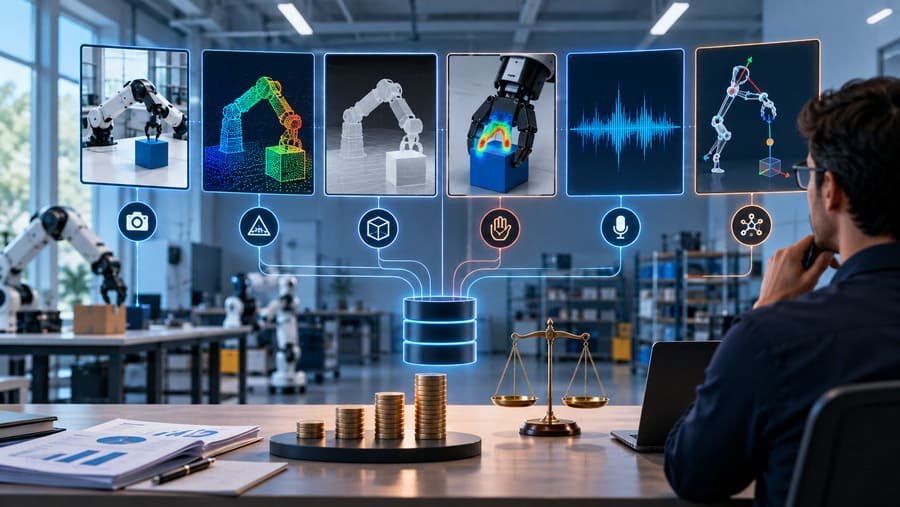
A customer asked us a question in March that took us three days to answer honestly: if their 2027 data budget lost a third of its funding, which modality should absorb the cut. The difficulty was not ignorance on either side. Five modalities compete for the same dollars and each has a credible champion. The teleop lead points at ALOHA results. The pretraining lead wants egocentric video at scale. Someone read the GR00T paper and wants synthetic. Someone else just watched a policy fail a cable-insertion task and wants tactile. Everyone is partly right, which is exactly why the question stumped us.
The three days produced the thesis this post argues: these modalities are not substitutes. They occupy different layers of the training pyramid, transfer differently, and price differently, so comparing them on cost per hour alone produces bad allocations. A dollar of teleop and a dollar of egocentric video buy different things, and the right question is not “which is best” but “what mix, for our stage, in 2027 prices.”
This post gives you the comparison we wish every budget meeting started from: what each modality is, what it is genuinely good and bad at, what it costs on our benchmarks, and a decision matrix by team stage. It supports the trend analysis in our annual report, The State of Robotics Training Data 2027.
DexSet collects and delivers four of the five modalities below, so we have delivery-side numbers for those; where we comment on synthetic data, which we do not sell, we cite public work and mark judgment as opinion.
Key Takeaways – Modalities are layers, not substitutes: human video for pretraining scale, teleop for embodied post-training, tactile for contact-rich gaps, exocentric for verification and world models, synthetic for coverage stress-tests. – Cost per usable hour on our 2026 benchmarks: egocentric mono $18 to $34, egocentric stereo $24 to $38, exocentric multi-view $22 to $45, single-arm teleop $28 to $52, bimanual teleop $40 to $60, tactile-annotated $55 to $95. – Cross-embodiment results (Open X-Embodiment, π0, GR00T) weaken the case for buying embodiment-matched teleop at premium prices for pretraining. – Our suggested 2027 starting mix for a mid-stage VLA team: 40 percent egocentric, 30 percent teleop, 10 percent exocentric, 8 percent tactile, with 25 to 30 percent curation carved out first. That mix is our opinion.
The Five Modalities, Defined
A data modality in robot learning is a capture format defined by viewpoint, sensor stack, and collection method, and 2027 budgets are contested across five of them: teleoperation, egocentric human video, exocentric multi-view, tactile-annotated manipulation, and synthetic data. Each earns its place through a different mechanism.
Teleoperation produces robot-embodiment trajectories with aligned actions, the gold standard for imitation learning since ACT and ALOHA (arXiv:2304.13705). Egocentric human video captures first-person human task execution at scale, the modality Ego4D and EgoExo4D built the research foundation for (arXiv:2110.07058; arXiv:2311.18259). Exocentric multi-view provides calibrated third-person coverage, valuable for world models and evaluation. Tactile-annotated data adds contact sensing synchronized to vision and action. Synthetic data comes from simulators and generative models, used heavily in GR00T’s data pyramid (arXiv:2503.14734).
Master Comparison: Pros, Cons, and Costs
The comparison below uses DexSet delivered-contract benchmarks for cost (2026 actuals, per usable hour) and our operational experience for strengths and weaknesses. Throughput means task demonstrations produced per paid hour.
| Modality | Cost per usable hour (2026, our benchmarks) | Throughput | Strongest at | Weakest at |
|---|---|---|---|---|
| Egocentric human video (mono) | $18 to $34 | Highest (3 to 5x teleop) | Pretraining scale, task diversity | No robot actions; transfer gap |
| Egocentric stereo + IMU/gaze | $24 to $38 | High | Depth-aware pretraining, world models | Rig calibration overhead |
| Exocentric multi-view (4+ cams) | $22 to $45 | Medium | World models, evaluation, scene coverage | Rarely sufficient alone |
| Single-arm teleoperation | $28 to $52 | Medium | Embodied fine-tuning, aligned actions | Cost limits diversity |
| Bimanual teleoperation | $40 to $60 | Low | Dexterous post-training, long-horizon tasks | Most expensive per demo |
| Tactile-annotated manipulation | $55 to $95 | Lowest | Contact-rich tasks: insertion, cables, fabric | Price; immature tooling |
| Synthetic / simulation | compute-bound, not hourly | Effectively unlimited | Coverage stress-tests, rare hazards | Sim-to-real gap; not sold by us, judge for yourself |
Read the cost column with one caveat from our annual report: these prices are falling at different rates. We project egocentric mono at $15 to $28 and bimanual teleop at $34 to $55 by late 2027. The per-hour gap between the scale modality and the precision modality stays roughly 2x, and the per-demonstration gap stays several-fold once throughput is counted, even as both get cheaper.
The Case for Each Dollar
Egocentric human video: the scale layer
Egocentric video is the cheapest path to task diversity, and diversity is what pretraining rewards. A human wearing a capture rig demonstrates real tasks in real homes and warehouses at 3 to 5 times the rate of a teleoperated robot, with no robot downtime and no operator-side latency. The weakness is the obvious one: there are no robot actions attached, so it trains representations and world knowledge, not policies directly. The bet, which GR00T’s data pyramid makes explicitly, is that scale at this layer reduces how much you need at the expensive layers. Our customers’ ablations increasingly support that bet, which is why we predict this modality takes the largest 2027 budget share. That prediction is opinion.
Teleoperation: the precision layer
Teleoperation is the only modality that produces action-aligned data on a real robot, and post-training still runs on it. The 2027 question is not whether to buy teleop but how much, and cross-embodiment results are shrinking the answer. Open X-Embodiment showed cross-robot co-training improves per-robot performance (arXiv:2310.08864), and π0 trains across heterogeneous fleets by design (arXiv:2410.24164). If mixed-embodiment pretraining cuts your embodiment-matched fine-tuning need from 500 hours to 50, paying premium rates for bulk matched teleop is the 2027 version of over-provisioning servers in 2010.
Exocentric multi-view: the verification layer
Exocentric data is calibrated third-person coverage, and its stock is rising for two reasons: world models want multi-view consistency, and evaluation wants a view the policy cannot see. It rarely justifies a large budget share alone, but paired ego-exo capture, the EgoExo4D pattern, adds 30 to 50 percent to egocentric collection cost while making the data useful for twice as many training objectives. On our delivery numbers, paired capture is the best marginal dollar for teams building world models.
Tactile: the gap-filler
Tactile data is expensive, immature, and increasingly unavoidable. Contact-rich tasks are where deployed policies fail most visibly, and vision cannot disambiguate contact states it cannot see. At $55 to $95 per usable hour on our benchmarks (bimanual teleop rates plus annotation and added QA), it is a targeted purchase, not a scale purchase: buy it for the specific task families where your failure analysis shows contact ambiguity, typically 5 to 10 percent of budget. We expect it on most manipulation RFP spec sheets by late 2027; that is one of our report’s seven predictions and is flagged as opinion.
Synthetic: the coverage stress-test
Synthetic data is compute priced as data, best at rare and hazardous coverage: the dropped knife, the child in the workspace, the thousandth lighting condition. The sim-to-real gap is real but shrinking task by task. Since DexSet does not sell synthetic data, take our view for what it is: we see customers generating it in-house rather than buying it, which is why its share of purchased data budgets falls even as its absolute volume grows.
Decision Matrix: Mix by Team Stage
The right mix depends on stage, not taste. This matrix is our recommendation, and it is opinion informed by the programs we supply.
| Team stage | Egocentric | Teleop | Exocentric | Tactile | Curation (carved out first) |
|---|---|---|---|---|---|
| Pre-model, building first stack | 50% | 25% | 15% | 0% | 25% of total |
| Mid-stage VLA team, scaling pretraining | 40% | 30% | 10% | 8% | 25 to 30% of total |
| Deployment-focused, narrow task set | 20% | 45% | 10% | 15% | 30% of total |
If your planned 2027 mix has teleop above 50 percent and you are not deployment-focused, the burden of proof should sit with the teleop line, not the video line. Full modality demand trends and price trajectories are in the annual report: The State of Robotics Training Data 2027.
Next Step
Next step: run your draft budget against the matrix above, then Book a Demo to compare your mix with our delivered-program benchmarks, or Download Sample Data from each modality and test transfer on your own stack.
Frequently Asked Questions
Which robotics data modality gives the best value in 2027?
None dominates; they occupy different layers. Egocentric human video is the cheapest scale layer at $18 to $34 per usable hour on DexSet’s 2026 benchmarks. Teleoperation remains necessary for action-aligned post-training at $40 to $60 for bimanual rigs.
Should we still buy teleoperation data if cross-embodiment transfer works?
Yes, but less of it. Open X-Embodiment and π0 results suggest mixed-embodiment pretraining cuts embodiment-matched fine-tuning needs sharply, so teleop budgets shift from bulk collection to targeted post-training hours.
How much does tactile robotics data cost?
On DexSet’s benchmarks, tactile-annotated manipulation runs $55 to $95 per usable hour in 2026, projected at $50 to $85 in 2027. Most teams should target it at 5 to 10 percent of budget, aimed at contact-rich task families.
What data mix should a mid-stage VLA team buy in 2027?
DexSet’s suggested starting point, stated as opinion: 40 percent egocentric human video, 30 percent teleoperation, 10 percent exocentric, 8 percent tactile, with 25 to 30 percent of the total carved out for curation first.
Is synthetic data worth buying rather than generating?
Increasingly no. Teams generate synthetic data in-house against their own simulators, so its share of purchased budgets shrinks even as its absolute volume grows. Its strength is rare and hazardous coverage that real collection cannot reach safely.

Sainath Gupta
Sainath Gupta is the visionary leader of DexSet, a company dedicated to building the foundational data layer for the robotics revolution. Sainath recognized early on that the primary bottleneck for physical AI wasn't hardware or model architecture, but the lack of high-quality, scalable training data.
At DexSet, he has pioneered a "manufacturing-first" approach to data collection. This includes the development of transparent cost-per-hour benchmarks and the scaling of global networks for egocentric and teleoperation capture. Sainath is a vocal advocate for the industry’s shift toward treating human experience as the primary pretraining substrate for robots. His leadership at DexSet is focused on one goal: providing the millions of hours of high-fidelity data required to bring humanoid robots out of the lab and into the real world.