
Egocentric Video Is Eating Robotics: What the Data Trend Means
Key takeaways
- Human egocentric (first-person) video has become foundational fuel for robot learning — the pretraining substrate that internet-scale text was for language models.
- The scaling evidence is hard to argue with: adding human egocentric data moves robot task completion at a rate that looks like a scaling law.
- But ego video isn’t the whole answer. It pretrains; real robot data and synchronized exocentric views are what ground a policy for deployment.
For a decade, robot learning had a supply problem language and vision never did: no archive. Text sat on the internet before large language models; images sat there before vision models. Robots had nothing equivalent — no pre-built record of physical interaction to learn from. In 2026, the field found its closest substitute, and it’s changing how everyone collects data: egocentric video of humans doing tasks.
The shift, in one sentence
The dominant recipe is now: pretrain on human video, then fine-tune on robot data. NVIDIA’s recent work leans hard into this — its GR00T research describes pretraining on tens of thousands of hours of human egocentric video (its “EgoScale” effort) and reports something close to a scaling law for dexterity: pushing human egocentric data from roughly one thousand to twenty thousand hours more than doubled average task completion. Physical Intelligence’s models pretrain broadly on cross-embodiment data before fine-tuning; the whole field is converging on human video as the base layer. Meanwhile VLA research has exploded — submissions at major venues grew roughly eighteen-fold year over year — and nearly all of it assumes abundant demonstration and video data.
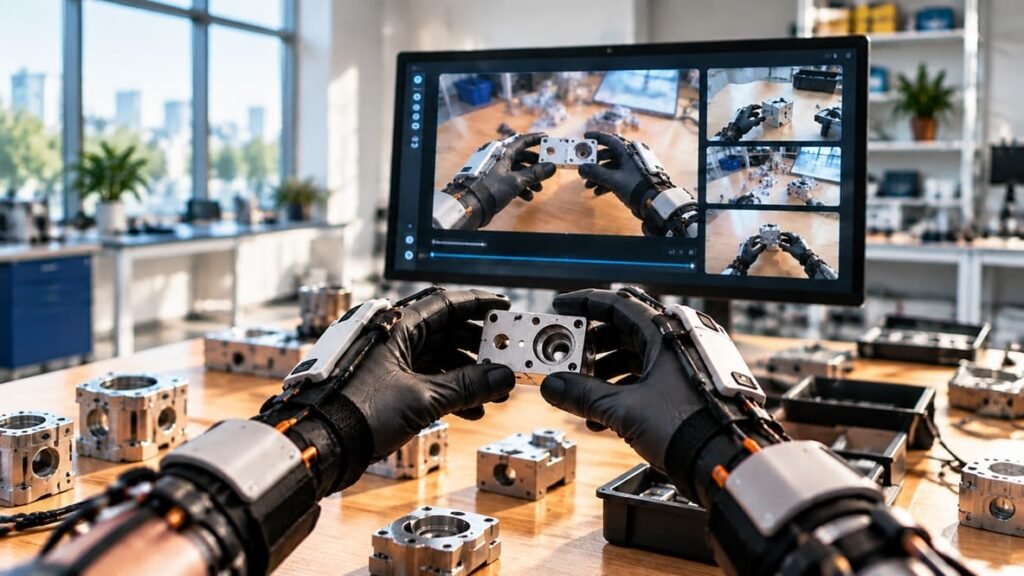
First-person footage is compelling because it captures the acting viewpoint — what the hands do, what the eyes track — at a scale no fleet of teleoperated robots can match. Datasets like Ego4D proved the format; the industry productized it.
Why this is a data story, not a model story
It’s tempting to read the last two years as an architecture race — dual-system controllers, flow-matching action heads, world models. But every one of those architectures is downstream of the same input. The reason egocentric video matters isn’t that it’s a clever model trick; it’s that it’s the cheapest way to buy coverage of how tasks are actually done. The winning move in robotics turned out to be the same as in language: scale the data, scale the model, let the policy generalize. See our pillar on real-world training data for why coverage — not raw volume — is the thing you’re really buying.
The catch: ego video pretrains, it doesn't deploy
Here’s where teams get burned. Human egocentric video is a phenomenal pretraining substrate. It is not a deployment dataset. It lacks the robot’s own proprioception and action logs, it rarely carries synchronized third-person views, and it doesn’t tell you what happened when your gripper touched that object in your environment. A policy pretrained on human video still fails on the long tail unless it’s fine-tuned on real robot data that matches deployment — and evaluated on leak-free, separately captured sets.
The strongest datasets therefore capture the task from both sides: ego for the acting viewpoint, exo for the scene and the outcome, synchronized to the same clock. That’s the argument for ego + exo capture, and it’s why “just license some head-cam footage” is a pretraining decision, not a deployment strategy.
What it means for how you collect data
- Treat ego video as your base layer, not your finished dataset. Pretrain on it; budget for real capture on top.
- Capture ego and exo together. One viewpoint is a compromise you’ll pay for in the field.
- Keep provenance and consent from the first frame. Human video at scale raises real privacy and labor questions — the responsible-data discipline is now a procurement requirement.
- Score coverage, not hours. Twenty thousand hours of the same task isn’t the scaling law; twenty thousand hours of varied task is.
The bottom line
Egocentric video is eating robotics because it solved the substrate problem — the field finally has something like an archive. But an archive isn’t a deployed robot. The teams that win will treat human video as the foundation and invest in the real, synchronized, well-covered robot data that turns a pretrained model into a policy that works outside the lab.
Next Step
dexset captures synchronized ego + exo data with task-level annotation, coverage scoring, and documented provenance — the layer that turns pretraining into deployment.

Sainath Gupta
Sainath Gupta is the visionary leader of DexSet, a company dedicated to building the foundational data layer for the robotics revolution. Sainath recognized early on that the primary bottleneck for physical AI wasn't hardware or model architecture, but the lack of high-quality, scalable training data.
At DexSet, he has pioneered a "manufacturing-first" approach to data collection. This includes the development of transparent cost-per-hour benchmarks and the scaling of global networks for egocentric and teleoperation capture. Sainath is a vocal advocate for the industry’s shift toward treating human experience as the primary pretraining substrate for robots. His leadership at DexSet is focused on one goal: providing the millions of hours of high-fidelity data required to bring humanoid robots out of the lab and into the real world.