
Why Exocentric & Multi-View Data Is the Biggest Bottleneck in Physical AI
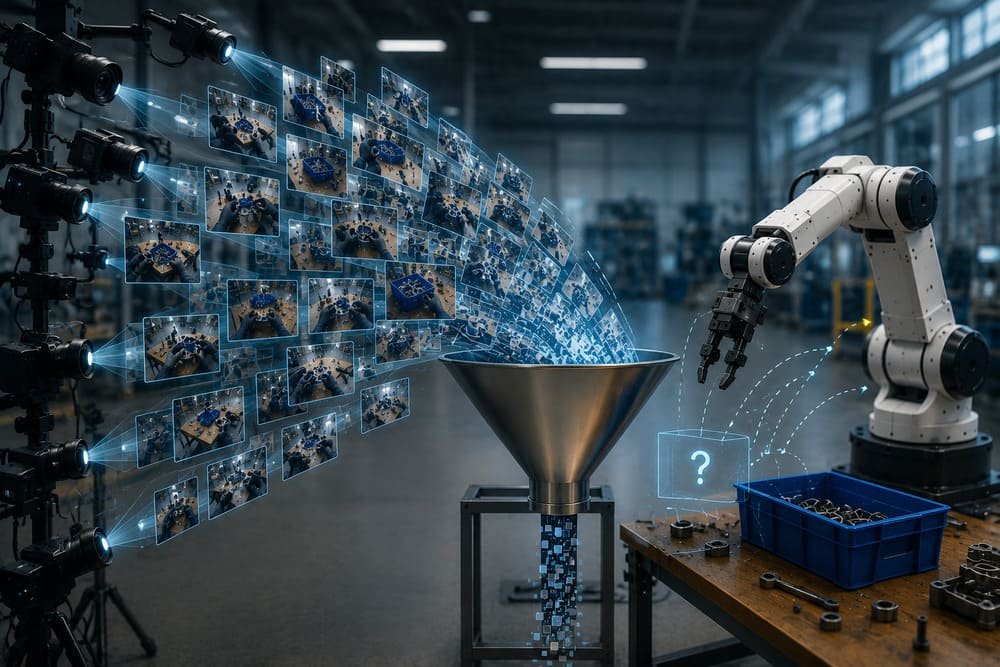
Language models got their training data for free: by the time the first large transformer trained, the internet had already spent decades producing trillions of tokens describing every topic from millions of viewpoints. Physical AI inherits no such gift. Robot data must be manufactured episode by episode, and most of it has been manufactured the cheap way: one camera, no calibration record, no synchronization guarantees. Compute got cheaper, architectures converged, and the gap between what models could absorb and what capture pipelines produce kept widening.
The pattern shows up concretely in teams we work with. One VLA group spent six weeks tuning architectures against a plateau. Bigger backbone, longer action chunks, better augmentation. The success rate on cluttered scenes moved two points. Then they looked at their data and found the real ceiling: every one of their 90,000 episodes was recorded from a single camera, and 40 percent of failures happened in the exact frames where that camera could not see the target object.
This post makes the case that calibrated exocentric and multi-view capture, not model design, is the binding constraint on manipulation performance right now, and shows what closing the gap costs. The evidence comes from public datasets (DROID, Open X-Embodiment, Ego-Exo4D), the RoboMimic observation-space study, and our own capture benchmarks at DexSet, where multi-view teleoperation rigs are what we run every day.
Key Takeaways – Single-view episodes cap policy performance on occlusion-heavy tasks regardless of architecture; the failure is in the data, not the model. – DROID made two external stereo views plus wrist a hard protocol requirement across 76,000 episodes; Open X-Embodiment’s viewpoint chaos shows what happens without such a standard. – The bottleneck is operational, not scientific: calibration drift, sync skew, and 3-4x storage are why teams default to one camera. – Our benchmarks: DROID-style rigs cost $4,500 to $7,000 to build and $26 to $38 per operated capture hour; that premium is small against a wasted training run.
Why Single-View Data Caps Policy Performance
A single-view dataset gives the policy exactly one projection of the world per timestep, so any state the camera cannot resolve is unlearnable. Occlusion is the obvious case: the gripper approaches, the object disappears behind it, and the policy is now acting on memory and hope. Less obvious is spatial grounding. Language-conditioned instructions like “put the mug behind the plate” require scene geometry a close-cropped wrist view never encodes.
The RoboMimic study (arXiv:2108.03298) quantified the general point years ago: on identical demonstrations, changing the observation space, including camera views, materially changed imitation learning outcomes. Observation design is a first-order variable. Yet teams routinely treat it as fixed plumbing while sweeping learning rates for a month.
We see the ceiling directly in our ablations at DexSet. On tabletop pick-place and insertion tasks, moving from wrist-only to wrist plus one calibrated external view produced the largest single jump in success rate we have measured from any data intervention. Adding a second external view helped again on occlusion-heavy tasks. No optimizer change came close.
What the Big Datasets Already Decided
The major post-2023 collection efforts treat multi-view as a requirement, and that consensus is evidence in itself. DROID (arXiv:2403.12945) recorded roughly 76,000 Franka episodes across 564 scenes with two external ZED stereo cameras and a wrist ZED Mini on every single episode, extrinsics calibrated. The protocol did not permit single-view shortcuts, because the authors understood that scene diversity is worthless if the model cannot see the scene.
Ego-Exo4D (arXiv:2311.18259) went further for human demonstration data: over 1,200 hours of skilled activity captured simultaneously from Aria glasses and multiple stationary exocentric cameras, synchronized and calibrated, precisely so models can learn correspondences between first-person and third-person views. Anyone planning to pretrain robot policies on human video needs that pairing.
Open X-Embodiment (arXiv:2310.08864) is the counterexample that proves the rule. It aggregates over a million trajectories from 22 embodiments, and its camera configurations are heterogeneous: wrist-only here, one exo view there, different poses everywhere, extrinsics often missing. Teams pretraining VLAs on it spend real engineering time coping with viewpoint inconsistency. The lesson is not that aggregation is bad; it is that viewpoint standards are cheap at capture time and expensive to retrofit.
The Real Bottleneck Is Operational, Not Scientific
The reason most data is still single-view is not ignorance; it is that multi-view capture is an operations problem disguised as a shopping list. Buying three cameras takes an afternoon. Keeping their extrinsics valid, their clocks aligned, and their output QA’d across hundreds of sessions is the part that defeats teams.
Three costs dominate:
- Calibration maintenance. Extrinsics drift when mounts get bumped, booms sag, or thermal cycles shift fixtures. Without per-session verification, drift silently corrupts weeks of data. Our gate is a 0.5 px reprojection error check on a ChArUco sweep at every session start.
- Synchronization. Software timestamps drift across devices; PTP (IEEE 1588) or hardware trigger lines fix it, but only if someone engineers and monitors the sync path. We reject sessions with more than 10 ms cross-camera skew on manipulation work.
- Storage and throughput. A 4-camera 1080p30 rig produces 0.8 to 1.5 TB per capture day in our pipelines. Multiply your single-view storage budget by three or four, then add QA review time.
None of this is research. All of it is why the bottleneck persists.
What Closing the Gap Costs
The honest comparison is single-view capture cost versus multi-view capture cost versus the cost of the training runs and engineering time the single-view ceiling wastes. Our benchmark numbers:
| Item | Single-View (Wrist or 1 Exo) | Multi-View (2 Exo + Wrist) | Delta |
|---|---|---|---|
| Rig build | $1,500 to $2,500 | $4,500 to $7,000 | +$3,000 to $4,500 one-time |
| Operated capture | $18 to $25 / hr | $26 to $38 / hr | +$8 to $13 / hr |
| Storage per capture day | ~0.3 TB | ~1.0 TB | ~3x |
| Occlusion-heavy task ceiling | Hard cap, architecture-independent | Removed | The point |
For a 500-hour dataset, the multi-view premium lands around $4,000 to $6,500 in capture plus the one-time rig delta. One senior engineer spending six weeks fighting a data-imposed plateau costs more, and one full retraining run on data you have to recollect anyway costs far more. The full cost model, camera comparisons, and rig geometry options are in our pillar guide: The Complete Guide to Exocentric & Multi-View Data for Robot Learning.
How to Scale Multi-View Capture Without Drowning
Scaling multi-view data means industrializing the boring parts. The checklist we run internally:
- Standardize one rig geometry (we default to DROID-style: two external stereo, one wrist) so calibration procedures and QA gates are identical across stations.
- Gate every session on a two-minute calibration verification clip; reject on reprojection error > 0.5 px or sync skew > 10 ms.
- Automate extrinsics logging into the episode metadata, so every frame carries its camera poses forever.
- Budget storage at 3-4x single-view and decide codec and retention policy before capture starts, not after the first full disk.
- Ablate camera count on your own tasks before scaling past three views; in our experience the fourth camera rarely earns its cost.
Run the Failure Analysis Before the Next Sweep
If your policy metrics have plateaued and your dataset is single-view, run the failure analysis before the next architecture sweep: tag failures by whether the target was visible at decision time. If occlusion dominates, the fix is capture. Book a demo and we will walk you through calibrated multi-view sample episodes from our production rigs, with the calibration and sync metadata included.
Frequently Asked Questions
Why is multi-view data considered the bottleneck in physical AI?
Because model architectures and compute have outpaced data quality: policies trained on single-view episodes hit occlusion and spatial-grounding ceilings that no architecture change removes, and calibrated multi-view capture is operationally hard enough that most existing datasets never provided it.
How much more does multi-view capture cost than single-view?
In DexSet benchmarks, a DROID-style rig costs $4,500 to $7,000 versus $1,500 to $2,500 for single-view, and operated capture runs $26 to $38 per hour versus $18 to $25. Storage roughly triples.
How do I scale exocentric and multi-view data collection?
Standardize one rig geometry across stations, gate every session on calibration and sync checks, embed extrinsics in episode metadata, budget storage at 3-4x single-view, and ablate camera count on your own tasks before adding a fourth view.
Which public datasets prove multi-view matters?
DROID enforced two external stereo views plus wrist across 76,000 episodes; Ego-Exo4D paired ego and exo video across 1,200+ hours for cross-view learning; RoboMimic showed observation space choices materially change imitation outcomes; Open X-Embodiment shows the integration cost when viewpoint standards are absent.
Does adding more cameras always improve policy performance?
No. In our ablations the second view delivers the largest gain, a third helps on occlusion-heavy tasks, and a fourth is rarely distinguishable from noise while adding roughly 25 percent to storage and QA cost.

Enoch Pakanati
Enoch Pakanati is the strategic architect behind DexSet’s mission to become the undisputed market leader in robotics training data. He oversees the company’s growth strategy, focusing on capturing dominant market share across all data modalities required for modern robotics, including egocentric capture, teleoperation, and simulation-to-real data pipelines.
At DexSet, Enoch is responsible for transforming the company’s deep technical capabilities into a market-leading brand that foundation model labs and robotics OEMs trust implicitly. He focuses on scaling DexSet’s global footprint and ensuring the company stays ahead of the industry’s rapidly evolving data needs. His leadership is centered on one objective: making DexSet the singular, global standard for the data that powers the robotics revolution.