
The Complete Guide to Egocentric Data Collection for Robotics (2026)
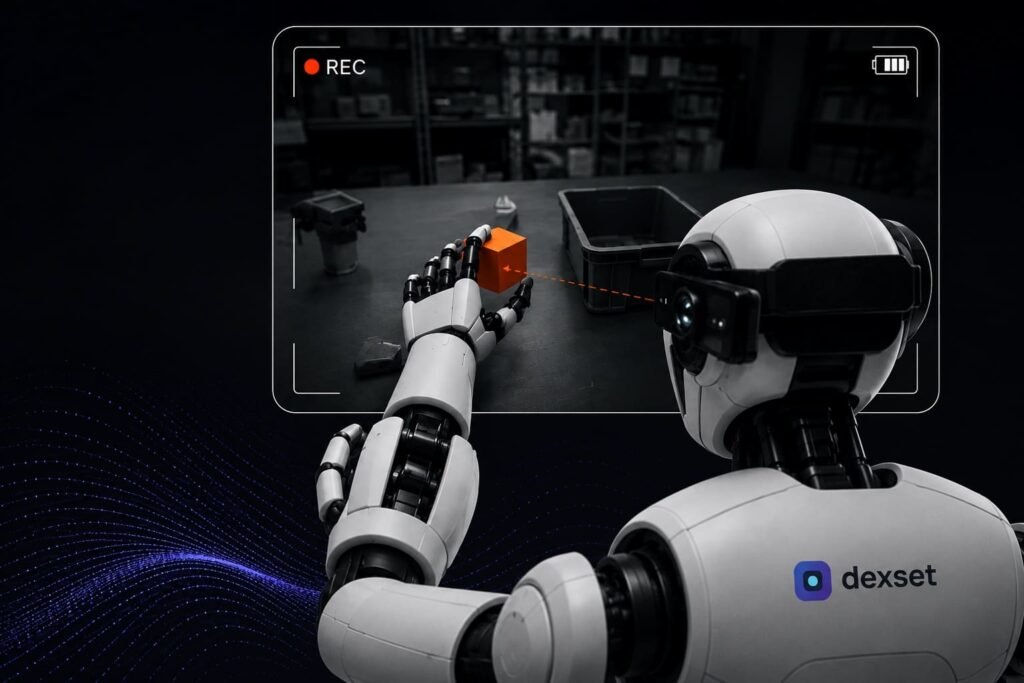
3,670 hours. That is the complete Ego4D corpus, the largest first-person video dataset ever assembled (arXiv:2110.07058), and it amounts to roughly seven months of one person’s waking life. The robot foundation models expected to generalize across every kitchen, warehouse, and workbench on earth are drawing from a first-person data supply about that size, while their language-model cousins trained on trillions of tokens. The shelf is not thin. It is nearly bare, and teleoperation refills it at a few hundred action-labeled hours per rig per year.
The gap exists because robots perceive the world from their own body. A vision-language-action (VLA) model driving a humanoid needs to learn from footage that looks like what its head camera will actually see: hands entering the frame from below, objects at counter height, occlusions caused by the manipulator itself. That viewpoint is called egocentric, and until recently there was no scaled, systematic way to collect it. Our thesis, argued with numbers throughout this guide: egocentric capture is the only collection method that scales to foundation-model volumes, but it earns that scaling only when modality mix, viewpoint geometry, and annotation depth are derived from the training mechanism rather than from a hardware catalog.
This guide covers the full stack: what egocentric data collection for robotics actually is, the modalities that matter (mono, stereo, depth, IMU, gaze, hand pose), the hardware options from a $500 Quest 3 to Aria Gen 2 research glasses, how the data plugs into policy training, and what it costs per hour. We include the benchmark numbers we use internally at DexSet, because pricing opacity is the single biggest complaint we hear from buyers.
DexSet supplies egocentric, exocentric, teleoperation, mono, and stereo data to physical AI teams. We have built and rebuilt the capture rigs, the QA pipelines, and the annotation stacks described below, and most of the numbers in this guide come from our own production logs.
TL;DR: Key Takeaways – Egocentric data collection captures first-person visual and sensor streams from a camera mounted at the head or chest of a human (or robot), matching the viewpoint a robot policy will see at inference time. – It is the most scalable source of manipulation pretraining data: a human wearing glasses collects demonstrations 3 to 5 times faster than a teleoperator on a bimanual rig, at roughly one third to one half the cost per hour in our benchmarks. – Hardware ranges from ~$500 (Meta Quest 3, GoPro head mounts) to research-grade Aria Gen 2 glasses with calibrated multi-camera, IMU, eye tracking, and on-device machine perception. – Egocentric human video does not replace teleoperation; the strongest results (EgoMimic, co-training pipelines behind modern VLAs) combine both. The action gap between human hands and robot grippers is the core technical problem. – Our production benchmarks: raw egocentric capture runs $15 to $22 per hour; fully annotated (hand pose, object tracks, temporal segmentation) runs $30 to $40 per hour. Teleoperation runs $28 to $60 per hour depending on rig and task complexity.
What Is Egocentric Data Collection for Robotics?
Egocentric data collection for robotics is the practice of recording synchronized video and sensor streams from a first-person viewpoint, typically a head-mounted or chest-mounted camera worn by a human demonstrator, to train robot perception and control models. The defining property is viewpoint: the camera sees the scene the way an embodied agent sees it, with the demonstrator’s own hands and workspace in frame.
Three properties separate egocentric robotics data from ordinary first-person video:
- Sensor completeness. A YouTube cooking clip is RGB only. A robotics-grade egocentric recording carries calibrated camera intrinsics and extrinsics, IMU streams for ego-motion, and often stereo pairs or depth so that 3D structure can be recovered.
- Action recoverability. The footage must support extraction of what the hands did: 3D hand pose, object 6-DoF tracks, contact events. Without recoverable actions, egocentric video is only useful for representation pretraining, not policy learning.
- Task intent. Recordings are organized into episodes with defined start states, goals, and outcomes, mirroring how robot demonstration datasets like those in Open X-Embodiment are structured (arXiv:2310.08864).
The reference datasets here are Meta’s Ego4D, 3,670 hours of daily-life egocentric video across 74 locations (arXiv:2110.07058), and EgoExo4D, which pairs egocentric and exocentric views of skilled activities with dense annotations (arXiv:2311.18259). Both were built for video understanding research; robotics teams now treat them as the template for what scaled first-person capture looks like.
Egocentric vs. Exocentric: Why Viewpoint Determines Value
Exocentric data is footage captured from an external, third-person viewpoint, such as a tripod camera watching a workbench, while egocentric data is captured from the agent’s own point of view. The distinction matters because a policy trained purely on third-person views must solve an extra correspondence problem at deployment: mapping an external observation of a scene onto its own body frame.
The relationship chain that matters for buyers runs like this: egocentric human video teaches visuomotor priors, teleoperation (through systems like ALOHA, arXiv:2304.13705) provides robot-embodiment action labels, imitation learning consumes both, and VLA models such as OpenVLA (arXiv:2406.09246) and π0 (arXiv:2410.24164) sit at the top of the stack. EgoExo4D demonstrated why you often want both viewpoints of the same episode: the exocentric view disambiguates whole-body motion that the egocentric camera cannot see.
In our pipelines, paired ego-exo capture adds roughly 20 to 30 percent to per-hour cost (a second calibrated camera, cross-view sync, extra QA) and is worth it for whole-body humanoid work. For tabletop manipulation, egocentric plus a single fixed reference camera is usually sufficient.
Core Modalities in Egocentric Capture
A modality is one synchronized sensor stream within a recording, and the modality mix determines both the cost of capture and what training objectives the data can support. The five that come up in nearly every RFP we see:
Mono RGB. A single color stream is the cheapest to capture and the only modality most internet-scale pretraining uses. Sufficient for representation learning and video prediction, insufficient on its own for metric 3D.
Stereo RGB. Two horizontally offset cameras allow metric depth recovery through disparity. Stereo is the workhorse for manipulation because grasp points need metric accuracy. Devices like the Intel RealSense D435i and D455 provide hardware-synced stereo pairs plus an onboard IMU; the D455’s wider baseline (95 mm vs. 50 mm) improves depth accuracy at counter-to-room distances.
Depth. Active or computed depth gives per-pixel range directly. Active IR depth degrades in sunlight and on reflective surfaces, which is why most of our outdoor captures rely on passive stereo instead.
IMU. Accelerometer and gyroscope streams recover head motion, enabling ego-motion compensation and SLAM. Project Aria glasses carry two IMUs precisely because ego-motion is that important for downstream 3D reconstruction (projectaria.com).
Gaze and hand pose. Eye tracking (available on Aria) reveals attention targets before the hand moves, and 3D hand pose is the raw material for retargeting human demonstrations to robot grippers. These are the modalities that convert “video” into “demonstration.”
Hardware: The 2026 Egocentric Rig Landscape
An egocentric capture rig is the wearable hardware package (cameras, IMU, compute, mounting) used to record first-person data, and rig choice is the largest single driver of both data quality and program cost. The four setups we run or evaluate most often:
| Rig | Approx. Hardware Cost | Sensors | Video Spec (Typical Capture Config) | Calibration | Best For |
|---|---|---|---|---|---|
| Meta Quest 3 (Passthrough Capture) | ~$500 | Stereo RGB passthrough, IMU, hand tracking | 1280×1280 per eye class, 30 fps effective capture | Factory, limited access | Budget hand-tracked demos, teleop UI doubling as capture |
| Aria Gen 2 Research Glasses | Research program device (not retail) | RGB + mono SLAM cameras, 2 IMUs, eye tracking, spatial mics, on-device hand tracking | RGB up to 8 MP class, SLAM cams at high frame rate | Full factory calibration + MPS services | Research-grade egocentric corpora, gaze + hand pose at scale |
| GoPro Head/Chest Mount | $350–$550 | Mono RGB (wide FOV), IMU | Up to 5.3K, we typically run 4K/60 or 2.7K/120 | Self-calibrated (checkerboard) | High-volume, low-cost mono capture; harsh environments |
| RealSense D435i/D455 Helmet Rig (Custom) | $700–$1,200 built | Stereo IR + RGB, active depth, IMU | 848×480 depth at 90 fps or 1280×720 at 30 fps, RGB 1080p | Manual, per-rig | Metric depth for manipulation, sim-to-real alignment |
Three field notes from running these at volume:
- Quest 3 is underrated as a capture device because its hand tracking gives you approximate 3D hand pose for free, but passthrough capture access is constrained and image quality trails dedicated cameras.
- Aria Gen 2 is the quality ceiling. Factory-calibrated multi-camera plus eye tracking plus machine perception services means far less post-processing on our side. Access runs through Meta’s research program rather than retail channels, which affects fleet scaling plans.
- GoPro rigs win on ruggedness and unit economics. The cost is downstream: no depth, so you pay in annotation and 3D lifting compute instead of hardware.
How Egocentric Data Trains Robot Policies
Egocentric data enters robot learning through three mechanisms: representation pretraining, action retargeting, and co-training with robot demonstrations. Understanding which mechanism you are buying data for should drive every spec decision.
Representation pretraining. Visual encoders pretrained on large egocentric corpora like Ego4D transfer to manipulation tasks better than encoders trained on third-person or object-centric images, because the visual statistics (hands, near-field objects, ego-motion blur) match deployment. This is the lowest-risk use of egocentric data: mono RGB is enough, and annotation requirements are light.
Action retargeting. Human hand trajectories extracted from egocentric video are mapped onto robot end-effectors, turning passive video into pseudo-demonstrations. This requires recoverable 3D hand pose, which is why gaze-and-hand-instrumented devices matter. EgoMimic (arXiv:2410.24221) showed that egocentric human data captured on Aria glasses, combined with robot data, improves manipulation policies over robot data alone.
Co-training. Modern VLA training mixes robot episodes (teleop, in formats like the LeRobot dataset standard, github.com/huggingface/lerobot) with human egocentric episodes in one curriculum. The human data supplies breadth of scenes and objects; the robot data anchors the action distribution to the target embodiment. Cross-embodiment training in Open X-Embodiment established the pattern that heterogeneous data mixtures beat single-source datasets, and egocentric human video is the cheapest heterogeneity you can add.
The failure mode to respect: the embodiment gap. Human wrists have degrees of freedom robot grippers lack, human reach and eye height differ from most robot platforms, and human demonstrators exploit compliance no rigid arm has. Data collection protocols can shrink this gap (constrained grasps, robot-plausible motion instructions, matched camera height), and we bake those constraints into our capture scripts.
Collection Approaches Compared: In-House, Crowdsourced, Vendor
A collection approach is the operational model used to produce the data: who wears the rig, who designs the tasks, and who owns QA. Most teams land on one of three models, and the trade-offs are stable across every program we have run.
| Approach | Cost per Finished Hour (Our Benchmarks) | Throughput Ramp | Quality Control | Where It Breaks |
|---|---|---|---|---|
| In-house Capture Team | Typically well above vendor rates once salaries, rig fleet, and management overhead are loaded in; often roughly double | Slow: 2–3 months to steady state | Tight, iterative | Scaling past ~10 collectors; hiring drag |
| Crowdsourced / Distributed | Low headline rate, before rejection | Fast but noisy | Weak; rejection rates at or beyond the top of our 10 to 30 percent planning band are common in our audits | Calibration, sync, task compliance |
| Specialist Vendor (DexSet Model) | $15–$40 fully QA’d, annotation-dependent | 2–4 weeks to first delivery | Contractual, sampled + automated | Task designs needing daily iteration with your researchers |
The honest read: in-house wins when your task distribution changes weekly and researchers need to redesign protocols on the fly. A vendor wins when the task list is stable and the bottleneck is volume with consistent QA. Crowdsourcing looks cheap until you price the rejection rate and the engineering time spent triaging unsynced, uncalibrated footage.
Cost and Economics: What Egocentric Data Actually Costs
The cost of egocentric data is best expressed as dollars per finished, QA-passed hour at a defined annotation depth, because raw capture is a minority of total program cost. Competitors rarely publish numbers, so here are ours. These are current DexSet benchmark ranges, stated as typical figures we see across programs, not quotes:
| Line Item | Typical Range (Per Finished Hour) | Notes |
|---|---|---|
| Raw Egocentric Capture (mono/stereo, IMU, episode structure) | $15–$22 | Collector time, rig amortization, upload, storage |
| + Temporal Annotation (task/step segmentation, outcome labels) | +$5–$8 | Largely tooling-assisted |
| + 3D Hand Pose + Object Tracks | +$8–$12 | The expensive layer; drives the $30–$40 fully-annotated figure |
| Paired Ego + Exo Capture | +20–30% on capture line | Second camera, cross-view sync, extra QA |
| Teleoperation (for comparison) | $28–$60 | Rig and task complexity dependent; bimanual fine manipulation sits at the top |
Two planning rules of thumb from our production logs:
- Budget 15 to 25 percent of hours for QA failure. Motion blur, dropped IMU packets, and off-task episodes are facts of life. Vendors should absorb this; if you collect in-house, plan for it.
- Annotation depth should follow the training mechanism. If you are pretraining encoders, do not pay for hand pose. If you are retargeting actions, hand pose is the whole point. We regularly see RFPs over-specified by $10+ per hour because annotation depth was copied from a paper rather than derived from the training plan.
One more line item buyers forget: storage and delivery. Stereo capture at 30 fps with IMU sidecars generates roughly 50 to 120 GB per hour depending on resolution and compression, so a 5,000-hour corpus is a few hundred terabytes before derivatives. Cloud egress on a corpus that size is real money, which is why we quote delivery format and transfer method inside the per-hour price rather than as a surprise on the final invoice. Ask any vendor to do the same.
At these rates, a 5,000-hour egocentric corpus with full annotation lands between $150K and $200K. The equivalent volume via bimanual teleoperation would run $140K to $300K and take 3 to 5 times as long on a comparable rig fleet, which is the arithmetic behind the current industry shift toward human egocentric pretraining with a smaller teleop fine-tuning set.
Case Study Proof: 4,000 Hours for a Humanoid VLA Team
A humanoid foundation model team came to us with a stalled co-training experiment: their teleop corpus was high quality but topped out near 400 hours, and scaling it 10x on their own rigs would have taken most of a year. We scoped a 4,000-hour egocentric program across kitchen, warehouse shelving, and assembly-bench task families, captured on stereo rigs at camera heights matched to their robot’s head frame, with hand pose and object tracks on the 30 percent of hours their researchers flagged as retarget-critical.
Delivery ran 14 weeks. Their team reported that co-training on the mixed corpus improved task success on unseen-object manipulation evaluations relative to their robot-only baseline, consistent with the direction published in EgoMimic-style co-training work. The full breakdown of task families, QA gates, and the capture protocol is in the case study blog this pillar links to below.
Related reading from this series: – Why Egocentric Data Collection for Robotics Is the Biggest Bottleneck in Physical AI – Comparing Egocentric Data Collection Approaches: Pros, Cons and Costs – Case Study: Scaling Egocentric Data Collection for a VLA Model – 5 Hidden Challenges in Egocentric Data Collection
Download: The Egocentric Data RFP Template
An RFP template turns this guide into a procurement tool: it lists the 40 questions we believe every buyer should ask a data vendor, covering rig specs, calibration evidence, sync tolerances, QA sampling methodology, annotation rubrics, pricing structure, and data licensing. We built it from the RFPs we answer, including the questions we wish more buyers asked. Download it, delete our name from the header if you like, and send it to every vendor on your shortlist including us.
Put These Numbers to Work
Frequently Asked Questions
What is egocentric data collection for robotics?
Egocentric data collection for robotics is the recording of synchronized first-person video and sensor streams (RGB, stereo, depth, IMU, gaze, hand pose) from head- or chest-mounted rigs, structured into task episodes, to train robot perception and manipulation models.
How is egocentric data different from teleoperation data?
Egocentric data captures a human performing tasks with their own hands from a first-person camera, while teleoperation data captures a robot performing tasks under human control, with exact joint-space action labels. Egocentric data is cheaper and faster to scale; teleoperation data matches the robot embodiment exactly. Most modern VLA pipelines use both.
What hardware is used for egocentric data collection?
Common rigs include Meta Quest 3 (~$500, stereo passthrough and hand tracking), Aria Gen 2 research glasses (calibrated multi-camera, IMU, eye tracking), GoPro head or chest mounts ($350 to $550, mono RGB), and custom helmet rigs built around Intel RealSense D435i or D455 stereo depth cameras.
How much does egocentric data collection cost per hour?
In DexSet’s benchmarks, raw QA-passed egocentric capture runs $15 to $22 per hour, and fully annotated data with hand pose and object tracks runs $30 to $40 per hour. Teleoperation data runs $28 to $60 per hour for comparison.
Can egocentric human video replace robot demonstration data?
No. Egocentric human video scales pretraining and improves generalization, but the embodiment gap between human hands and robot grippers means policies still need robot-embodiment data (teleoperation or autonomous rollouts) for reliable control. Research such as EgoMimic supports combining both.
How many hours of egocentric data does a robotics team need?
It depends on the mechanism: encoder pretraining benefits from thousands of hours of lightly annotated video, while retargeting pipelines often start showing gains with hundreds of hours of densely annotated, task-matched capture combined with a robot demonstration set.

Sainath Gupta
Sainath Gupta is the visionary leader of DexSet, a company dedicated to building the foundational data layer for the robotics revolution. Sainath recognized early on that the primary bottleneck for physical AI wasn't hardware or model architecture, but the lack of high-quality, scalable training data.
At DexSet, he has pioneered a "manufacturing-first" approach to data collection. This includes the development of transparent cost-per-hour benchmarks and the scaling of global networks for egocentric and teleoperation capture. Sainath is a vocal advocate for the industry’s shift toward treating human experience as the primary pretraining substrate for robots. His leadership at DexSet is focused on one goal: providing the millions of hours of high-fidelity data required to bring humanoid robots out of the lab and into the real world.