
Teleoperation Data Collection for Robot Learning: The Complete 2026 Guide
Midway through a humanoid data program last year, our cost per usable episode rose almost 40 percent in a single week, and for two days nobody could explain it. Every rig passed its health checks. The QA gates were green. The answer had nothing to do with hardware or pipelines: two trained operators had left, their replacements were producing at novice rates, and the ramp math did the rest. Papers make demonstration collection look like a solved problem. In production, it is a staffing, hardware, and QA operation that most ML teams have never run before.
That week is this guide in miniature, and it carries the thesis the whole page argues: teleoperation data collection is an industrial operation, not an ML task, and it succeeds or fails on operational levers. It is part hardware engineering (leader arms, cameras, time sync), part human operations (hiring, training, and retaining operators), and part data engineering (formats, QA, versioning). Underestimate any one leg and the dataset comes out late, expensive, or unusable.
This guide covers the full stack: what teleoperation data collection actually is, the five main rig approaches and what they cost, the economics of operator labor, how demonstrations turn into trained policies, and the QA thresholds that separate usable datasets from expensive noise. The numbers on operator throughput, cost per hour, and rejection rates come from our own collection floors; the hardware and algorithm claims come from the primary literature (ALOHA, GELLO, UMI, DROID, Open-TeleVision), cited throughout.
TL;DR – Teleoperation data collection is the process of recording synchronized robot actions and sensor observations while a human remotely controls the robot through a task, producing demonstrations for imitation learning. – Five rig families dominate: leader-follower arms (ALOHA, ~$20k bimanual), low-cost kinematic leaders (GELLO, roughly $300 per arm), VR controllers/headsets (Quest 3, Vision Pro), 6-DoF desktop devices (SpaceMouse), and robot-free handheld capture (UMI). – Realistic all-in operator cost runs $28 to $60 per teleop hour. Novice operators produce 8 to 12 usable episodes per hour; trained operators reach 25 to 40 within two to three weeks. – Expect 10 to 30 percent QA rejection. Budget for it up front or your episode targets will slip. – 50 clean demonstrations trained with ACT reached 80 to 90 percent success on fine bimanual tasks in the original ALOHA work. Quality compounds; volume alone does not.
What Is Teleoperation Data Collection?
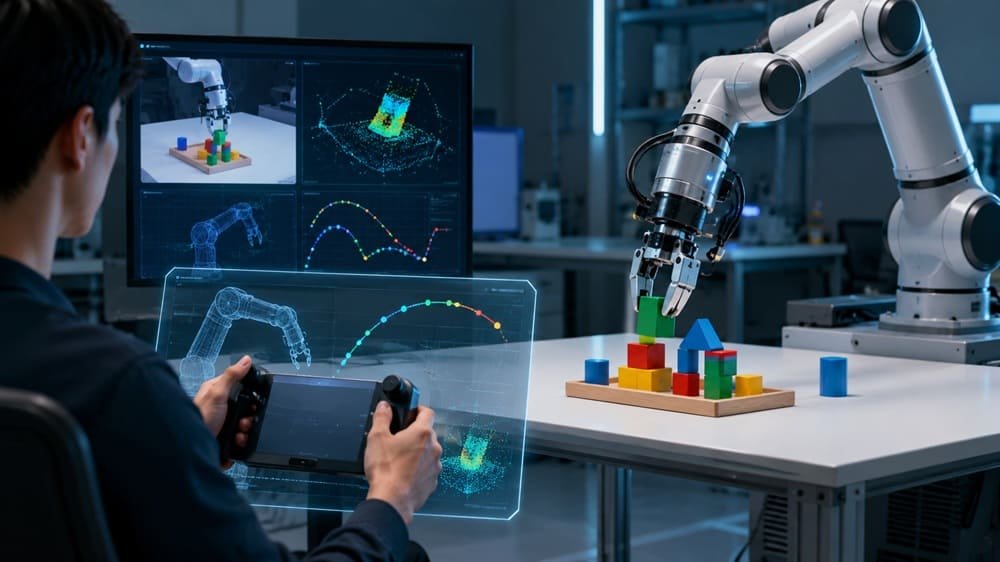
Teleoperation data collection is the process of recording a robot’s proprioceptive states, actions, and camera observations while a human operator remotely controls the robot through a task, producing time-aligned demonstration episodes used to train imitation learning policies. Each episode is a synchronized log: joint positions and velocities, commanded actions, gripper state, and multiple camera streams, typically stored in HDF5 or the LeRobot dataset format (github.com/huggingface/lerobot).
The entity chain matters for anyone mapping this space. Teleoperation produces demonstrations. Demonstrations feed imitation learning algorithms such as ACT (Action Chunking with Transformers, arxiv.org/abs/2304.13705) and Diffusion Policy (arxiv.org/abs/2303.04137). Those policies, scaled across tasks and embodiments, become the training substrate for vision-language-action (VLA) models. Open X-Embodiment aggregated over one million trajectories across 22 robot embodiments largely from teleoperated sources (arxiv.org/abs/2310.08864). No teleop data, no VLA.
A useful mental model: a teleop episode is worth exactly as much as its worst-synchronized stream. A 50 Hz action log paired with a camera that drifted 80 ms out of alignment teaches the policy that objects move before the hand does. That single failure mode wastes more training budget than any other we see.
Core Concepts and Data Modalities
A teleoperation dataset is defined by four things: the action space, the observation streams, the control and capture rates, and the episode structure. Get these right before collecting a single demo, because retrofitting a format after 10,000 episodes is miserable.
Action Space and Leader-Follower Mapping
Leader-follower joint mapping is the control scheme in which a human moves a small “leader” arm and a “follower” robot arm mirrors those joint positions in real time. ALOHA uses this directly: two WidowX-class leader arms drive two ViperX 300 followers, joint to joint, which gives operators immediate kinesthetic intuition and avoids inverse kinematics singularities (arxiv.org/abs/2304.13705). GELLO takes the same idea and rebuilds the leader from hobby-grade Dynamixel servos and printed parts for roughly $300 per arm (arxiv.org/abs/2309.13037). VR and SpaceMouse rigs instead command end-effector poses and rely on an IK solver, which is cheaper but introduces its own artifacts near joint limits.
Observation Streams: Mono, Stereo, Wrist, and Overhead
Observation streams are the camera and sensor feeds recorded alongside actions, and their placement determines what the policy can actually learn. The standard manipulation setup is one or two exocentric (scene) cameras plus one wrist camera per arm. Stereo pairs or depth add geometric grounding for tasks with occlusion. Our default rig records three RGB streams at 640×480, 30 fps, plus joint states at the control rate. Egocentric head cameras matter for humanoid teleop, where systems like Open-TeleVision stream an actively controlled head view into the operator’s headset (arxiv.org/abs/2407.01512).
Control Rate vs Camera Rate: The 50 Hz / 30 fps Problem
The rate mismatch problem is the timing gap created when actions are logged at 50 Hz but cameras capture at 30 fps, leaving no camera frame for two out of every five action steps. ACT-style pipelines handle this by training on the nearest or interpolated frame and predicting action chunks (sequences of 50 to 100 future actions) rather than single steps, which smooths over per-step jitter. What the algorithm cannot fix is unsynchronized clocks. Hardware-timestamp every stream at the source, log in one process or use a shared monotonic clock, and record the offsets. In our QA pipeline, any episode with inter-stream skew above 33 ms (one camera frame) is auto-flagged, and it is the single most common rejection reason on new rigs.
Episode Structure and Task Definition
An episode is one complete attempt at a defined task, from a randomized initial state to a labeled terminal state. Discipline here is what makes a dataset trainable: written task cards, explicit reset procedures, randomized object poses within a marked region, and a per-episode success label assigned at collection time. Datasets that skip initial-state randomization produce policies that memorize a table layout instead of learning a skill.
The Five Rig Approaches Compared
Rig choice is the decision that fixes your cost floor, your data quality ceiling, and which tasks you can collect at all. There is no universal winner; there is a right answer per task family and budget.
| Approach | Example system | Hardware cost | Control fidelity | Operator ramp | Best for | Weakness |
|---|---|---|---|---|---|---|
| Bimanual leader-follower | ALOHA (Stanford) | ~$20k; Mobile ALOHA ~$32k with base | Joint-level, 50 Hz, kinesthetic | Fast (days) | Fine bimanual manipulation | Cost per station; fixed embodiment |
| Low-cost kinematic leader | GELLO | ~$300 per leader arm + robot | Joint-level, high | Fast | Scaling stations cheaply on arms you own | Build/maintenance effort; per-robot tuning |
| VR headset + controllers | Quest 3 rigs; Open-TeleVision style | $500 to $3,500 + robot | Pose-level via IK, medium-high | Medium (1 to 2 weeks) | Humanoids, mobile manipulation, immersive tasks | IK artifacts, some operator fatigue/sim sickness |
| 6-DoF desktop device | 3Dconnexion SpaceMouse | $150 to $450 + robot | Pose-level, low-medium | Slow for contact-rich work | Simple pick-place, lab prototyping | Slow, unintuitive for dexterous or bimanual tasks |
| Robot-free handheld | UMI gripper | Under $1,500 per device | Demonstrations without a robot | Fast | In-the-wild diversity, pre-robot data | Embodiment gap; SLAM-dependent pose quality |
Three field notes that the spec sheets miss. First, DROID, one of the largest open manipulation datasets (76,000 episodes, 350 hours, 564 scenes), was collected with a Meta Quest 2 controller driving a Franka arm, proof that consumer VR hardware scales to serious datasets (arxiv.org/abs/2403.12945). Second, GELLO is the highest-throughput-per-dollar option if you already own the follower arms, but plan for a part-time technician; printed leaders drift and servos strip. Third, UMI (arxiv.org/abs/2402.10329) is the only approach that collects before your robot ships, which makes it a strong hedge for teams still finalizing hardware.
For a deeper head-to-head, see our companion piece on comparing teleoperation approaches.
Economics: What Teleoperation Data Actually Costs
The true cost of teleoperation data is operator hours multiplied by an all-in rate, divided by usable episode yield, and most budgets get all three numbers wrong. Hardware is the smaller line item; a $20k ALOHA station running two shifts amortizes to under $3 per collection hour over a year. Labor and QA dominate.
Our first-hand benchmarks, consistent across programs we run:
| Cost and throughput factor | Typical range (our benchmarks) |
|---|---|
| All-in operator cost (wages, supervision, facility, hardware amortization) | $28 to $60 per teleop hour |
| Novice operator throughput (weeks 1 to 2) | 8 to 12 usable episodes per hour |
| Trained operator throughput (week 3 onward) | 25 to 40 usable episodes per hour |
| QA rejection rate (mature pipeline) | 10 to 15 percent |
| QA rejection rate (new task or new rig, first 2 weeks) | 20 to 30 percent |
| Effective cost per usable episode | roughly $0.90 to $6.00 depending on task complexity |
Two implications fall out of that table. The operator ramp curve is a 3x throughput difference, so operator retention is a data-cost lever bigger than any hardware decision; churn resets you to novice yield. And QA rejection compounds against you: a 10,000-episode target with 25 percent rejection means collecting 13,300, not 10,000. We cover the bottleneck math in detail in why teleoperation data is the bottleneck in physical AI.
ROI framing for buyers: at $40 per hour all-in and 30 usable episodes per hour, a 50,000-episode dataset costs about $67k in collection labor before QA overhead. Compare that against three to six months of two ML engineers building and debugging an in-house collection operation, and outsourced collection frequently wins on time even when it ties on cost.
From Demonstrations to Policy: The Imitation Learning Pipeline
The imitation learning pipeline is the sequence that converts teleoperated demonstrations into an evaluated robot policy: collect episodes, convert to a training format, train ACT or a diffusion policy, then measure real-world success rate. The pipeline is short; the feedback loop is what teams underuse.
- Collect and QA. Episodes stream into storage with per-episode metadata (task, operator, rig, success label). QA gates on sync skew, dropped frames, trajectory smoothness, and task success.
- Convert. HDF5 or ROS 2 bags convert to LeRobot format for training and sharing on Hugging Face.
- Train. ACT with action chunking (predicting ~100-step action sequences at 50 Hz) or Diffusion Policy for multimodal action distributions.
- Evaluate. Fixed evaluation protocol: N rollouts per task with randomized initial states, report success rate.
- Loop. Failure modes from evaluation define next week’s collection priorities.
The proof point worth anchoring on: the original ACT work reached 80 to 90 percent success on fine bimanual tasks such as cable routing and battery insertion from only 50 demonstrations per task (arxiv.org/abs/2304.13705). Demonstration quality and consistency, not raw volume, set that outcome. We have watched 400 sloppy episodes lose to 120 clean ones on the same task, same architecture. Collect less, reject more, retrain sooner.
Case Study Proof: Scaling a VLA Data Program
A humanoid foundation model team came to us needing 12,000 QA-passed bimanual episodes across 40 household tasks in ten weeks, after their in-house effort had produced 1,900 episodes in eight weeks with a 34 percent rejection rate. We stood up six leader-follower stations, ran a two-week operator certification program, and enforced automated sync and smoothness gates at ingest. By week four the floor was producing 1,400 usable episodes per week; the program closed at 12,600 QA-passed episodes with a 12 percent final rejection rate, and the team’s ACT baseline improved from 41 to 68 percent average task success on their internal eval. The full breakdown, including what failed in weeks one and two, is in the VLA case study.
Standing Up a Collection Program: The First 30 Days
A collection program launch is a 30-day sequence of hardware bring-up, protocol authoring, operator certification, and QA gate activation, in that order. Teams that compress or reorder it pay the cost back with interest in weeks five through eight. Our standard sequence:
Days 1 to 7: rigs and clocks. Assemble stations, calibrate cameras (record intrinsics and extrinsics per rig, per calibration), and prove time sync before anyone collects a demonstration. Log a physical sync event (a clapboard works) and verify every stream lands within one camera frame. A day spent here saves a re-collection later; skew discovered after 5,000 episodes is not fixable in post.
Days 8 to 14: protocol. Write task cards for the first five tasks: success criteria, reset procedure, randomization zones marked physically on the workspace, and expected episode duration. Pilot each card yourself before an operator touches it. Every ambiguity you leave in a task card becomes a labeling inconsistency in the dataset.
Days 15 to 28: certification. Run operators through reference tasks with a throughput bar (we use 20 usable episodes per hour) and a quality bar (QA pass rate above 80 percent) before production collection begins. Expect the standard ramp: 8 to 12 usable episodes per hour early, 25 to 40 after two to three weeks.
Day 30: gates on. Nightly automated QA becomes mandatory, with per-operator, per-rig reports every morning. From this point, the program self-corrects.
Build vs Buy: The Honest Decision Criteria
The build-versus-buy question comes down to whether demonstration collection is a competency your team needs to own or a supply problem it needs solved. Building makes sense in three cases: your embodiment is unusual enough that no vendor has matching rigs, your data requirements are small (under roughly 5,000 episodes), or collection know-how is itself part of your product thesis. Buying makes sense when the deadline is the constraint. The math from the economics section applies either way, but in-house programs carry two costs that rarely appear in the comparison spreadsheet: the two to four engineer-months of pipeline and QA tooling before the first reliable episode, and the management overhead of running an operations floor inside an ML organization. We are a vendor, so discount our view accordingly; then ask any team that has run both models which cost they underestimated.
Free Resource: Teleoperation Data RFP Scorecard
A vendor RFP scorecard is a weighted rubric for comparing teleoperation data providers on the criteria that actually predict dataset quality. Ours scores ten dimensions, including sync guarantees, QA rejection transparency, operator training programs, format deliverables, and per-episode pricing disclosure. Most vendors will not publish cost per hour; make them fill in the sheet. [Download the RFP scorecard (XLSX)] and use it on us too.
Related reading: 5 hidden challenges in teleoperation data collection.
Next Step
If you are scoping a demonstration data program, two options. Download 10 free teleoperation episodes (HDF5 plus synchronized MP4, three camera views, 50 Hz actions) and run them through your training stack. Or book a 30-minute scoping call with our data operations team and leave with a per-episode cost estimate for your task list. [Download Sample Data] | [Book a Demo]
Frequently Asked Questions
What is teleoperation data collection?
Teleoperation data collection is the recording of synchronized robot actions, joint states, and camera observations while a human operator remotely controls the robot through a task. The resulting episodes train imitation learning policies such as ACT and diffusion policies, which underpin VLA models.
How much does teleoperation data collection cost?
Our all-in benchmark is $28 to $60 per operator hour, covering wages, supervision, facility, and hardware amortization. With trained operators producing 25 to 40 usable episodes per hour, effective cost lands between roughly $0.90 and $6.00 per usable episode depending on task complexity.
How many demonstrations do I need to train a policy?
Fewer than most teams assume, if quality is high. The original ALOHA/ACT results reached 80 to 90 percent success on fine bimanual tasks with about 50 demonstrations per task. Multi-task and VLA training raises the requirement into the thousands per skill family, which is where collection economics start to dominate.
What is the best rig for teleoperation data collection?
It depends on the task family and budget, per the comparison table above. Fine bimanual manipulation favors leader-follower rigs (ALOHA at ~$20k, or GELLO leaders at ~$300 per arm on robots you own). Humanoid and mobile tasks favor VR teleop. Robot-free UMI capture wins when hardware has not shipped yet.
Why do teleoperation datasets get rejected in QA?
The main causes are inter-stream time skew above one camera frame, dropped frames, jerky or hesitant trajectories, failed task completions, and reset protocol violations. Expect 20 to 30 percent rejection in the first two weeks on a new task and 10 to 15 percent once the pipeline matures.
Can I collect demonstration data without a robot?
Yes. UMI-style handheld grippers record demonstrations with a wrist-mounted camera and SLAM-derived poses, no robot required. The trade-off is an embodiment gap when transferring to your platform, so most teams use it to supplement, not replace, on-robot teleop.
What format should teleoperation data be stored in?
HDF5 per episode and the LeRobot dataset format are the current de facto standards; ROS 2 bags are common at capture time. Whatever the container, require hardware timestamps on every stream and per-episode metadata (task, operator ID, rig ID, success label).

Sainath Gupta
Sainath Gupta is the visionary leader of DexSet, a company dedicated to building the foundational data layer for the robotics revolution. Sainath recognized early on that the primary bottleneck for physical AI wasn't hardware or model architecture, but the lack of high-quality, scalable training data.
At DexSet, he has pioneered a "manufacturing-first" approach to data collection. This includes the development of transparent cost-per-hour benchmarks and the scaling of global networks for egocentric and teleoperation capture. Sainath is a vocal advocate for the industry’s shift toward treating human experience as the primary pretraining substrate for robots. His leadership at DexSet is focused on one goal: providing the millions of hours of high-fidelity data required to bring humanoid robots out of the lab and into the real world.