
5 Hidden Challenges in Training Data for Vision-Language-Action (VLA) Models and How to Solve Them
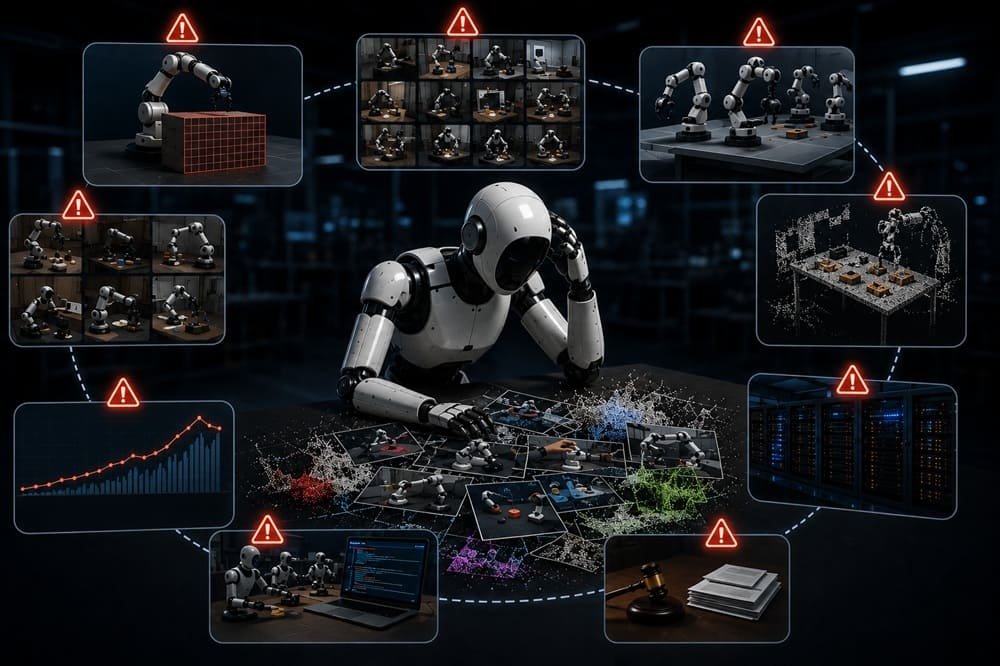
Spot-checking your robot dataset is making things worse. Not the data, your judgment of it: per-episode visual review manufactures confidence, while the defects that actually sink VLA fine-tunes live at the distribution level, where no individual episode looks wrong. That is the thesis of this post, and its practical consequence: the unit of QA for VLA data is the batch and the corpus, not the episode.
The obvious VLA training data quality problems get solved early because they are loud. Not enough episodes, missing camera streams, no language labels: these announce themselves in week one. The problems that actually sink fine-tunes are quiet. They pass a visual spot-check, survive ingestion without errors, and only surface weeks later as a loss curve that plateaus early or a policy that fumbles tasks it should own.
These failures stay hidden for a structural reason. A robot dataset has no compiler. Nothing throws an exception when your timestamps drift 40 ms or when 92% of your instructions share one sentence shape. The data trains. The model just trains worse, and the gap gets attributed to architecture, hyperparameters, or “needing more data,” which leads teams to buy more of the same defective distribution.
We gate every dataset that leaves DexSet through a QA pipeline built around these exact failure modes, so this post is written from the reject pile. For each of the five challenges: what it is, how it hides, how it damages training, and the check that catches it. All five checks are runnable before you spend a single GPU-hour.
Key Takeaways – The five quiet VLA training data quality failures: frame-action timestamp skew, instruction monoculture, silent failure episodes, embodiment/config drift, and mixture starvation. – Each one passes casual inspection and each one measurably degrades fine-tunes; contamination rates as low as 5-10% flatten gains on precision tasks in our ablations. – Every one has a cheap automated check; together they cost $5-9 per data-hour in our pipeline, a fraction of the GPU spend they protect. – Diversity metrics belong in acceptance criteria, not in hopes: template share, verb counts, and per-task hour caps should be contractual.
Challenge 1: Frame-Action Timestamp Skew
Timestamp skew is a systematic offset or drift between when a camera frame was captured and when the recorded action actually executed. Software timestamps on separate device clocks drift, USB cameras buffer unpredictably, and a rig that was aligned in January is often 30-50 ms off by March.
Why it hides: video looks fine, actions replay fine, and nothing is corrupt. Why it hurts: modern VLAs predict action chunks, and continuous-action heads (diffusion in Octo, arxiv.org/abs/2405.12213; flow matching in pi-zero, arxiv.org/abs/2410.24164) regress targets whose alignment with observations is the whole training signal. Skew smears that mapping. In our fine-tune ablations, loss curves separate measurably once skew passes about 10 ms, which is where we set our rig tolerance.
The fix: hardware timestamping where possible, a physical sync event at episode start (a visible gripper snap works), and an automated cross-correlation check between commanded motion and observed motion per episode. Reject on drift, do not average it away.
Challenge 2: Instruction Monoculture
Instruction monoculture is a label distribution where most episodes share a handful of sentence templates, regardless of how many total instructions exist. A 100,000-episode corpus with 14 templates is monoculture at scale; we audited exactly that situation in a recent humanoid client engagement.
Why it hides: ataset cards report episode counts, not instruction diversity – the metric that actually predicts language generalization. Why it hurts: the model learns the templates as fixed keys rather than learning language. RT-1-era templated labels produced policies with a vocabulary of about a dozen verbs (arxiv.org/abs/2212.06817); the semantic breadth in RT-2 came from web co-training, not from the robot labels (arxiv.org/abs/2307.15818). If your labels are monoculture, paraphrase failure is guaranteed.
The fix: measure template share, unique verbs, and spatial-relation coverage per batch, and set hard thresholds. We cap any single template at 8% of a batch and run paraphrase augmentation on failures. Priced honestly, a proper natural-language annotation pass adds $8-15 per data-hour. It is the least skippable line in the budget.
Challenge 3: Silent Failure Episodes
A silent failure episode is a demonstration where the task did not actually succeed – the most damaging robot dataset QA gap in teleoperation-based collection but the episode carries no failure label, so it trains the policy on a wrong outcome presented as a right one. teleoperators drop objects, miss insertions by a few millimeters, or complete the wrong variant – which is why teleoperation data collection requires explicit success criteria baked into the session protocol of an ambiguous task, and at collection pace nobody logs it.
Why it hides: failures look like successes at thumbnail resolution, and per-episode review feels too expensive so teams sample 2% and hope. Why it hurts: imitation learning has no mechanism to discount bad demonstrations; a 5-10% contamination rate is enough to visibly flatten fine-tune gains on precision tasks in our ablations.
The fix: explicit success criteria written per task family before collection, a success label as a required field, and dual review on a stratified sample weighted toward long-horizon and precision tasks. This is most of what our $5-9 per data-hour teleoperation data quality review buys.
Challenge 4: Embodiment and Configuration Drift
Configuration drift is unannounced variation in the physical setup across a collection: cameras nudged between sessions, gripper fingers swapped after wear, firmware updates that change controller latency, tables raised two centimeters. Each change is small. Accumulated, your “single embodiment” corpus is quietly five embodiments.
Why it hides: no single episode is wrong, so episode-level QA passes everything. Why it hurts: the policy either averages across configurations it cannot distinguish or keys on incidental visual cues to tell them apart. Cross-embodiment training works when variation is labeled, which is exactly how Open X-Embodiment makes 22 embodiments useful (arxiv.org/abs/2310.08864); unlabeled variation is just noise.
The fix: a per-session calibration ritual (camera extrinsics check, gripper state, controller version logged into episode metadata) and drift detection that compares session-level statistics. Metadata is free at collection time and unrecoverable afterward.
Challenge 5: Mixture Starvation
Mixture starvation is a training mixture where one data source or task family dominates sampling, starving the components that were the reason you built the mixture. It happens by accident: datasets differ in episode length, so uniform episode sampling silently overweights short-episode sources.
Why it hides: the mixture config looks balanced on paper while the effective batch composition is not. Why it hurts: OpenVLA and Octo both hand-tuned per-dataset mixture weights rather than sampling naively, and OpenVLA’s curated 970k-episode mixture is a large part of how a 7B model beat a 55B one (arxiv.org/abs/2406.09246). Teams that skip mixture sampling accounting also routinely drop web co-training too low and watch open-vocabulary grounding decay.
The fix: account mixtures in timesteps or tokens, not episodes; log effective composition per training run; cap per-task-family hours at collection time so the raw corpus starts balanced (we use a 60-hour cap per family in typical fine-tuning collections).
A note on why these five cluster together: they are all distribution problems rather than instance problems. Any single episode can pass inspection while the corpus as a whole is defective, which is why per-episode spot checks feel reassuring and prove nothing. The unit of QA for VLA data is the batch and the corpus. Once a team internalizes that, the checks below stop looking like overhead and start looking like the cheapest model improvement available.
How Do You Check VLA Training Data Quality? (5 Checks)
| Challenge | Cheap Detection Check | Threshold We Use |
|---|---|---|
| Timestamp skew | Command-vs-observed motion cross-correlation per episode | Reject > 10 ms |
| Instruction monoculture | Template share + unique-verb count per 1,000-episode batch | No template > 8% |
| Silent failures | Success criteria + stratified dual review | 5% dual-review floor |
| Configuration drift | Session metadata + session-statistics comparison | Any unlogged change fails |
| Mixture starvation | Timestep-level composition logging per run | Match declared weights ±5% |
Run these against any dataset, ours included, before training on it. The full framework, including costs and the vendor RFP scorecard these checks feed into, is in the complete guide to VLA training data.
Next Step
download our free LeRobot-format sample pack and run these five checks against it yourself; the QA report ships alongside the episodes. Or start with the complete VLA training data guide.
Frequently Asked Questions
What are the most common quality problems in VLA training data?
The quiet ones: frame-action timestamp skew, instruction template monoculture, unlabeled failure episodes, unlogged configuration drift, and unbalanced training mixtures. All five pass casual inspection and all five measurably degrade fine-tunes.
How much timestamp error is acceptable in robot demonstration data?
For continuous-action models we hold frame-to-action skew under 10 ms, because our fine-tune ablations show measurable degradation beyond that. Discrete-token models tolerate more, but skew is cheap to control at capture time and expensive to fix later.
How do I check a robot dataset for label quality before training?
Measure instruction template share and unique-verb counts per batch, verify success labels on a stratified dual-reviewed sample, and cross-correlate commanded against observed motion for sync. All three checks run in hours on commodity hardware.
Why does my VLA fine-tune plateau even with more data?
Usually because the new data repeats the old distribution: same tasks, same templates, same scene. Past roughly 50-150 demonstrations per task, marginal episodes add little; audit diversity before adding volume. This is the most common symptom of undetected VLA training data quality problems in the distribution.

Sainath Gupta
Sainath Gupta is the visionary leader of DexSet, a company dedicated to building the foundational data layer for the robotics revolution. Sainath recognized early on that the primary bottleneck for physical AI wasn't hardware or model architecture, but the lack of high-quality, scalable training data.
At DexSet, he has pioneered a "manufacturing-first" approach to data collection. This includes the development of transparent cost-per-hour benchmarks and the scaling of global networks for egocentric and teleoperation capture. Sainath is a vocal advocate for the industry’s shift toward treating human experience as the primary pretraining substrate for robots. His leadership at DexSet is focused on one goal: providing the millions of hours of high-fidelity data required to bring humanoid robots out of the lab and into the real world.