
The Complete Guide to Training Data for Vision-Language-Action (VLA) Models (2026)
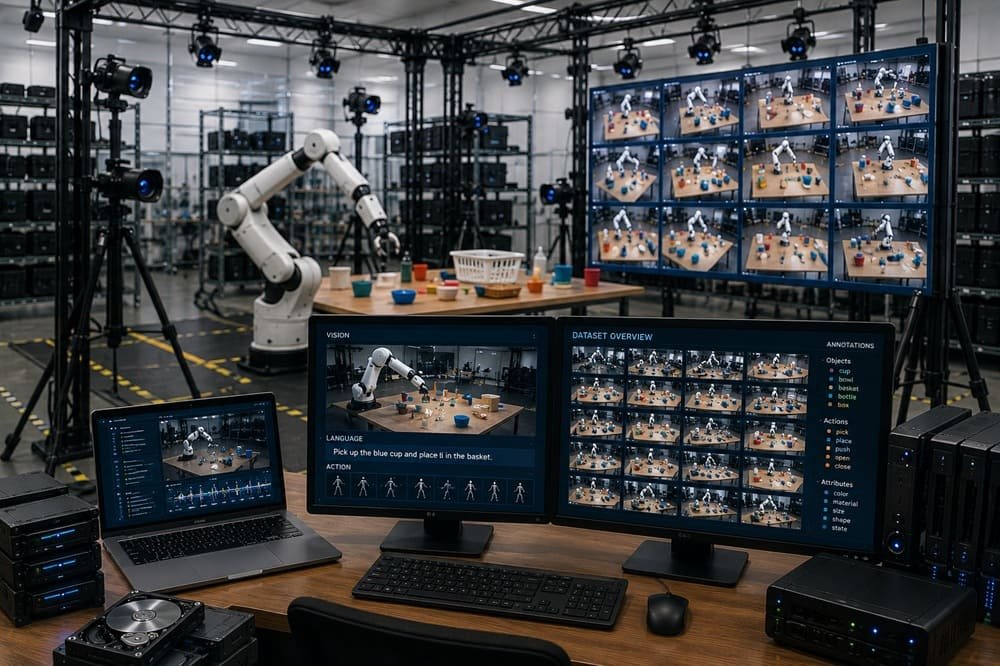
Five billion image-text pairs sit in LAION-5B (arxiv.org/abs/2210.08402); just over one million robot trajectories sit in Open X-Embodiment, the largest open robot dataset ever assembled (arxiv.org/abs/2310.08864). Those two numbers should not both describe the training diet of a single model family, yet every production VLA pairs a vision-language half fed at web scale with an action half starved at roughly one-thousandth of it. That mismatch, more than any architecture choice, is the defining constraint of physical AI in 2026.
The gap exists because the two halves come from different worlds. The vision-language half was pretrained on image-text pairs that already existed. The action half needs robot trajectories that do not exist until someone physically collects them, frame-synchronized, action-labeled, and paired with language instructions. You cannot scrape your way out of that. Which is why, on most VLA programs, the architecture question gets settled in a week and the compute budget in a month, while the question of how many language-annotated trajectories the model needs, at what task diversity, on which embodiments, goes unanswered the longest.
This guide gives you the full picture: what VLA training data is, how the landmark models (RT-1, RT-2, OpenVLA, Octo, pi-zero, GR00T) actually sourced their data, how action representation changes your labeling requirements, what collection and annotation cost per hour, and how to scope a dataset that transfers to your embodiment instead of overfitting to someone else’s lab. The thesis we argue throughout, and the one our delivery data keeps confirming: once you stand on the open-data base layer, dataset composition (task diversity, instruction diversity, capture fidelity) predicts VLA capability better than episode count, so budget should follow distribution, not volume.
DexSet supplies egocentric, exocentric, teleoperation, mono, and stereo data to robot foundation model teams. The numbers in this guide come from our own rigs, QA pipelines, and cost benchmarks, alongside the primary papers. Where a figure is our internal benchmark rather than a published result, we say so.
TL;DR: Key Takeaways – VLA training data consists of robot trajectories (synchronized camera frames + robot actions) paired with natural-language instructions, usually collected via teleoperation. – Landmark scale points: RT-1 used ~130k episodes over 17 months; OpenVLA pretrained on ~970k episodes from Open X-Embodiment; pi-zero reports on the order of 10,000 hours of dexterous robot data. – Action representation drives labeling spec: discrete action tokens (RT-2, OpenVLA) tolerate lower control rates; continuous-action heads (pi-zero flow matching, Octo diffusion) reward 50 Hz, low-jitter capture. – In our benchmarks, teleoperation collection runs $28-60 per robot-hour depending on rig and task complexity; a proper language annotation pass adds $8-15 per hour of data. – Data mixture beats raw volume: co-training on web-scale vision-language data plus a well-balanced robot mixture is what gives VLAs semantic generalization. – Task and scene diversity predict generalization better than episode count once you pass a per-task floor (roughly 50-150 demonstrations per task in the imitation-learning literature).
What Is Training Data for Vision-Language-Action (VLA) Models?
Training data for VLA models is a corpus of robot demonstration episodes in which each timestep pairs visual observations, robot proprioceptive state, and executed actions, and each episode (or segment) carries a natural-language instruction describing the task. A VLA model consumes images and an instruction as input and produces robot actions as output, so its training data must contain all three aligned in time.
A single well-formed episode contains:
- Observations. One or more camera streams (wrist-mounted, over-the-shoulder exocentric, or head-mounted egocentric), typically 224×224 to 1080p RGB at 10-60 fps, optionally stereo pairs or depth.
- Proprioception. Joint positions, gripper state, end-effector pose, usually at the control rate.
- Actions. The command stream that produced the motion: delta end-effector poses, joint targets, or gripper commands, timestamped against frames.
- Language. An instruction such as “put the red mug on the top shelf,” attached at episode level, and increasingly at sub-episode segment level for long-horizon tasks.
The entity chain matters for anyone mapping this space: teleoperation rigs (ALOHA-style leader-follower arms, VR controllers, exoskeletons) produce demonstrations; demonstrations feed imitation learning; imitation learning at scale, on top of a pretrained vision-language backbone, is what turns a VLM into a VLA. The Hugging Face LeRobot project has become the de facto open format for storing these episodes, and its dataset cards are a good reference for what a clean schema looks like.
How the Landmark VLA Models Sourced Their Data
Every major VLA result is downstream of a specific, documented data strategy, and the strategies differ more than the architectures do. Reading the data sections of these papers teaches you more about building a VLA than reading the model sections.
| Model (Year) | Org | Params | Robot Data | Language Source | Action Representation |
|---|---|---|---|---|---|
| RT-1 (2022) | 35M | ~130k episodes, 13 robots, 17 months, ~700 tasks | Templated instructions | Discrete tokens, 256 bins (arxiv.org/abs/2212.06817) | |
| RT-2 (2023) | Google DeepMind | 12B / 55B | RT-1 data, co-fine-tuned with web-scale VLM data | Templated + web text | Actions as text tokens (arxiv.org/abs/2307.15818) |
| Octo (2024) | UC Berkeley et al. | 27M / 93M | 800k trajectories from Open X-Embodiment | Mixed, dataset-dependent | Diffusion head, continuous (arxiv.org/abs/2405.12213) |
| OpenVLA (2024) | Stanford et al. | 7B | 970k episodes from Open X-Embodiment | Mixed OXE instructions | Discrete tokens (arxiv.org/abs/2406.09246) |
| pi-zero (2024) | Physical Intelligence | ~3B | On the order of 10k hours, 7 platforms, 68 task families | Natural + segment-level relabeling | Flow matching, 50 Hz continuous (arxiv.org/abs/2410.24164) |
| GR00T N1 (2025) | NVIDIA | 2B | Data pyramid: web video + synthetic + real robot data | Mixed human + generated | Continuous, diffusion-based (arxiv.org/abs/2503.14734) |
Three lessons sit in that table. First, scale climbed from 130k episodes to roughly a million in two years, but the biggest capability jumps (RT-2 over RT-1, pi-zero over Octo-class models) came from mixture changes, not just volume. Second, OpenVLA at 7B outperformed the 55B RT-2-X on the paper’s 29-task evaluation suite, which tells you curated cross-embodiment data can substitute for an order of magnitude of parameters. Third, nobody serious trains on robot data alone anymore; co-training against web-scale vision-language corpora is standard because it is what keeps semantic knowledge (what “the leftmost ripe banana” means) alive while the model learns motor control.
Core Data Modalities for VLA Training
Modality choice determines what your VLA can learn and what your collection rig must capture. The main axes are viewpoint (egocentric vs exocentric), depth strategy (mono vs stereo), and collection method (teleoperation vs human video).
Egocentric vs Exocentric Views
Egocentric data is captured from the robot’s or demonstrator’s own viewpoint; exocentric data is captured from external cameras watching the workspace. Wrist and head cameras give the policy view-invariant, occlusion-realistic inputs and tend to transfer better across scene layouts. Exocentric views give annotators and QA reviewers the context to verify task success and label segments. In our pipelines we treat exocentric streams as partly a QA instrument: an episode with only a wrist view is roughly twice as expensive to verify because reviewers must scrub proprioception logs to confirm success.
Mono vs Stereo
Mono capture records a single RGB stream per viewpoint; stereo capture records calibrated pairs that support depth estimation. Most published VLAs train on mono RGB because the backbone VLMs are mono. Stereo earns its extra cost on contact-rich and clutter-heavy manipulation, where depth ambiguity is a dominant failure mode. Our rule of thumb: mono for pretraining breadth, stereo for the fine-tuning set on your target tasks.
Teleoperation vs Human Video
Teleoperation produces the gold standard because the action stream is the robot’s own. Leader-follower rigs like ALOHA (arxiv.org/abs/2304.13705) hit high dexterity at a hardware cost around $20k per station; VR-based rigs are cheaper and faster to train operators on but add pose-retargeting noise. Human egocentric video (Ego4D, EgoExo4D scale) has no action labels, so it enters VLA training as a co-training or pretraining signal, the approach GR00T N1 formalizes as a data pyramid. Human video buys you visual and behavioral priors cheaply; it never replaces the teleop layer where actions live.
Action Representation: Tokenization vs Continuous Actions
Action representation is the choice of how robot actions are encoded for the model to predict, and it silently rewrites your data spec. There are two dominant families.
Discrete action tokenization (RT-1, RT-2, OpenVLA) bins each action dimension, typically into 256 buckets, and treats action prediction as next-token prediction. It plugs directly into a language-model backbone and tolerates modest control rates. The FAST tokenizer (arxiv.org/abs/2501.09747) pushed this further with a compression-based scheme that makes autoregressive VLAs viable on high-frequency data.
Continuous action heads (Octo’s diffusion head, pi-zero’s flow matching) regress action chunks directly. They excel at dexterous, high-rate control (pi-zero runs 50 Hz) but they punish sloppy capture. Timestamp jitter between frames and actions that a tokenized model shrugs off will smear a flow-matching target distribution.
What this means for data buyers, from our QA logs:
- For tokenized targets, 10-15 Hz aligned capture is usually sufficient; invest the savings in task diversity.
- For continuous heads, capture at 30-60 Hz with hardware-timestamped sync; we hold frame-to-action skew under 10 ms on our teleop rigs because beyond that we can measure it in fine-tune loss.
- Action-chunk prediction (introduced with ACT on ALOHA) means episodes must be free of teleoperator pauses mid-chunk, which is a QA check most teams add only after their first bad fine-tune.
Language Annotation: The Layer Everyone Underestimates
Language annotation is the process of attaching instructions to robot episodes, and it is where VLA datasets most often quietly fail. A VLA is only as language-conditioned as its labels are diverse.
Templated vs natural instructions. RT-1-era datasets used templates (“pick X”, “move X near Y”). Templates are cheap and consistent, and they teach the model a grammar of about a dozen verbs. Models trained on templated instructions follow paraphrases poorly; the semantic generalization RT-2 demonstrated came from the web co-training, not the robot labels. Current practice, visible in the pi-zero and DROID (arxiv.org/abs/2403.12945) pipelines, is natural free-form instructions plus paraphrase augmentation.
Episode-level vs segment-level labeling. Episode-level labeling attaches one instruction to a whole demonstration. Segment-level labeling breaks a long-horizon episode into sub-tasks (“open the drawer”, “place the spoon inside”, “close the drawer”) with aligned timestamps. Segment labels cost more but unlock long-horizon training and better credit assignment. In our pipeline, segment-level labeling costs roughly 2.5x the episode-level pass because annotators must scrub video and mark boundaries, not just watch and describe.
Our first-hand benchmark: a language annotation pass adds $8-15 per hour of robot data depending on instruction density and whether we run single or dual annotation. We also run an instruction diversity QA gate: across any 1,000-episode batch we require minimum thresholds for unique verbs, unique object references, and spatial-relation phrases, because we have watched fine-tunes on label-poor batches lose the ability to follow anything but the majority phrasing.
Data Mixtures, Co-Training, and Cross-Embodiment Transfer
A data mixture is the weighted combination of datasets a VLA trains on, and mixture design is now a first-class engineering discipline. Three decisions dominate.
Web co-training ratio. RT-2 established that co-fine-tuning on web vision-language data alongside robot data preserves semantic breadth. Teams that fine-tune on robot data alone consistently report the model “forgetting” open-vocabulary grounding.
Cross-embodiment weighting. Open X-Embodiment showed that pooling data across 22 robot types improves average success, and OpenVLA and Octo both hand-tuned per-dataset mixture weights rather than sampling uniformly. Transfer across embodiments is real but not free: it appears strongest between similar morphologies (single-arm manipulators with parallel grippers) and weakest into dexterous hands and humanoids, which is exactly why humanoid programs still commission embodiment-matched collection.
There is no published universal mixture ratio, and be suspicious of anyone who quotes one. What the papers do agree on is the shape of the curve: heavily downweight any single dataset that would dominate by timestep count, keep a meaningful web co-training fraction throughout fine-tuning rather than dropping it to zero, and upweight the small datasets that match your target embodiment and camera geometry. In practice we see teams land between 10% and 40% embodiment-matched data by timestep in their final fine-tuning mixtures, with the exact point set by held-out evaluation rather than by principle. Measure mixtures in timesteps or tokens, not episodes; episode lengths vary enough between sources that episode-level accounting quietly misstates composition by 2-3x.
Diversity vs depth. Once a task passes a demonstration floor (Mobile ALOHA showed strong results co-training with as few as 50 demonstrations per task on top of a broad base, arxiv.org/abs/2401.02117), the marginal episode of task 12 is worth less than the first episode of task 13. When we rebalance client collections, we usually shift budget from episode count toward scene, object, and instruction diversity, and the downstream evaluations reward it.
Cost and Economics: What VLA Training Data Actually Costs
VLA data cost is driven by four stacked line items: rig amortization, operator time, annotation, and QA. Vendors who quote a single opaque per-episode price are hiding this stack. Here is ours, from DexSet production benchmarks (round figures, typical ranges we see):
| Cost Component | Typical Range | Notes |
|---|---|---|
| Teleop collection (VR rig, tabletop tasks) | $28-38 per robot-hour | Includes operator, station amortization, resets |
| Teleop collection (leader-follower, bimanual/contact-rich) | $40-60 per robot-hour | ALOHA-class rigs, slower resets, higher operator skill |
| Language annotation, episode-level | $8-10 per data-hour | Natural instructions, single pass |
| Language annotation, segment-level + paraphrases | $12-15 per data-hour | Timestamped sub-task boundaries, dual pass on 10% |
| QA and success verification | $5-9 per data-hour | Success labels, sync checks, instruction diversity gate |
| Useful episodes per collection hour | 20-40 tabletop; 8-15 long-horizon | After discarding failed/aborted episodes |
Worked example: a 2,000-hour bimanual manipulation corpus with segment-level language and full QA lands between $114k and $168k. Against that, note that pi-zero-class results were built on roughly 10,000 hours. This is why mixture design and cross-embodiment pretraining matter commercially: nobody fine-tuning a foundation model should be paying to recollect the base layer that OXE-scale open data already provides. Pay for the embodiment-matched, task-matched, well-labeled top of the pyramid.
Case Study Proof: Scaling a Fine-Tuning Corpus for a Humanoid Team
A humanoid foundation model team came to us with an OpenVLA-style base model and a fine-tuning problem: strong tabletop scores, weak performance on their bimanual kitchen tasks, and instructions that only worked when phrased like the training templates. We scoped a 1,400-hour teleoperation collection across 42 task families with a hard instruction-diversity requirement (no template allowed to exceed 8% of a batch) and segment-level labels on all long-horizon episodes.
The mixture, not the volume, did the work. Their prior corpus had 3x our episode count but 9 task families and 14 instruction templates. After fine-tuning on the new corpus blended 60/40 with their legacy data, their internal evaluation showed task success on held-out kitchen tasks roughly doubling, and paraphrased-instruction success moved from near-random to parity with template phrasing. We report those as directional results from the client’s own evaluation harness, not audited benchmarks. The full breakdown is in our case study write-up.
Scoping Your Own Collection: The RFP Scorecard
A VLA data RFP scorecard is a structured checklist for comparing data vendors on the dimensions that predict fine-tune quality. If you take one action from this guide, make vendors answer these in writing:
- Frame-to-action sync tolerance, in milliseconds, with measurement method.
- Control and capture rates, and whether timestamps are hardware or software.
- Instruction sourcing: templated, natural, or paraphrase-augmented, with a diversity metric per batch.
- Episode-level vs segment-level labeling, priced separately.
- Success-labeling protocol and inter-annotator agreement.
- Cost per robot-hour, broken into collection, annotation, and QA. Refuse bundled per-episode pricing.
- Delivery format (LeRobot-compatible schemas save your team weeks).
We publish ours as a downloadable template. [Download the VLA Data RFP Scorecard] and use it against us too.
Related reading this week:
Next Step
If you are scoping a VLA data collection this quarter, two options. Book a demo and we will walk through our teleop rigs, annotation pipeline, and the instruction diversity QA gate live. Or download sample data: a free LeRobot-format sample pack of bimanual teleop episodes with segment-level language labels, so your team can inspect sync quality before you talk to anyone.
Frequently Asked Questions
What is training data for vision-language-action (VLA) models?
It is a corpus of robot demonstration episodes pairing synchronized camera observations and robot actions with natural-language instructions. VLA models train on it, usually via imitation learning on top of a pretrained vision-language backbone, to map images plus an instruction to robot actions.
How much robot data does a VLA model need?
Pretraining-scale efforts use hundreds of thousands of episodes (OpenVLA used ~970k from Open X-Embodiment; pi-zero reports on the order of 10,000 hours). Fine-tuning an existing VLA to a new embodiment or task set typically needs far less: the literature shows meaningful results from 50-150 demonstrations per task on top of a broad base, with 500-2,000 hours being a common commercial fine-tuning corpus.
What does VLA training data cost?
In DexSet’s benchmarks, teleoperation collection runs $28-60 per robot-hour depending on rig and task complexity, language annotation adds $8-15 per data-hour, and QA adds $5-9. A 2,000-hour fully annotated corpus typically lands between $110k and $170k.
Do I need stereo or depth data for VLA training?
Not for most pretraining, since mainstream VLA backbones consume mono RGB. Stereo or depth earns its cost on contact-rich, cluttered, or precision tasks in your fine-tuning set, where mono depth ambiguity is a leading failure mode.
Can I train a VLA on human video instead of teleoperation?
Only partially. Human egocentric video has no robot action labels, so it serves as a pretraining or co-training signal (the GR00T N1 data pyramid approach), improving visual and behavioral priors. The action-labeled teleoperation layer remains mandatory for the policy to output executable control.
What is the difference between action tokenization and continuous actions?
Tokenized VLAs (RT-2, OpenVLA) discretize each action dimension into bins and predict actions as tokens, which suits language-model backbones and moderate control rates. Continuous-action VLAs (pi-zero with flow matching, Octo with diffusion) regress action chunks directly, enabling 50 Hz dexterous control but demanding tighter timestamp sync in the training data.

Sainath Gupta
Sainath Gupta is the visionary leader of DexSet, a company dedicated to building the foundational data layer for the robotics revolution. Sainath recognized early on that the primary bottleneck for physical AI wasn't hardware or model architecture, but the lack of high-quality, scalable training data.
At DexSet, he has pioneered a "manufacturing-first" approach to data collection. This includes the development of transparent cost-per-hour benchmarks and the scaling of global networks for egocentric and teleoperation capture. Sainath is a vocal advocate for the industry’s shift toward treating human experience as the primary pretraining substrate for robots. His leadership at DexSet is focused on one goal: providing the millions of hours of high-fidelity data required to bring humanoid robots out of the lab and into the real world.