
5 Hidden Challenges in Egocentric Data Collection for Robotics and How to Solve Them
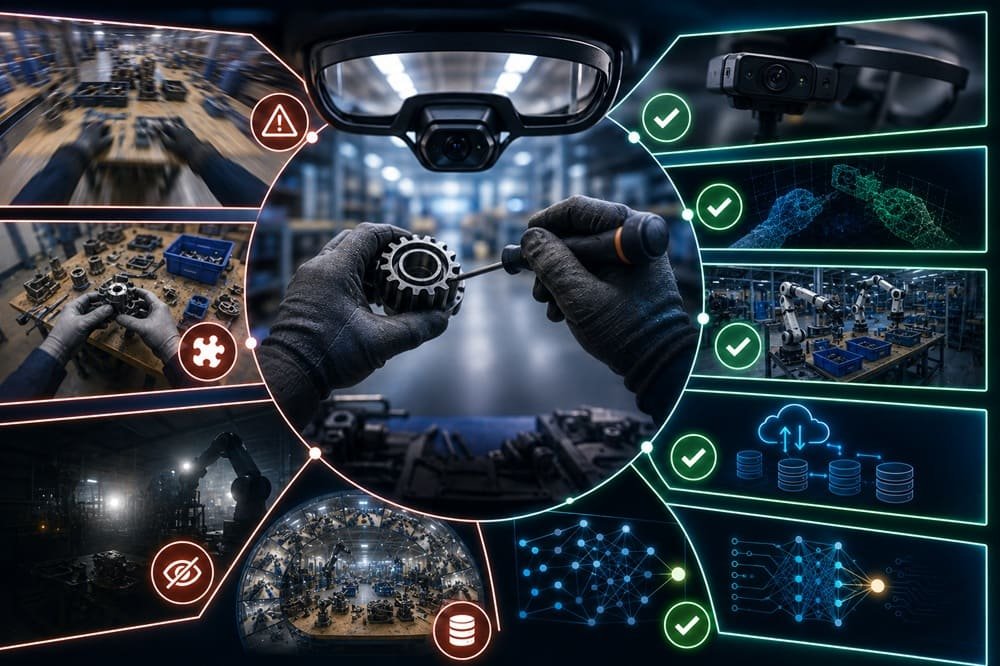
Aviation stopped losing aircraft to dramatic causes decades ago; what remained were the quiet ones, a skipped checklist item, an ambiguous callout, a gauge that read normal until the moment it mattered, and the industry’s answer was to treat small procedural failures as the primary safety problem rather than a footnote. Egocentric data collection is living through the pre-checklist era of that same history. Budgets and rig choice get argued about in every kickoff meeting, so they get managed. The hours that actually get rejected in my QA queue fail for quieter reasons: a timestamp that drifted 80 milliseconds, an auto-exposure loop hunting under warehouse LEDs, a bystander’s face where a consent form should be.
These failures stay hidden because each one is invisible at capture time. The collector sees a normal recording. The file uploads fine. The problem surfaces weeks later, when an engineer tries to align IMU packets with video frames, or a lawyer asks who signed off on the person in frame 40,000. By then the collection trip is over and the fix is a re-shoot. That is this post’s thesis: the failures that destroy egocentric datasets are procedural and invisible at capture time, so only enforced process, not better hardware, catches them before they compound.
I review egocentric footage for a living, roughly a few thousand hours a quarter across DexSet’s programs. This post covers the five failure modes that cost our clients (and, in the early days, us) the most money, what each one does to your training data, and the fix we now enforce by default. Every one of these is checkable before you scale, and none of them appears on a hardware spec sheet.
Key Takeaways – The expensive failures in egocentric collection are invisible at capture time: sync drift, exposure instability, bystander privacy, protocol drift, and metadata chaos. – Sensor sync should be verified per session, not trusted; drift beyond ~10 ms between IMU and frames degrades ego-motion estimation and any action retargeting built on it. – Auto-exposure and rolling shutter quietly poison fast-motion segments; lock exposure ranges per environment and test at task speed. – Privacy is a data-quality gate, not just a legal one; footage you cannot license cleanly is footage you cannot ship, whatever its pixel quality. – Fixing these adds roughly $2 to $5 per hour in process cost and saves multiples of that in rejected hours; our first-pass yields moved from ~70 to 85+ percent after enforcing the five fixes below.
Challenge 1: Sensor Sync Drift
Sensor sync drift is the accumulating misalignment between timestamps of different streams (video frames, IMU packets, depth, gaze) recorded on the same rig. Consumer devices are the usual culprits: separate clocks, buffered writes, and dropped packets each add error, and error compounds over a 40-minute session.
Why it hurts: ego-motion estimation fuses IMU with frames, and hand-trajectory extraction inherits any misalignment as velocity noise. Once drift passes roughly 10 ms, we see it in reprojection error; past 30 ms, retargeting-grade annotation is off the table for that session. Purpose-built devices earn their price here; Aria-class glasses timestamp all streams against a common clock with factory calibration (projectaria.com), which is a large part of why their finished-hour costs are competitive despite the hardware premium.
The fix: a physical sync event at every session start and end (a clap or strobe visible to all sensors), automated drift measurement between the two events, and a hard QA gate. On custom RealSense rigs, we also pin capture to hardware timestamps rather than host arrival times. Cost: seconds per session and one script.
Challenge 2: Auto-Exposure and Motion Blur at Task Speed
Auto-exposure instability is the camera’s exposure control oscillating or lagging as the wearer’s head sweeps between bright and dark regions, and it is the single largest source of rejected kitchen and warehouse footage in our logs. Head-mounted cameras experience scene luminance changes far faster than handheld ones. Add rolling shutter and fast hand motion and you get smeared, flickering segments exactly where the manipulation happens.
The insidious part is that slow test recordings look fine. Collectors validate the rig while standing still; the failure only appears at task speed, and encoders trained on smeared hands learn smeared hands.
The fix: per-environment exposure presets (shutter-priority for fast tasks), a five-minute test capture at full task speed before every new location, and an automated blur metric in the QA pipeline. On GoPro-class rigs we run higher frame rates (60 to 120 fps) to buy shutter headroom. This one protocol change moved a client program’s first-pass yield by eight points.
Challenge 3: Bystander Privacy and Consent
Bystander capture is the recording of people who never consented to be in your dataset, and in egocentric collection it is the default outcome rather than the exception, because the camera goes wherever the collector’s head turns. Large academic efforts treated this as a first-class problem; Ego4D built consent processes and de-identification into its collection across 74 locations (arXiv:2110.07058), and commercial programs are held to a stricter standard, not a looser one.
Treat this as data quality, not legal overhead: an hour you cannot license is an hour you cannot deliver, and face-blurring after the fact degrades exactly the frames where a person interacts with the scene.
The fix: controlled capture sites with posted notice and signed consent for everyone who could enter frame, collector training to pause on unexpected entries, and automated face/plate detection as a QA flag rather than a silent blur. Where blurring is unavoidable, we log it in episode metadata so downstream users can filter.
Challenge 4: Protocol Drift Across Collectors and Weeks
Protocol drift is the slow divergence between what your task specification says and what collectors actually do by week six. Human demonstrators optimize for their own comfort: grasps migrate to five-finger tricks a parallel-jaw gripper cannot copy, “reset the scene” becomes approximate, and each site develops a local dialect of the task. None of this looks like an error in any single episode. In aggregate, it shifts your action distribution away from anything a robot can imitate, widening the embodiment gap that retargeting work like EgoMimic goes to such lengths to close (arXiv:2410.24221).
The fix: written task cards with start-state photos and outcome rules, motion constraints stated in robot terms (gripper envelope, reach profile), weekly sampled review per collector rather than per batch, and re-training triggered by drift metrics instead of complaints. Episode-structured schemas, like the conventions the LeRobot ecosystem standardized (github.com/huggingface/lerobot), make drift measurable because every episode declares what it claims to contain.
Challenge 5: Metadata Chaos
Metadata chaos is the absence of a consistent schema binding each recording to its calibration, rig identity, task card, collector, consent record, and QA status, and it is the challenge teams discover last because nothing fails until you scale. At 100 hours, a spreadsheet works. At 4,000 hours across 26 collectors and two rig families, a spreadsheet is how you lose track of which calibration file belongs to which helmet after a lens swap.
The downstream symptom is quiet and awful: models trained on hours whose intrinsics are wrong by one rig revision. Cross-institution efforts like Open X-Embodiment succeeded precisely because they forced heterogeneous data into a common, self-describing format (arXiv:2310.08864).
The fix: schema before scale. Every episode carries rig serial, calibration hash, protocol version, consent reference, and QA verdict as first-class fields, validated at ingestion, so a bad calibration recall touches exactly the affected hours and no others.
The Checklist
| Hidden Challenge | Detection | Fix | Process Cost |
|---|---|---|---|
| Sync drift | Clap/strobe events + automated drift check | Common-clock rigs or hardware timestamps; hard QA gate at 10 ms | ~$0.50/hr |
| Exposure/blur | Blur metric on every batch | Per-site presets, task-speed test capture, 60 to 120 fps | ~$1/hr |
| Bystander privacy | Face/plate detection flags | Controlled sites, consent workflow, logged blurs | $1 to $2/hr |
| Protocol drift | Weekly per-collector sampling | Task cards, robot-term constraints, drift-triggered retraining | $1 to $2/hr |
| Metadata chaos | Ingestion-time schema validation | Episode-level schema with calibration hash and consent reference | ~$0.50/hr |
Total: roughly $2 to $5 per hour of process cost. Against a 15 to 25 percent rejection rate on unmanaged programs, it is the cheapest insurance in robotics data. The full economics, rig comparisons, and program design context live in our pillar guide: The Complete Guide to Egocentric Data Collection for Robotics.
Take the Checklist With You
We turned this post into a one-page QA checklist our own collectors carry. Download it, tape it to your rig case, and if you would rather someone else run the checklist for you, that is literally our job.
Frequently Asked Questions
What is the most common quality failure in egocentric robotics data?
In DexSet’s QA logs, exposure and motion-blur failures at task speed are the most common rejection cause, followed by sensor sync drift between IMU and video streams.
How much sync error is acceptable between IMU and video?
We gate at roughly 10 milliseconds for retargeting-grade data; beyond 30 milliseconds, hand-trajectory extraction becomes unreliable for that session.
How do you handle bystander privacy in egocentric collection?
Controlled capture sites with posted notice and signed consent, collector training to pause on unexpected entries, automated face detection as a QA flag, and metadata records for any blurred segments.
What is protocol drift and why does it matter?
Protocol drift is collectors gradually diverging from the task specification, such as using grasps a robot gripper cannot reproduce. It shifts the dataset’s action distribution away from the robot embodiment and degrades retargeting and co-training value.
How much does proper QA add to egocentric data cost?
Roughly $2 to $5 per hour in process cost across sync checks, blur metrics, privacy workflow, drift sampling, and schema validation, which typically pays for itself by lifting first-pass yield from around 70 percent to 85 percent or higher.

Enoch Pakanati
Enoch Pakanati is the strategic architect behind DexSet’s mission to become the undisputed market leader in robotics training data. He oversees the company’s growth strategy, focusing on capturing dominant market share across all data modalities required for modern robotics, including egocentric capture, teleoperation, and simulation-to-real data pipelines.
At DexSet, Enoch is responsible for transforming the company’s deep technical capabilities into a market-leading brand that foundation model labs and robotics OEMs trust implicitly. He focuses on scaling DexSet’s global footprint and ensuring the company stays ahead of the industry’s rapidly evolving data needs. His leadership is centered on one objective: making DexSet the singular, global standard for the data that powers the robotics revolution.