
There is no best egocentric capture rig, and shopping for one is how robotics teams burn their first data budget. I have built or debugged every rig family in this post, and the pattern behind the expensive mistakes I get called in to fix is always the same: a team copied another lab’s hardware without copying the training objective that made the hardware correct. That is the thesis this comparison defends: rig choice is a downstream consequence of your training mechanism, and any comparison that ranks rigs without naming the mechanism is selling you something.
The confusion is understandable. The hardware landscape moved fast: research glasses like Aria Gen 2 appeared alongside consumer devices like the Meta Quest 3 that happen to make decent capture rigs, while GoPros and RealSense cameras have been quietly strapped to helmets for years. Each option makes a different trade between image quality, sensor completeness, cost, and how much post-processing pain you inherit.
This post compares the four egocentric rig families we run in production, plus teleoperation and simulation as the two alternatives buyers always ask about. You get pros, cons, our per-hour cost benchmarks, and a decision matrix that maps rigs to training objectives.
At DexSet we operate all of these rigs daily across egocentric, exocentric, and teleoperation programs, so the failure modes below are ones we have paid for personally.
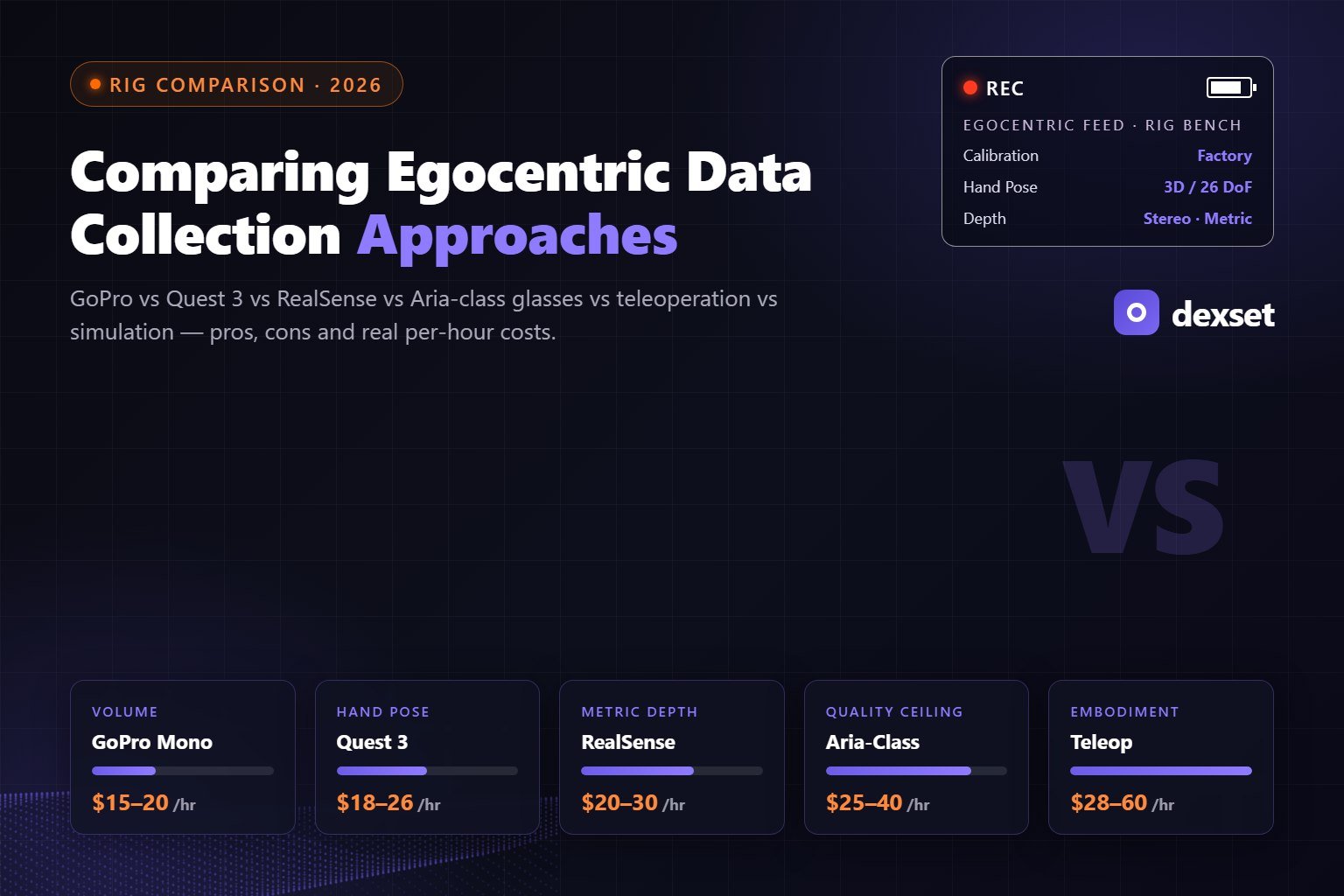
Key Takeaways – Rig choice should follow training mechanism: mono action cams for encoder pretraining, instrumented glasses for action retargeting, stereo depth helmets for metric 3D, teleop for embodiment-matched fine-tuning. – Our finished-hour cost benchmarks: GoPro mono $15 to $20, Quest 3 $18 to $26, RealSense helmet $20 to $30, Aria-class glasses $25 to $40, teleoperation $28 to $60. – Cheap capture is not cheap data. Uncalibrated mono footage shifts cost from hardware to annotation and 3D lifting compute. – Simulation complements rather than replaces real capture; the sim-to-real gap in contact-rich manipulation remains the limiting factor. – Pilot 50 to 100 hours on your shortlisted rig and train on it before committing to a full program.
What Counts as an Egocentric Collection Approach?
An egocentric collection approach is the combination of a wearable sensor rig, a capture protocol, and a post-processing pipeline that together produce first-person training episodes. The rig gets the attention, but all three layers set your cost. A $500 headset with a sloppy protocol produces more expensive data than a disciplined GoPro program, once you price the rejected hours.
For orientation across the whole field of modalities, hardware, and economics, see our pillar: The Complete Guide to Egocentric Data Collection for Robotics. This post narrows to the comparison question.
The Master Comparison Table
| Approach | Hardware Cost | Sensors You Get | Finished Cost/Hr (Our Benchmarks) | Biggest Strength | Biggest Weakness |
|---|---|---|---|---|---|
| GoPro head/chest mount | $350 to $550 | Mono RGB (wide FOV), IMU | $15 to $20 | Cheapest scale; rugged | No depth, no hand pose; annotation-heavy |
| Meta Quest 3 | ~$500 | Stereo passthrough, IMU, hand tracking | $18 to $26 | Built-in 3D hand pose | Constrained capture access; middling image quality |
| RealSense D435i/D455 helmet | $700 to $1,200 built | Stereo IR + RGB, active depth, IMU | $20 to $30 | Metric depth for manipulation | Custom build; per-rig calibration burden |
| Aria-class research glasses | Research program access | Multi-camera RGB + SLAM, 2 IMUs, eye tracking, hand tracking | $25 to $40 | Factory calibration, gaze, richest streams | Fleet scaling gated by program access |
| Teleoperation (ALOHA-class) | ~$20K+ per station | Robot proprioception + cameras, exact actions | $28 to $60 | Perfect embodiment match | Throughput ceiling; capex and lab ops |
| Simulation | Compute cost | Anything you render | $1 to $5 equivalent | Infinite variation, free labels | Sim-to-real gap in contacts and materials |
Costs are DexSet production benchmarks for QA-passed hours at typical annotation depths; your protocol and rejection rate will move them.
GoPro Rigs: The Volume Play
A GoPro-based rig is a mono wide-angle action camera on a head or chest mount, and it remains the highest-throughput, lowest-cost way to collect egocentric video. We run 4K/60 or 2.7K/120 depending on task speed. The cameras survive kitchens, warehouses, and weather, batteries swap in seconds, and collectors need five minutes of training.
The costs arrive downstream. Mono RGB has no metric depth, so any 3D understanding must be lifted with structure-from-motion or learned depth, and hand pose must be estimated rather than measured. For encoder pretraining on thousands of hours, that trade is usually correct; the Ego4D corpus proved how far lightly instrumented first-person video can go (arXiv:2110.07058). For action retargeting, it is usually wrong.
Choose when: you need thousands of hours for representation learning and can tolerate estimated 3D. Avoid when: your pipeline consumes metric hand trajectories.
Quest 3: The Accidental Capture Device
The Meta Quest 3 is a ~$500 consumer VR headset whose passthrough cameras and native hand tracking make it a surprisingly capable egocentric rig. The hand tracking is the point: you get approximate 3D hand pose at capture time, free, on hardware a college student can buy retail. Teams also reuse the same headset as a teleoperation interface, which keeps the hardware pool simple.
The weaknesses are real. Access to raw passthrough streams is constrained by platform policy, effective image quality trails dedicated cameras, and wearing a headset for long capture shifts changes how people move; collectors are measurably more hesitant in headset than in glasses, and that hesitancy shows up in the motion statistics of your dataset.
Choose when: hand pose matters, budget is tight, and sessions are short. Avoid when: you need long natural sessions or top-tier image quality.
RealSense Helmet Rigs: Metric Depth on a Budget
A RealSense helmet rig mounts an Intel D435i or D455 stereo depth camera on headgear, giving hardware-synced stereo, active depth, and an onboard IMU for roughly $700 to $1,200 built. The D455’s 95 mm baseline improves depth accuracy at room distances over the D435i’s 50 mm; we pick per task family. When your consumers need metric 3D (grasp point estimation, sim scene reconstruction, depth-conditioned policies), this is the price-performance sweet spot.
You pay in operations. These are custom builds, so calibration is on you, mounts loosen, IR projectors misbehave in sunlight, and USB bandwidth is a daily negotiation. Budget real engineering time or the depth streams silently degrade.
Choose when: metric depth is a hard requirement. Avoid when: you cannot staff rig maintenance.
Aria-Class Glasses: The Quality Ceiling
Aria Gen 2 research glasses are purpose-built egocentric capture devices with calibrated multi-camera arrays, dual IMUs, eye tracking, and on-device machine perception (projectaria.com). Data arrives factory-calibrated with services for SLAM and hand tracking, which deletes whole stages of your post-processing pipeline. EgoExo4D was collected on Aria hardware (arXiv:2311.18259), and retargeting work like EgoMimic used Aria capture as its human-data source (arXiv:2410.24221). Collectors also behave naturally in glasses, which matters more than teams expect.
The constraint is access: these are research program devices rather than retail products, so fleet scaling depends on program terms rather than a purchase order.
Choose when: you need retargeting-grade data with gaze and hand pose at research quality. Avoid when: your plan requires buying 200 units next month.
Teleop and Sim: The Two Non-Egocentric Alternatives
Teleoperation and simulation are the alternatives every budget conversation reaches, and both are complements rather than substitutes. Teleoperation through ALOHA-class rigs (arXiv:2304.13705) is the only approach that produces exact robot-embodiment actions, which is why fine-tuning sets are teleop even when pretraining is egocentric; the LeRobot ecosystem has standardized much of this tooling (github.com/huggingface/lerobot). Simulation generates unlimited labeled variation at $1 to $5 per equivalent hour, and remains weakest exactly where manipulation is hardest: contact dynamics, deformables, and material appearance.
Decision Matrix: Match the Rig to the Mechanism
| Your Training Objective | First Choice | Second Choice |
|---|---|---|
| Visual encoder pretraining at scale | GoPro mono | Quest 3 |
| Action retargeting to grippers | Aria-class glasses | Quest 3 |
| Depth-conditioned manipulation | RealSense helmet | Aria-class glasses |
| Embodiment-matched fine-tuning | Teleoperation | (no substitute) |
| Domain randomization / rare events | Simulation | Sim + real mix |
Choosing From Here
The full economics, QA gates, and rig field notes behind this comparison are in the pillar guide linked above. If you would rather see the data than read about it, book a demo and we will put sample episodes from three different rigs side by side on a call.
Frequently Asked Questions
Which egocentric capture rig is cheapest per hour?
GoPro-based mono rigs are cheapest in our benchmarks at $15 to $20 per finished hour, but they shift cost into annotation and 3D lifting because they capture no depth or hand pose.
Is the Meta Quest 3 good for robotics data collection?
Yes, for short sessions where 3D hand pose matters and budgets are tight. Its native hand tracking provides approximate pose at capture time, though passthrough access limits and image quality keep it below dedicated rigs for long natural capture.
When do I need stereo depth instead of mono video?
When downstream consumers need metric 3D: grasp point estimation, scene reconstruction for sim, or depth-conditioned policies. RealSense D435i/D455 helmet rigs are the common budget path; Aria-class glasses the research-grade one.
Can simulation replace egocentric data collection?
No. Simulation adds cheap variation and labels but still misses contact dynamics and material realism in manipulation, so real egocentric and teleop data remain necessary anchors.
How should I choose between these approaches?
Derive the choice from your training mechanism: mono for encoder pretraining, instrumented glasses or Quest 3 for retargeting, stereo helmets for metric depth, teleoperation for embodiment-matched fine-tuning. Pilot 50 to 100 hours before scaling.