Dexset

Comparing Training Data Approaches for Vision-Language-Action (VLA) Models: Pros, Cons & Costs

Zero robot action labels exist in the world’s largest manipulation video corpora. Thousands of hours of humans pouring, folding, and assembling, on YouTube and in Ego4D-scale datasets, and not one recorded motor command among them. That single number is why the VLA data sourcing debate never resolves cleanly: the cheapest, most scalable source of manipulation data is missing the one field an action model trains on, and every source that has the field costs real money per hour.

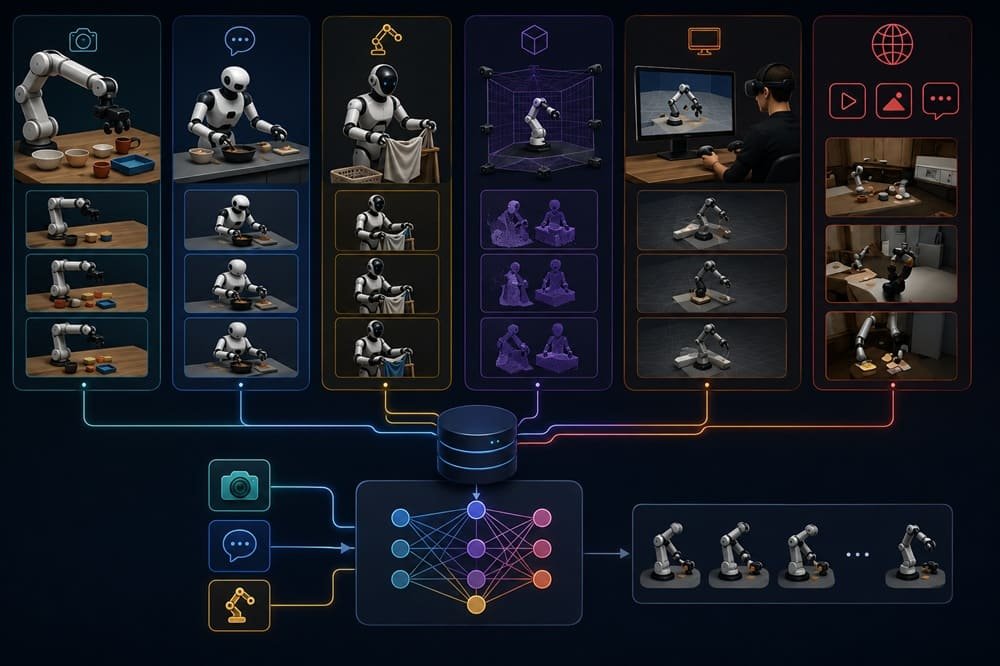
So the budget conversation inside most teams collapses into familiar camps. Someone wants to teleoperate everything because actions are the labels. Someone wants to generate everything in simulation because it is cheap. Someone read the GR00T paper and wants to pretrain on YouTube. All three are right about the strengths and quiet about the weaknesses, and the budget only covers one of them properly.

Our thesis, argued below with published results and our own collection benchmarks: these approaches are not substitutes, they are layers, with different label completeness, different transfer properties, and per-hour costs that differ by two orders of magnitude. Treating them as interchangeable is how teams end up with 40,000 synthetic episodes that fine-tune into a policy that cannot close a real gripper on a real deformable object.

This post compares the four practical sourcing approaches: teleoperation, human video, synthetic generation, and open datasets. For each you get what it is, where it wins, where it fails, and what it costs, ending with the decision matrix we use when scoping client collections. Costs marked as DexSet benchmarks are from our own production pipeline; the rest cite primary sources.

Key Takeaways – Teleoperation is the only approach that produces complete observation-action-language triples; it costs $28-60 per robot-hour in our benchmarks. – Human video is the cheapest per hour and the most scalable, but has no action labels; it works as a pretraining layer, never as the whole diet. – Synthetic data has near-zero marginal cost and perfect labels, but pays a sim-to-real tax on contact-rich tasks. – Open datasets (Open X-Embodiment, DROID, BridgeData V2) are effectively free and belong in every mixture; their limit is embodiment and domain mismatch. – The winning pattern in published systems is a pyramid: open + web data at the base, synthetic in the middle, embodiment-matched teleoperation on top.

Approach 1: Teleoperation

Teleoperation data is collected by a human operator directly controlling the robot while every observation and command is recorded, making the robot’s own action stream the training label. This is the approach behind ALOHA/ACT (arxiv.org/abs/2304.13705), DROID (arxiv.org/abs/2403.12945), and the top layer of essentially every serious VLA pipeline including pi-zero’s roughly 10,000-hour corpus (arxiv.org/abs/2410.24164).

Pros: complete and exact action labels; embodiment-matched by construction; supports contact-rich and bimanual tasks; language can be attached at collection time while context is fresh.

Cons: real-time throughput ceiling (20-40 usable tabletop episodes per hour on our rigs, 8-15 for long-horizon work); operator skill variance shows up in the data; rigs cost real money (an ALOHA-class bimanual station is around $20k before cameras).

Cost (DexSet benchmark): $28-38 per robot-hour for VR-rig tabletop collection, $40-60 for leader-follower bimanual work, plus $8-15 per data-hour for language annotation and $5-9 for QA.

Approach 2: Human Egocentric Video

Human video data is footage of people performing tasks, captured from head-mounted or fixed cameras, containing rich visual and behavioral signal but no robot action labels. Ego4D-scale corpora and in-house egocentric capture both fall here.

Pros: an order of magnitude cheaper per hour than teleoperation; humans perform tasks at natural speed with natural strategies; enormous diversity is reachable; head-mounted capture rigs are cheap to scale across many wearers.

Cons: no action labels, so it cannot train the action head directly; embodiment gap between human hands and robot grippers; requires retargeting or representation-learning machinery to become useful.

Cost (DexSet benchmark): $15-25 per hour for structured egocentric capture with task scripts and QA, roughly half the cost of teleoperation for the same wall-clock hour.

Where it fits: as pretraining and co-training signal. NVIDIA’s GR00T N1 explicitly structures this as the wide base of its data pyramid (arxiv.org/abs/2503.14734).

Approach 3: Synthetic and Simulation Data

Synthetic data is generated in physics simulators or by generative models, with actions and annotations produced programmatically at near-zero marginal cost. Perfect labels, infinite resets, no hardware wear.

Pros: marginal cost approaches zero after environment setup; perfect ground truth including states no sensor can capture; safe exploration of failure states; trivially parallelizable.

Cons: the sim-to-real gap is worst exactly where manipulation is hardest: contact dynamics, deformables, friction, specular and transparent objects. Environment engineering is a real up-front cost that budget lines often forget. Policies trained purely in sim routinely need real-data fine-tuning anyway.

Cost: environment and asset engineering is the dominant term (weeks of engineer time per task family); generation itself is compute-priced. Treat it as high fixed cost, near-zero marginal cost.

Approach 4: Open Datasets

Open datasets are published robot demonstration corpora, led by Open X-Embodiment with over one million trajectories across 22 embodiments (arxiv.org/abs/2310.08864), DROID with 76k episodes across 564 scenes, and BridgeData V2 with roughly 60k trajectories (arxiv.org/abs/2308.12952).

Pros: free; instantly available; proven at scale (OpenVLA pretrained on ~970k OXE episodes, arxiv.org/abs/2406.09246); increasingly standardized via LeRobot formats.

Cons: your embodiment, cameras, and tasks are probably not in there; instruction quality varies wildly between constituent datasets; license terms need actual reading; everyone else trains on the same data, so it confers no advantage by itself.

Side-by-Side Comparison

DimensionTeleoperationHuman VideoSyntheticOpen Datasets
Action labelsComplete, exactNonePerfect, programmaticComplete, variable quality
Cost per data-hour$28-60 + annotation (DexSet benchmark)$15-25 (DexSet benchmark)Near-zero marginal, high fixedFree
Embodiment matchExactPoor (human)ConfigurableRarely exact
Contact-rich fidelityHighVisual onlyWeak to moderateHigh where present
Scale ceilingLow (real time)HighVery highFixed (~1M episodes)
Language qualityControllable at sourceMust be addedTemplated by defaultInconsistent
Best roleFine-tuning top layerPretraining baseMid-layer augmentationPretraining base

The Decision Matrix We Actually Use

The right mixture follows from two questions: how far is your embodiment from the open corpora, and how contact-rich are your target tasks?

  • Standard single arm, tabletop tasks: open datasets + a thin teleop fine-tuning layer (200-500 hours). Cheapest viable path.
  • Standard arm, contact-rich or precision tasks: add stereo teleop collection on the target tasks; synthetic helps for coverage but will not close the contact gap alone.
  • Dexterous hands or humanoids: cross-embodiment transfer is weakest here. Budget for substantial embodiment-matched teleoperation (1,000+ hours) over a human-video and open-data base.
  • Long-horizon mobile manipulation: prioritize segment-level language labels; Mobile ALOHA showed strong results co-training with roughly 50 demos per task on a broad base (arxiv.org/abs/2401.02117), so spread hours across many tasks.

Two budgeting notes that surprise first-time buyers. First, annotation and QA scale with data-hours, not with approach, so a cheap collection method with poor labels often costs more per useful training hour than an expensive one delivered clean; a $30 teleop hour that ships with diverse language labels and verified success flags beats a $15 hour that needs a relabeling pass and a 20% cull. Second, the approaches interact: a few hundred hours of well-instrumented teleoperation is also the calibration set that makes your synthetic pipeline honest, because it gives you real contact dynamics to validate against. Teams that sequence it that way (teleop first, sim scaled second) report far less sim-to-real disappointment than teams that generate first and verify never.

The pattern across every row: nobody should pay collection rates for the base of the pyramid, and nobody should expect the free layers to cover the top. For the full scoping framework, mixture ratios, and our vendor RFP scorecard, see the complete guide to VLA training data.

Next Step

if you are weighing these approaches for a real budget, read the complete VLA training data guide or book a demo and we will pressure-test your planned mixture against our collection benchmarks.

Frequently Asked Questions

What is the cheapest way to get training data for a VLA model?

Start with free open datasets (Open X-Embodiment, DROID, BridgeData V2) for pretraining, then buy only embodiment-matched teleoperation for fine-tuning. In our benchmarks that fine-tuning layer costs $28-60 per robot-hour plus annotation, and 200-500 hours is often enough for standard manipulators.

Not alone. Synthetic data provides cheap coverage and perfect labels but carries a sim-to-real gap that is worst on contact dynamics and deformable objects. Published systems use it as a middle layer between web-scale video and real teleoperation.

In DexSet’s pipeline, structured egocentric human video runs $15-25 per hour versus $28-60 per robot-hour for teleoperation. The difference is labels: teleoperation records executable robot actions, human video does not, so they occupy different layers of the training mixture rather than competing.

Both. OXE-scale open data is the standard pretraining base and costs nothing. Custom collection earns its price where open data is thin: your specific embodiment, your camera geometry, your tasks, and instruction phrasing diverse enough to make language conditioning work.
Comparing Data Capture Hardware for Embodied AI Approaches: Pros, Cons and Costs

Our prediction, held at roughly 80 percent confidence: within two years, no serious VLA training stack will rely on a single capture approach, and the teams still arguing egocentric versus teleoperation will have lost the argument to “both.” That is an opinion, clearly flagged; the evidence behind it is not. Three camps currently give three confident, incompatible answers to the data collection question: strap cameras on humans, build teleop rigs, or ring the workspace with depth cameras. Each camp has papers proving its approach works, and none of the papers tell you what each approach costs per usable hour, or which one fits the model you are actually training.

The argument persists because these approaches produce different data, not the same data at different prices. That is the thesis this comparison argues: the four approaches are complements delivering different supervision signals, so the choice follows from your training objective. Egocentric human video has no robot actions in it. Teleoperation produces perfect action labels at real-time speed and real-time cost. Exocentric camera arrays see everything except the first-person view your humanoid will actually have. Choosing between them by hardware price alone is a category error.

This post compares the four capture approaches side by side: what hardware each needs, what data each yields, what each costs on our floors, and a decision matrix for matching approach to training objective. It condenses the hardware detail from our full guide to data capture hardware for embodied AI.

I run teleoperation systems at DexSet, where all four approaches operate in production, so the pros and cons below come from shift logs rather than spec sheets.

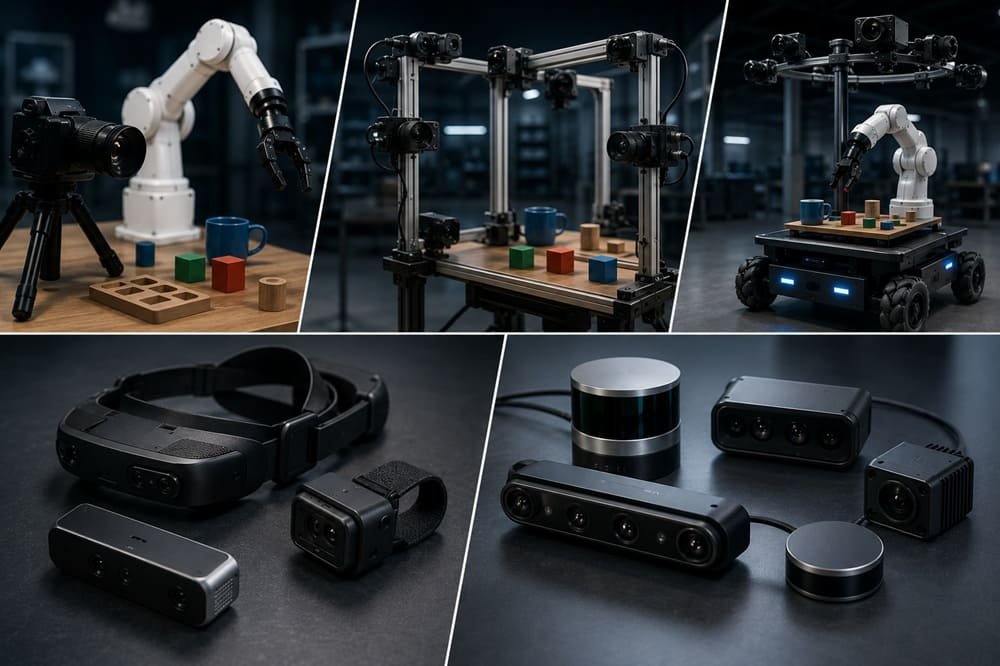
Key Takeaways – The four capture approaches are egocentric wearables, teleoperation, handheld demonstration devices (UMI-style), and multi-view exocentric arrays. They produce different modalities and are complements, not substitutes. – Egocentric capture is the cheapest per hour (a ~$400 GoPro seat) but carries no robot action labels; teleoperation is the most expensive but yields training-ready observation-action pairs. – Teleop hardware spans two orders of magnitude: ~$300 GELLO leader arms to $20,000+ ALOHA-class bimanual stations, with our delivered benchmarks at $28-60 per hour. – Most VLA training stacks want a blend: broad egocentric pretraining data plus targeted teleop fine-tuning data plus a small exo set for evaluation.

Approach 1: Egocentric Wearable Capture

Egocentric capture records first-person video and motion from devices worn by humans doing real tasks, no robot required. It is the approach behind Ego4D and Ego-Exo4D (arxiv.org/abs/2311.18259), and the standard source of large-scale pretraining data for humanoid perception.

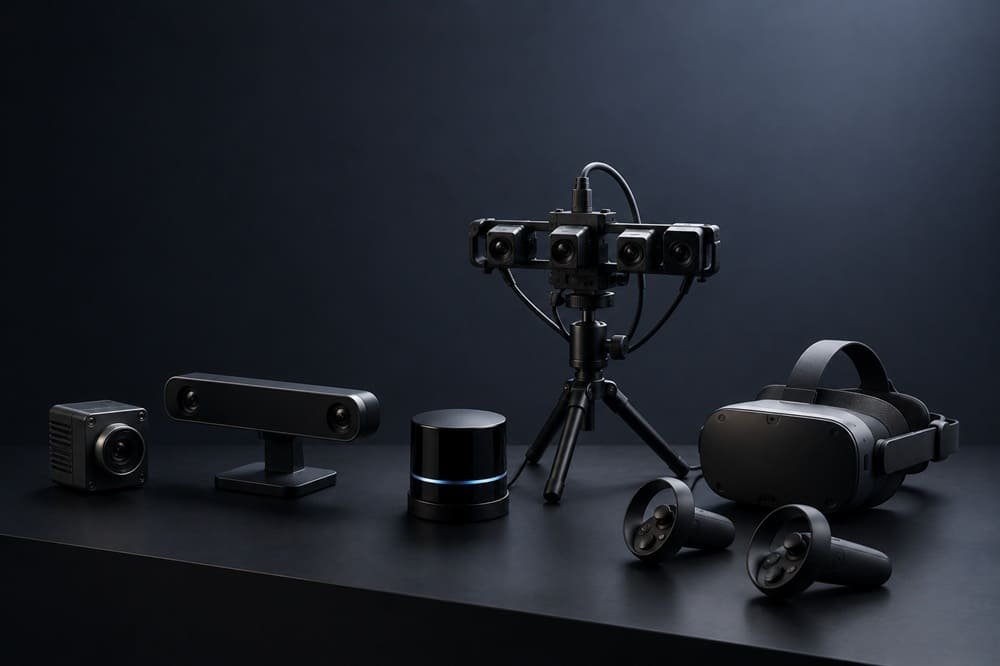
Hardware options: GoPro head mounts (~$400, 5.3K/60, ~150 g), Meta Quest 3 (~$500, adds hand tracking and 6DoF pose), Apple Vision Pro ($3,499, adds eye tracking and LiDAR), and Project Aria research glasses (research access, best-in-class sensor sync at ~75 g).

Pros: lowest cost per hour of any approach; scales with people instead of robots; captures true task diversity in homes, kitchens, and warehouses; light devices sustain 6+ hour shifts.

Cons: no robot action labels, so it cannot train a policy by itself; consumer devices have weak cross-device sync; gaze and hand pose require the expensive end of the hardware range.

Approach 2: Teleoperation Capture

Teleoperation capture records a human operator controlling a real robot, producing synchronized observation-action pairs, which is exactly the supervision imitation learning consumes. The chain is direct: teleoperation produces demonstrations, demonstrations train ACT- and diffusion-policy-style models, and those methods feed VLA systems like OpenVLA and pi-0.

Hardware options: ALOHA-class leader-follower stations (~$20,000+ per bimanual cell, the platform behind ACT, arxiv.org/abs/2304.13705), GELLO printed leader arms (~$300 per arm on robots you already own, arxiv.org/abs/2309.13037), and VR teleop with a Quest 3 or Vision Pro streaming head and hand pose to the robot.

Pros: training-ready action labels at capture time; joint-space leader arms give fine bimanual control; output drops straight into LeRobot or HDF5 episode formats.

Cons: cost scales with robots, not just people; one real-time hour per data hour per rig; resets and calibration eat 30 to 40 percent of every shift; operator skill affects data quality.

Approach 3: Handheld Demonstration Devices

Handheld demonstration devices are robot-free grippers, UMI being the reference design, that a human carries through tasks while a wrist-mounted camera records; robot actions are recovered afterward via SLAM (arxiv.org/abs/2402.10329). The approach splits the difference between egocentric video and teleoperation.

Hardware: a 3D-printed UMI-style gripper plus a fisheye GoPro, roughly $400 per unit.

Pros: near-egocentric cost with usable action supervision; natural human motion, no retargeting latency; trivially parallel, ten grippers cost less than one robot arm.

Cons: no proprioception or force signal; action quality depends on SLAM post-processing, which becomes its own QA pipeline; single-gripper design limits bimanual tasks.

Approach 4: Multi-View Exocentric Arrays

Multi-view exocentric capture surrounds a workspace with synchronized third-person cameras, recording the scene from four to twelve angles at once. DROID standardized this pattern across labs (arxiv.org/abs/2403.12945), and it is the default source of evaluation and cross-view data.

Hardware options: Intel RealSense D435i (~$300-350) or D455 (~$420-450, wider baseline, hardware sync pin), Stereolabs ZED 2i (~$500, neural depth, needs an NVIDIA GPU per node), Luxonis OAK-D (~$250-350, on-device compute).

Pros: metric depth and full-scene coverage; hardware sync solves the alignment problem RealSense-style; fixed rigs need no operator wearables at all.

Cons: not the robot’s viewpoint; per-studio infrastructure (sync wiring, lighting, terabyte-per-shift storage) roughly doubles the camera bill; useless for capturing task diversity outside the cell.

What the Landmark Datasets Chose

The published datasets that shaped this field each committed to one of these approaches, and their choices are useful evidence. Ego4D collected thousands of hours of unscripted daily activity on head-mounted cameras because egocentric scale was the objective and action labels were not. ALOHA and Mobile ALOHA (arxiv.org/abs/2401.02117) went all-in on leader-follower teleoperation because fine bimanual action supervision was the entire point. DROID distributed identical RealSense-based exocentric rigs to dozens of labs to get multi-view consistency across sites. And Ego-Exo4D deliberately paired Aria glasses with stationary cameras, an explicit bet that ego plus exo beats either alone.

None of these teams picked their hardware by price. They picked by the supervision signal their research needed, then engineered the cost down. That is the right order of operations for a production pipeline too.

The Master Comparison Table

Approach Typical Hardware Capex per Seat/Cell Data Yielded Action Labels Our Delivered Cost Benchmarks Best For
Egocentric wearable GoPro ~$400, Quest 3 ~$500, Vision Pro $3,499, Aria (research) $400-4,000 First-person RGB, IMU, pose, gaze (device-dependent) None Lowest per hour (one third to one half of teleop) Pretraining scale, humanoid viewpoint priors
Teleoperation GELLO ~$300/arm, ALOHA ~$20k station, VR teleop $500-3,499 + robot $600-30,000 Obs-action pairs, proprioception, 50 Hz control Native, highest quality $28-60/hr Policy fine-tuning, bimanual manipulation
Handheld (UMI-style) Printed gripper + GoPro, ~$400 $400-600 Wrist-cam RGB + SLAM-recovered trajectories Recovered, no force/proprio Between egocentric and teleop Cheap single-arm demos at volume
Exocentric array 4-8x D455/ZED 2i/OAK-D $2,500-12,000 per studio Multi-view RGB-D, synced None (pairs with teleop) Studio amortizes across every episode captured inside it Evaluation, cross-view consistency, world models

Decision Matrix: Matching Approach to Training Objective

The right capture approach is determined by what your model consumes, and the mapping is more stable than hardware fashion.

  • Pretraining a humanoid perception backbone: egocentric wearables first. Buy GoPro seats for volume; add Aria or Vision Pro only where gaze labels earn their cost.
  • Fine-tuning a VLA policy on manipulation tasks: teleoperation. GELLO on existing arms if you own robots; an ALOHA-class cell if bimanual dexterity is the product.
  • Thousands of single-arm demos on a budget: UMI-style handheld grippers, with a budgeted SLAM QA pass.
  • Evaluation sets and world-model data: an exo array of hardware-synced D455s wrapped around one teleop cell, so every episode is captured ego and exo simultaneously.
  • All of the above on a deadline: that blend is precisely what a data vendor amortizes across clients; the build-versus-buy arithmetic is in the full hardware guide.

Next Step

Ready to scope your data program? Talk to our team.

Frequently Asked Questions

Which robot data collection approach is cheapest?

Egocentric wearable capture. A ~$400 GoPro head-mount seat produces first-person video at one third to one half the per-hour cost of teleoperation in our benchmarks, but it yields no robot action labels.

For policy training, yes. Teleoperation is the only approach that natively records synchronized observation-action pairs with proprioception, which is the supervision imitation learning and VLA fine-tuning require.

UMI is a handheld, robot-free gripper design with a wrist-mounted fisheye GoPro; actions are recovered by SLAM in post-processing. Use it when you need thousands of single-arm demonstrations at near-egocentric cost and can accept the absence of force and proprioception data.

For evaluation and cross-view generalization, a small one helps. Wrapping four to six hardware-synced RealSense D455s around one teleop cell gives you paired ego-exo episodes, the structure Ego-Exo4D demonstrated matters for viewpoint generalization.

Yes, and most serious VLA stacks do: broad egocentric data for pretraining, teleop episodes for fine-tuning, and exo views for evaluation. The practical requirement is one shared episode format and honest per-source metadata.

[Download Sample Data] from all four capture approaches, or start with the complete guide to data capture hardware for embodied AI.

The Complete Guide to Data Capture Hardware for Embodied AI (2026)

A Head of Data on a scoping call last quarter asked us which single capture device her team should standardize on, and for the first time in months, we had no quick answer. We had run every device she named in production. The problem was the question: it has no device-shaped answer, because a capture device is not a purchase, it is a commitment. The hardware you choose locks your pipeline into what that device can timestamp, sync, and survive, and teams that fail on data usually failed at that moment, months before anyone touched a model. That is this guide’s thesis: capture hardware is a data-strategy decision, judged on seven axes and on cost per delivered hour, never on spec sheets.

The reason the question stumps buyers is that capture hardware for embodied AI sits in a gap between consumer electronics and lab equipment. A Quest 3 was built for gaming, not for exporting synchronized RGB, IMU, and hand pose at training quality. A RealSense was built for prototyping, not for 40 units running ten hours a day. Vendor spec sheets answer none of the questions that matter for foundation model training, so teams learn the hard lessons after the purchase order clears.

This guide gives you the full picture: every major hardware category (headsets, research glasses, action cameras, stereo depth cameras, teleoperation rigs, handheld grippers, tactile sensors), compared on the seven axes that decide whether your dataset trains a VLA model or fills a hard drive. You will leave with real prices, a cost-per-hour model, and a decision matrix mapped to the three capture strategies that matter: egocentric human data, teleoperation, and multi-view exocentric capture.

At DexSet we run these devices in production. Our teams operate teleop cells, headset fleets, and multi-camera capture studios that deliver egocentric, exocentric, mono, and stereo data to robotics foundation model teams. Every number in this guide comes from our own rigs, published research, or a linked primary source.

TL;DR: Key Takeaways – Data capture hardware for embodied AI spans four categories: wearable egocentric devices ($350 to $3,499), stereo depth cameras ($250 to $500 per unit), teleoperation rigs ($300 per arm to $20,000+ per station), and tactile sensors. – The seven evaluation axes are price, resolution/fps, depth quality, sync capability, wearability, SDK maturity, and data formats. Sync capability is the axis teams most often ignore and most often regret. – A Meta Quest 3 at ~$500 covers most teleoperation UI needs; the Apple Vision Pro at $3,499 earns its price only for eye tracking and high-resolution passthrough research. – Teleop capex is lower than most CTOs assume: a GELLO leader arm costs roughly $300 per arm, against $20,000+ for a full ALOHA-class bimanual station. – In our production benchmarks, delivered teleop data runs $28 to $60 per hour depending on rig and task complexity; egocentric human data runs meaningfully cheaper per hour but trains different capabilities.

What Is Data Capture Hardware for Embodied AI?

Data capture hardware for embodied AI is the set of physical devices, wearables, cameras, teleoperation interfaces, and sensors, used to record the visual, spatial, inertial, tactile, and action data that trains robots and vision-language-action (VLA) models. It is the acquisition layer of the robot learning stack: everything between the physical world and your training dataset.

The category matters because embodied AI models learn from demonstrations, not from text scraped off the internet. A VLA model like OpenVLA (arxiv.org/abs/2406.09246) or Physical Intelligence’s pi-0 (arxiv.org/abs/2410.24164) consumes synchronized streams of camera frames, proprioception, and actions. The hardware that records those streams sets a hard ceiling on model quality. No amount of post-processing recovers depth a sensor never measured or a timestamp a device never wrote.

Core Concepts and Data Modalities

Data modalities are the distinct sensor streams a capture device records, and every hardware decision starts by listing which modalities your model actually needs. The main ones for embodied AI are RGB video, stereo pairs, depth, IMU, eye gaze, hand and body pose, robot proprioception, and tactile signal.

Mono vs. Stereo RGB

Mono RGB is a single camera stream; stereo RGB is a calibrated pair that allows depth to be recovered by triangulation. Mono is cheaper and lighter and dominates large egocentric datasets like Ego4D (arxiv.org/abs/2110.07058). Stereo gives your model, or your post-processing pipeline, metric 3D structure, which matters for manipulation policies that must reason about distance to a grasp point. On our rigs, stereo roughly doubles storage and calibration workload, so we specify it only when the downstream model consumes it.

Depth

Depth is a per-pixel distance measurement, produced either by active sensors (structured light, time-of-flight) or by stereo matching. Active depth from a RealSense-class sensor works well indoors at 0.3 to 6 meters but degrades in sunlight and on reflective surfaces. Neural stereo depth (ZED 2i class) extends range but requires a GPU at capture time or in post.

IMU and Time Synchronization

An IMU (inertial measurement unit) records acceleration and angular velocity, typically at 200 Hz to 1,000 Hz, and it is only useful if its clock aligns with the camera clock. Cross-device sync is the silent killer of embodied AI datasets: a 40 ms offset between video and proprioception is invisible in playback and fatal for action-labeled training data. Devices differ enormously here. Project Aria timestamps all sensors on a shared clock; a GoPro gives you a self-consistent file but no native way to sync with a robot’s ROS 2 clock without an external signal.

Proprioception and Action Data

Proprioception is the robot’s own joint state (positions, velocities, torques), and action data is the command stream sent to the robot. These come from the robot or the teleoperation interface, not from cameras, which is why teleop rigs are capture hardware in their own right. Imitation learning methods like ACT, introduced with the ALOHA rig (arxiv.org/abs/2304.13705), train directly on this stream. The entity chain to keep straight: teleoperation produces demonstrations, demonstrations feed imitation learning, imitation learning trains the VLA policies that run on robots.

Tactile

Tactile sensing records contact geometry and force at the gripper, usually via vision-based sensors in the GelSight style, where a camera watches a deformable gel pad. Tactile is the newest modality in production pipelines and the least standardized; we cover the hardware below.

The Four Hardware Categories

Capture hardware for embodied AI falls into four categories: wearable egocentric devices, stereo and depth cameras for exocentric capture, teleoperation rigs, and handheld or tactile interfaces. Most production pipelines combine at least two.

Category 1: Wearable Egocentric Devices

Wearable egocentric devices are head-mounted cameras and headsets that record the world from a human’s first-person viewpoint, the same viewpoint a humanoid robot’s head camera will have. This category powers egocentric pretraining datasets like Ego-Exo4D (arxiv.org/abs/2311.18259) and doubles as the operator interface for immersive teleoperation systems like Open-TeleVision (arxiv.org/abs/2407.01512).

Device Price Sensors & Resolution Depth Sync Wearability (8h shift) SDK Maturity Native Data Formats
Meta Quest 3 ~$500 Color passthrough cameras, 6DoF inside-out tracking, hand tracking, IMU Passthrough depth estimate, not export-grade Good within headset; WebXR/OpenXR timestamps for teleop Moderate; 515 g, front-heavy after ~2h Strong (OpenXR, Meta SDK, large dev community) App-level capture; pose + hand joints via OpenXR
Apple Vision Pro $3,499 High-res micro-OLED displays, high-quality color passthrough, eye tracking, hand tracking, LiDAR LiDAR scene depth Excellent within device; ARKit timestamps Poor for long shifts; 600-650 g, external battery Strong but restrictive (visionOS, ARKit); raw camera access gated ARKit poses, hand skeletons; limited raw sensor export
Project Aria / Aria Gen 2 Research access (not retail) RGB camera, 2 mono SLAM cameras, eye tracking cameras, spatial mics, dual IMUs (Gen 2 adds PPG, improved compute) No active depth; SLAM-derived Best in class; all sensors on shared clock, VRS format Excellent; ~75 g glasses form factor Good (Project Aria Tools, MPS cloud services) VRS files, MPS trajectories, gaze (projectaria.com)
GoPro head mount (Hero-class) ~$400 Single wide FOV RGB, 5.3K/60 or 4K/120, IMU telemetry None Weak across devices; GPMF telemetry internal only Good; ~150 g with mount Moderate (GPMF parsers, no live SDK) MP4 + GPMF metadata track

The pattern to notice: the $3,499 device is not seven times better than the $500 device for data capture. Vision Pro wins when you need eye gaze and the highest-fidelity passthrough for perception research or premium teleop. Quest 3 wins on fleet economics: at our scale, one damaged Vision Pro costs the same as seven Quest 3 replacements. Aria wins on data quality per gram but is research-access only, which makes it a partnership decision rather than a purchasing decision. The GoPro remains the workhorse for raw egocentric video volume, and it is the camera inside the UMI gripper stack discussed below.

Category 2: Stereo Depth Cameras for Exocentric Capture

Stereo depth cameras are fixed or tripod-mounted sensors that record a scene from outside the actor, providing the third-person views used in multi-view exocentric datasets and in robot workspace monitoring. Datasets like DROID (arxiv.org/abs/2403.12945) standardized on this class of sensor.

Device Price RGB / Depth Resolution & FPS Depth Quality Sync Capability SDK Maturity Data Formats
Intel RealSense D435i ~$300-350 Depth 1280x720 @ up to 90 fps; RGB 1080p @ 30; IMU Good 0.3-3 m; global-shutter depth sensors Hardware sync pin across units Mature (librealsense, ROS 2 wrapper) ROS 2 bags, .bag/.ply, raw streams
Intel RealSense D455 ~$420-450 Depth 1280x720 @ 90 fps; wider 95 mm baseline; global-shutter RGB; IMU Better than D435i at 4-6 m range Hardware sync pin Mature (same stack) Same as D435i
Stereolabs ZED 2i ~$500 Stereo 2K @ 15, 1080p @ 30, 720p @ 60; IMU, barometer, magnetometer Neural stereo depth, usable 0.3-20 m Software sync; multi-cam via ZED Hub Mature but GPU-dependent (ZED SDK, needs NVIDIA) SVO recordings, ROS 2 wrapper
Luxonis OAK-D ~$250-350 4K RGB + 2x mono stereo pair; on-device compute Good short-range stereo depth Hardware FSYNC on some variants Growing (DepthAI, ROS 2 driver) DepthAI streams, ROS 2

For multi-view exo capture, the deciding axis is sync. RealSense’s hardware sync pin lets you drive eight cameras off one trigger, which is why it still dominates academic capture cells despite Intel’s on-again-off-again commitment to the product line. ZED 2i buys you longer range and better outdoor behavior at the cost of an NVIDIA GPU per capture node. OAK-D is the value play when you want on-device neural inference to filter or annotate at capture time.

Category 3: Teleoperation Rigs

Teleoperation rigs are the leader-follower arm pairs, exoskeletons, and VR-based control systems through which a human operator produces robot action data. This is the category where hardware choice most directly sets your cost per demonstration.

System Price What It Is Action Fidelity Operator Fatigue SDK / Ecosystem Data Formats
ALOHA / ALOHA 2 rig ~$20,000+ per bimanual station Two leader + two follower arms, joint-space mapping, 50 Hz High; fine bimanual tasks Moderate; seated, arms supported Strong research ecosystem (ACT, Mobile ALOHA, LeRobot support) HDF5 episodes; LeRobot dataset format
GELLO ~$300 per arm (plus follower robot) 3D-printed, Dynamixel-based kinematic-twin leader arm (arxiv.org/abs/2309.13037) High for the matched follower Low-moderate Open source, LeRobot-compatible Joint streams to ROS 2 / LeRobot
UMI gripper ~$400 build (printed gripper + GoPro) Handheld gripper with wrist-mounted fisheye GoPro; robot-free demonstrations (arxiv.org/abs/2402.10329) Good; SLAM-recovered actions, no proprioception Low; natural human motion Open source, active community MP4 + GPMF, post-processed to episodes
VR teleop (Quest 3 / Vision Pro + arms) $500-$3,499 + robot Headset streams head/hand pose to robot controller (Open-TeleVision style) Good; depends on retargeting Moderate; passthrough latency drives fatigue Growing; OpenXR + custom stacks Pose streams + robot logs
Tactile (DIGIT / GelSight-style) A few hundred dollars per fingertip (DIGIT-class); research-grade GelSight units cost thousands Vision-based tactile sensor in gripper fingertips Adds contact-rich signal N/A (robot-mounted) Moderate (open DIGIT designs; PyTouch-era tooling) Compressed tactile image streams

The $20,000 ALOHA figure and the $300 GELLO figure describe different points on the same curve, not competing products. ALOHA is a complete bimanual station including four arms. GELLO is a leader-arm design you bolt onto follower robots you already own. UMI removes the robot from data collection entirely, which is why it produces the cheapest demonstrations and the weakest proprioception. Every serious pipeline we run mixes at least two of these.

Category 4: Multi-View Exocentric Studios

A multi-view exocentric studio is an array of four to twelve synchronized cameras surrounding a workspace, recording the same manipulation from multiple third-person angles. Ego-Exo4D paired Aria glasses with four to five stationary GoPros per scene precisely because models trained on both viewpoints generalize better than either alone. Budget $2,500 to $6,000 per studio in cameras and mounts, then double it for the sync, lighting, and storage infrastructure that spec sheets never mention.

Decision Matrix: Which Hardware for Which Use Case

The right hardware follows from the capture strategy, and there are three dominant strategies: egocentric human data, teleoperation, and multi-view exocentric capture.

Use Case First Choice Budget Alternative Premium Option Avoid
Egocentric human data at scale (pretraining) GoPro head mounts (~$400/operator) Used Hero-class cameras Project Aria via research partnership Vision Pro (cost, battery, comfort)
Egocentric with gaze + trajectories Project Aria / Aria Gen 2 Quest 3 with logging app Aria Gen 2 GoPro (no gaze, no shared clock)
Immersive teleoperation UI Quest 3 (~$500) Quest 3 Vision Pro (eye tracking, passthrough fidelity) GoPro (not a display)
Bimanual fine manipulation demos ALOHA-class station (~$20k) GELLO leaders on existing arms (~$300/arm) ALOHA 2 with tactile fingertips UMI (no bimanual joint coupling)
Cheap single-arm demonstrations at volume UMI grippers (~$400 each) GELLO + one follower arm ALOHA station Vision Pro teleop (capex per seat)
Multi-view exo studio 4-8x RealSense D455, hardware-synced OAK-D array ZED 2i array with GPU nodes Unsynced consumer webcams
Contact-rich tasks DIGIT-class fingertips on any rig above Single tactile finger + RGB GelSight-style research sensors Skipping tactile, then labeling contact by eye

Cost, Economics, and ROI

Capture hardware economics are dominated by throughput and operator time, not by device price, so the correct unit of analysis is cost per delivered data hour. This is the section competitors leave out, so here are the numbers we actually use.

Capex per seat, typical ranges:

  • Egocentric human capture seat: $400 to $700 (camera, mount, spare batteries, storage cards)
  • VR teleop seat: $1,200 to $5,500 (headset, workstation, networking; excludes the robot)
  • GELLO teleop seat: $600 to $1,000 on top of an existing follower arm
  • ALOHA-class bimanual cell: $22,000 to $30,000 fully commissioned
  • Exo studio (6 cameras): $2,500 to $6,000 in sensors, roughly the same again in sync, mounting, lighting, and storage

Cost per delivered hour, our production benchmarks: teleoperation data lands at $28 to $60 per hour depending on rig type, task complexity, and QA depth. Egocentric human data typically lands at one third to one half of that, because a human wearing a camera needs no robot, no retargeting stack, and far less resets-per-hour overhead. These are the typical ranges we see across our own pipelines; treat them as planning numbers, not quotes.

The ROI logic is straightforward. A $20,000 ALOHA cell running two shifts amortizes to under $2 per data hour within a year; the operators cost ten times that. Buying cheaper hardware that cuts operator throughput by 20 percent is a false economy. Buying $3,499 headsets when $500 ones sustain the same demonstrations per hour is the opposite mistake.

Case Study: A Humanoid Foundation Model Team’s Capture Stack

The proof is in a deployment, so here is an anonymized configuration from our own work. A humanoid foundation model team came to us needing three data types simultaneously: egocentric human video for pretraining, bimanual teleop demonstrations for fine-tuning, and multi-view exo recordings for evaluation.

We stood up three lines. Line one: 30 GoPro head-mount seats for kitchen and warehouse egocentric capture, delivering several hundred hours per week. Line two: four ALOHA-class stations plus six GELLO-equipped single-arm cells, producing task-labeled demonstrations in LeRobot format (github.com/huggingface/lerobot). Line three: a six-camera RealSense D455 studio, hardware-synced, wrapped around one teleop cell for paired ego-exo evaluation episodes.

Two hardware lessons generalized. First, the D455’s wider baseline halved our depth QA rejections at 2 to 4 meters compared with the D435i units we started with. Second, moving VR teleop from Vision Pro pilots to Quest 3 fleet units cut capex per seat by 85 percent with no measurable drop in demonstrations per operator-hour on pick-and-place classes of tasks. The Vision Pros stayed in service for the subset of tasks where gaze labels earned their cost.

Get the RFP Scorecard

A hardware decision this size deserves a structured evaluation, so we built one you can reuse. The DexSet Data Capture Hardware RFP Scorecard is a one-page matrix that scores any device or vendor on the seven axes in this guide (price, resolution/fps, depth quality, sync, wearability, SDK maturity, data formats) plus delivery terms and QA guarantees. Teams use it to compare quotes on equal footing instead of vendor spec sheets. Download it below, and if you want the comparison done for you, that is literally our job.

Related reading from this series:

Next Step

Ready to scope your data program? Talk to our team.

Frequently Asked Questions

What is data capture hardware for embodied AI?

Data capture hardware for embodied AI is the set of wearable cameras, headsets, depth sensors, teleoperation rigs, and tactile sensors used to record the synchronized visual, inertial, action, and contact data that trains robot policies and vision-language-action models.

Only for specific needs. The Vision Pro’s eye tracking and passthrough fidelity justify its $3,499 price for gaze-labeled data and premium teleoperation research. For fleet teleop and general egocentric capture, the ~$500 Quest 3 delivers comparable demonstrations per operator-hour at one seventh the capex.

Between $300 and $30,000 depending on class. A GELLO leader arm costs roughly $300 per arm on top of a follower robot you already own; a UMI handheld gripper builds for about $400; a complete ALOHA-class bimanual station runs $20,000 or more fully commissioned.

Egocentric capture records from the actor’s first-person viewpoint using head-mounted devices; exocentric capture records the actor from external, third-person cameras. Datasets like Ego-Exo4D pair both because policies trained on combined viewpoints generalize better.

Because embodied AI models train on aligned observation-action pairs. A clock offset of tens of milliseconds between camera, IMU, and robot proprioception silently corrupts action labels, and it cannot be fixed after the fact without shared timestamps or an external sync signal.

For hardware-synchronized multi-view rigs, the Intel RealSense D455 (~$420-450) is the default choice because of its sync pin, 95 mm baseline, and mature ROS 2 support. The ZED 2i suits longer-range or outdoor scenes if each node has an NVIDIA GPU.

DexSet already runs the rigs in this guide at production scale. [Download the RFP Scorecard] to evaluate vendors on equal terms, or [Book a Demo] to see sample egocentric, teleop, and multi-view datasets from these exact devices. [Download Sample Data] is one click away.

Teleoperation Approaches Compared: ALOHA, GELLO, VR, SpaceMouse, and UMI

Budget first. Task second. That ordering, common as it is, ruins more teleoperation datasets than any hardware defect we have debugged. Rig selection is where programs are quietly won or lost, months before anyone trains a policy: pick a rig mismatched to your task family and you pay twice, once in operator throughput, again in data quality that caps policy performance no matter how many episodes you buy.

Our thesis in this post is the reversal of that ordering: choose the rig by task family, and let budget break ties. The mismatch happens because rigs get chosen by price or by whatever the last paper used, not by task requirements. A SpaceMouse is a fine tool that will still ruin a bimanual insertion dataset. A $20k ALOHA station is superb hardware that is overkill for single-arm pick-and-place.

This post compares the five approaches we run in production, with costs, throughput observations, and the failure modes that only show up after a few thousand episodes. Hardware claims cite the primary papers; throughput and maintenance numbers are ours.

Key Takeaways – Leader-follower rigs (ALOHA ~$20k, Mobile ALOHA ~$32k) give the highest control fidelity for fine bimanual work (arxiv.org/abs/2304.13705, arxiv.org/abs/2401.02117). – GELLO delivers most of that fidelity for roughly $300 per leader arm if you already own the robots (arxiv.org/abs/2309.13037). – VR teleop scales: DROID collected 76,000 episodes with a Quest 2 controller (arxiv.org/abs/2403.12945); Open-TeleVision extends it to humanoids (arxiv.org/abs/2407.01512). – UMI collects without a robot for under $1,500 per device (arxiv.org/abs/2402.10329). – Match rig to task family first, budget second. The decision matrix below is the shortcut.

Leader-Follower Arms: ALOHA and Kin

A leader-follower rig pairs a small passive “leader” arm that the operator moves by hand with a “follower” robot that mirrors leader joint positions at 50 Hz. Direct joint mapping skips inverse kinematics entirely, so operators feel the robot’s kinematics through their hands and singularities never surprise them. Stanford’s ALOHA, roughly $20k for the full bimanual cell, set the reference design, and its ACT results (80 to 90 percent success on fine tasks from ~50 demos) remain the standard proof that rig fidelity converts to policy performance. Mobile ALOHA adds a base for about $32k total.

In production the strengths hold: fastest operator ramp of any rig we run (days, not weeks) and the best fine-manipulation data. The costs are per-station capital and embodiment lock-in; the data transfers cleanly only to matching kinematics.

GELLO: Fidelity at a Tenth of the Price

GELLO is a low-cost leader arm built from Dynamixel hobby servos and 3D-printed links, kinematically scaled to match a specific follower robot, at roughly $300 per arm. If you already own Franka, UR, or xArm followers, GELLO adds leader-follower control for the price of a decent office chair, and our throughput on GELLO stations matches full ALOHA cells within noise on most tasks.

The honest downside is maintenance. Printed parts wear, servos strip, and each new follower model needs a scaled leader design. Budget a part-time technician per six to eight stations. Still the best throughput-per-dollar in the field, in our experience.

VR Teleoperation: Quest 3 and Open-TeleVision-Style Rigs

VR teleoperation maps headset and controller (or hand-tracking) poses to robot end-effector targets through an IK solver, trading joint-level fidelity for cheap, portable, immersive control. The scaling evidence is strong: DROID’s 76,000 episodes across 564 scenes came from Quest 2 controllers on Franka arms. For humanoids, Open-TeleVision streams an active stereo head camera into the headset so the operator sees what the robot sees, which is currently the most practical way to teleoperate whole upper-body humanoid tasks.

Watch for two production issues. IK artifacts near joint limits put subtle discontinuities into action streams that policies later reproduce. And a minority of operators fatigue quickly in-headset; we schedule VR operators in 45-minute blocks for that reason. Ramp runs one to two weeks, slower than leader-follower.

SpaceMouse: The Prototyping Workhorse

A SpaceMouse is a 6-DoF desktop puck ($150 to $450) that commands end-effector twist, and it is the right tool for lab prototyping and simple single-arm tasks rather than production collection. Throughput on contact-rich work is the worst of the five approaches; decoupled rotation and translation control never becomes intuitive for dexterous tasks. We keep one on every debug bench and none on the collection floor.

UMI: Demonstrations Without a Robot

UMI (Universal Manipulation Interface) is a handheld gripper with a wrist-mounted fisheye camera that records demonstrations directly from human hand motion, recovering poses via SLAM, no robot in the loop. Device cost is under $1,500, collection can happen anywhere, and it is the only approach that produces data before your robot ships. The trade-offs: pose quality depends on SLAM conditions, and the human-to-robot embodiment gap means UMI data usually supplements rather than replaces on-robot teleop.

Cost and Throughput Comparison

The table below combines published hardware costs with our observed operator throughput at maturity (usable episodes per hour on a moderate bimanual or single-arm task).

Rig Hardware cost Trained throughput (eps/hr) Operator ramp Fine bimanual quality Maintenance load
ALOHA leader-follower ~$20k (~$32k mobile) 30 to 40 2 to 5 days Excellent Low
GELLO + your robot ~$300 per leader arm 28 to 38 2 to 5 days Very good Medium (printed parts)
VR (Quest 3 class) $500 to $3,500 + robot 20 to 32 1 to 2 weeks Good, IK-limited Low
SpaceMouse $150 to $450 + robot 8 to 15 Never fully ramps on dexterous work Poor Low
UMI handheld <$1,500 per device 35 to 50 (no resets on robot) 1 to 3 days N/A (robot-free) Low, SLAM-sensitive

The Costs the Spec Sheets Leave Out

Total cost of ownership for a teleoperation rig includes calibration time, maintenance labor, and operator fatigue effects that never appear on a purchase order. Three examples from our own floors. GELLO stations cost us about two technician-hours per station per week in printed-part replacement and servo checks; cheap hardware, recurring labor. VR rigs cost almost nothing to maintain but lose 10 to 15 percent of scheduled operator time to session-length limits we impose for headset fatigue, and IK edge cases add a QA review burden that leader-follower rigs simply do not generate. ALOHA-class stations are the opposite trade: high capital, low ongoing attention, and the fastest path to trained-operator throughput. When you model a year of operation rather than a purchase, the gap between a $300 leader and a $20k cell narrows considerably; it rarely closes, but the ranking can flip for programs where technician time is scarcer than capital.

One more line item: re-rigging. Task families evolve, and a rig locked to one workspace geometry gets rebuilt more often than anyone forecasts. Budget a rebuild per station per quarter in active programs and you will be close.

Decision Matrix: Which Rig for Which Program

Choose by task family first: fine bimanual manipulation demands leader-follower (ALOHA if funded, GELLO if you own arms); humanoid and mobile manipulation demands VR with active head cameras; broad in-the-wild diversity or pre-hardware collection points to UMI; and SpaceMouse stays in the lab. Mixed programs are normal. Our own floors run GELLO for depth on core tasks and UMI for breadth across scenes, which is the pairing we recommend most often to VLA teams.

Full rig economics, QA thresholds, and the pipeline from demos to policy live in the complete teleoperation data collection guide.

Next Step

Ready to scope your data program? Talk to our team.

Frequently Asked Questions

Is GELLO as good as ALOHA for data collection?

For most tasks, close enough that the price difference decides it. GELLO gives joint-level leader-follower control at ~$300 per arm versus ~$20k for a full ALOHA cell, with similar operator throughput in our experience. ALOHA wins on build quality and out-of-box reliability.

Yes. DROID collected 76,000 episodes using Quest 2 controllers driving Franka arms across 13 institutions. Plan for IK artifact QA checks and shorter operator sessions to manage headset fatigue.

From roughly $300 (GELLO leader, robot excluded) to ~$20k (ALOHA bimanual cell) to ~$32k (Mobile ALOHA). VR setups run $500 to $3,500 plus the robot; UMI handheld devices come in under $1,500.

For simple single-arm pick-and-place and prototyping, yes. For contact-rich or bimanual tasks, no; throughput and trajectory quality lag every alternative, and policies inherit the hesitant motion.

Use it alongside, not instead. UMI excels at cheap scene diversity and pre-hardware collection, but the embodiment gap means on-robot teleop still anchors most production training sets.

Download sample data or book a rig consultation with our systems team.

Comparing Egocentric Data Collection for Robotics Approaches: Pros, Cons and Costs

There is no best egocentric capture rig, and shopping for one is how robotics teams burn their first data budget. I have built or debugged every rig family in this post, and the pattern behind the expensive mistakes I get called in to fix is always the same: a team copied another lab’s hardware without copying the training objective that made the hardware correct. That is the thesis this comparison defends: rig choice is a downstream consequence of your training mechanism, and any comparison that ranks rigs without naming the mechanism is selling you something.

The confusion is understandable. The hardware landscape moved fast: research glasses like Aria Gen 2 appeared alongside consumer devices like the Meta Quest 3 that happen to make decent capture rigs, while GoPros and RealSense cameras have been quietly strapped to helmets for years. Each option makes a different trade between image quality, sensor completeness, cost, and how much post-processing pain you inherit.

This post compares the four egocentric rig families we run in production, plus teleoperation and simulation as the two alternatives buyers always ask about. You get pros, cons, our per-hour cost benchmarks, and a decision matrix that maps rigs to training objectives.

At DexSet we operate all of these rigs daily across egocentric, exocentric, and teleoperation programs, so the failure modes below are ones we have paid for personally.

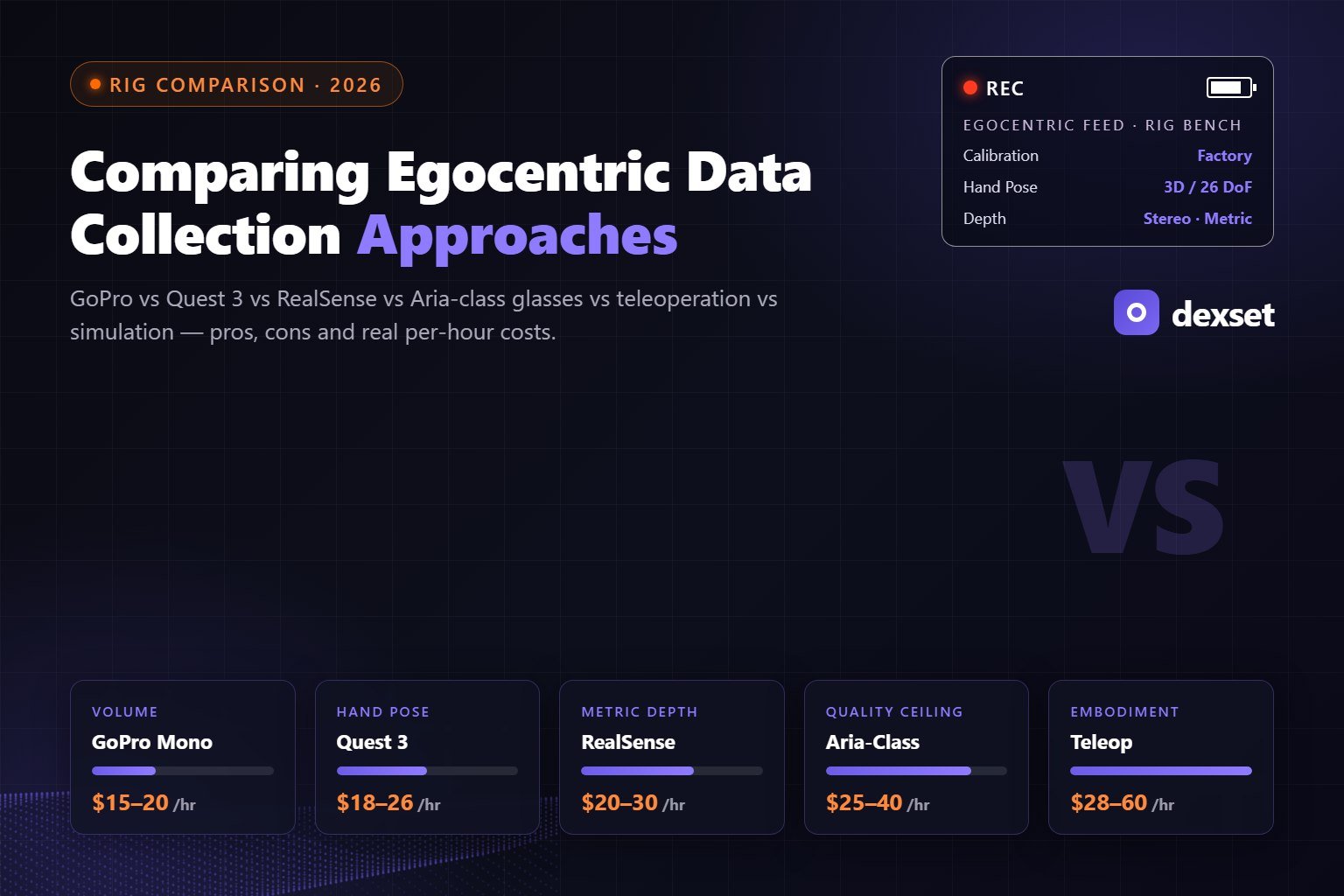
Key Takeaways – Rig choice should follow training mechanism: mono action cams for encoder pretraining, instrumented glasses for action retargeting, stereo depth helmets for metric 3D, teleop for embodiment-matched fine-tuning. – Our finished-hour cost benchmarks: GoPro mono $15 to $20, Quest 3 $18 to $26, RealSense helmet $20 to $30, Aria-class glasses $25 to $40, teleoperation $28 to $60. – Cheap capture is not cheap data. Uncalibrated mono footage shifts cost from hardware to annotation and 3D lifting compute. – Simulation complements rather than replaces real capture; the sim-to-real gap in contact-rich manipulation remains the limiting factor. – Pilot 50 to 100 hours on your shortlisted rig and train on it before committing to a full program.

What Counts as an Egocentric Collection Approach?

An egocentric collection approach is the combination of a wearable sensor rig, a capture protocol, and a post-processing pipeline that together produce first-person training episodes. The rig gets the attention, but all three layers set your cost. A $500 headset with a sloppy protocol produces more expensive data than a disciplined GoPro program, once you price the rejected hours.

For orientation across the whole field of modalities, hardware, and economics, see our pillar: The Complete Guide to Egocentric Data Collection for Robotics. This post narrows to the comparison question.

The Master Comparison Table

Approach Hardware Cost Sensors You Get Finished Cost/Hr (Our Benchmarks) Biggest Strength Biggest Weakness
GoPro head/chest mount $350 to $550 Mono RGB (wide FOV), IMU $15 to $20 Cheapest scale; rugged No depth, no hand pose; annotation-heavy
Meta Quest 3 ~$500 Stereo passthrough, IMU, hand tracking $18 to $26 Built-in 3D hand pose Constrained capture access; middling image quality
RealSense D435i/D455 helmet $700 to $1,200 built Stereo IR + RGB, active depth, IMU $20 to $30 Metric depth for manipulation Custom build; per-rig calibration burden
Aria-class research glasses Research program access Multi-camera RGB + SLAM, 2 IMUs, eye tracking, hand tracking $25 to $40 Factory calibration, gaze, richest streams Fleet scaling gated by program access
Teleoperation (ALOHA-class) ~$20K+ per station Robot proprioception + cameras, exact actions $28 to $60 Perfect embodiment match Throughput ceiling; capex and lab ops
Simulation Compute cost Anything you render $1 to $5 equivalent Infinite variation, free labels Sim-to-real gap in contacts and materials

Costs are DexSet production benchmarks for QA-passed hours at typical annotation depths; your protocol and rejection rate will move them.

GoPro Rigs: The Volume Play

A GoPro-based rig is a mono wide-angle action camera on a head or chest mount, and it remains the highest-throughput, lowest-cost way to collect egocentric video. We run 4K/60 or 2.7K/120 depending on task speed. The cameras survive kitchens, warehouses, and weather, batteries swap in seconds, and collectors need five minutes of training.

The costs arrive downstream. Mono RGB has no metric depth, so any 3D understanding must be lifted with structure-from-motion or learned depth, and hand pose must be estimated rather than measured. For encoder pretraining on thousands of hours, that trade is usually correct; the Ego4D corpus proved how far lightly instrumented first-person video can go (arXiv:2110.07058). For action retargeting, it is usually wrong.

Choose when: you need thousands of hours for representation learning and can tolerate estimated 3D. Avoid when: your pipeline consumes metric hand trajectories.

Quest 3: The Accidental Capture Device

The Meta Quest 3 is a ~$500 consumer VR headset whose passthrough cameras and native hand tracking make it a surprisingly capable egocentric rig. The hand tracking is the point: you get approximate 3D hand pose at capture time, free, on hardware a college student can buy retail. Teams also reuse the same headset as a teleoperation interface, which keeps the hardware pool simple.

The weaknesses are real. Access to raw passthrough streams is constrained by platform policy, effective image quality trails dedicated cameras, and wearing a headset for long capture shifts changes how people move; collectors are measurably more hesitant in headset than in glasses, and that hesitancy shows up in the motion statistics of your dataset.

Choose when: hand pose matters, budget is tight, and sessions are short. Avoid when: you need long natural sessions or top-tier image quality.

RealSense Helmet Rigs: Metric Depth on a Budget

A RealSense helmet rig mounts an Intel D435i or D455 stereo depth camera on headgear, giving hardware-synced stereo, active depth, and an onboard IMU for roughly $700 to $1,200 built. The D455’s 95 mm baseline improves depth accuracy at room distances over the D435i’s 50 mm; we pick per task family. When your consumers need metric 3D (grasp point estimation, sim scene reconstruction, depth-conditioned policies), this is the price-performance sweet spot.

You pay in operations. These are custom builds, so calibration is on you, mounts loosen, IR projectors misbehave in sunlight, and USB bandwidth is a daily negotiation. Budget real engineering time or the depth streams silently degrade.

Choose when: metric depth is a hard requirement. Avoid when: you cannot staff rig maintenance.

Aria-Class Glasses: The Quality Ceiling

Aria Gen 2 research glasses are purpose-built egocentric capture devices with calibrated multi-camera arrays, dual IMUs, eye tracking, and on-device machine perception (projectaria.com). Data arrives factory-calibrated with services for SLAM and hand tracking, which deletes whole stages of your post-processing pipeline. EgoExo4D was collected on Aria hardware (arXiv:2311.18259), and retargeting work like EgoMimic used Aria capture as its human-data source (arXiv:2410.24221). Collectors also behave naturally in glasses, which matters more than teams expect.

The constraint is access: these are research program devices rather than retail products, so fleet scaling depends on program terms rather than a purchase order.

Choose when: you need retargeting-grade data with gaze and hand pose at research quality. Avoid when: your plan requires buying 200 units next month.

Teleop and Sim: The Two Non-Egocentric Alternatives

Teleoperation and simulation are the alternatives every budget conversation reaches, and both are complements rather than substitutes. Teleoperation through ALOHA-class rigs (arXiv:2304.13705) is the only approach that produces exact robot-embodiment actions, which is why fine-tuning sets are teleop even when pretraining is egocentric; the LeRobot ecosystem has standardized much of this tooling (github.com/huggingface/lerobot). Simulation generates unlimited labeled variation at $1 to $5 per equivalent hour, and remains weakest exactly where manipulation is hardest: contact dynamics, deformables, and material appearance.

Decision Matrix: Match the Rig to the Mechanism

Your Training Objective First Choice Second Choice
Visual encoder pretraining at scale GoPro mono Quest 3
Action retargeting to grippers Aria-class glasses Quest 3
Depth-conditioned manipulation RealSense helmet Aria-class glasses
Embodiment-matched fine-tuning Teleoperation (no substitute)
Domain randomization / rare events Simulation Sim + real mix

Choosing From Here

The full economics, QA gates, and rig field notes behind this comparison are in the pillar guide linked above. If you would rather see the data than read about it, book a demo and we will put sample episodes from three different rigs side by side on a call.

Frequently Asked Questions

Which egocentric capture rig is cheapest per hour?

GoPro-based mono rigs are cheapest in our benchmarks at $15 to $20 per finished hour, but they shift cost into annotation and 3D lifting because they capture no depth or hand pose.

Yes, for short sessions where 3D hand pose matters and budgets are tight. Its native hand tracking provides approximate pose at capture time, though passthrough access limits and image quality keep it below dedicated rigs for long natural capture.

When downstream consumers need metric 3D: grasp point estimation, scene reconstruction for sim, or depth-conditioned policies. RealSense D435i/D455 helmet rigs are the common budget path; Aria-class glasses the research-grade one.

No. Simulation adds cheap variation and labels but still misses contact dynamics and material realism in manipulation, so real egocentric and teleop data remain necessary anchors.

Derive the choice from your training mechanism: mono for encoder pretraining, instrumented glasses or Quest 3 for retargeting, stereo helmets for metric depth, teleoperation for embodiment-matched fine-tuning. Pilot 50 to 100 hours before scaling.

Four Ways to Buy Robot Training Data, Compared: Pros, Cons, and Costs

Taped above a monitor in a buyer’s office we visited last year was a coffee-stained, three-page acceptance spec, its 10 ms sync tolerance circled twice in red pen. That battered document was doing more procurement work than the forty-page RFP folder on the shelf beside it, because it forced every vendor quote onto the same axes. It also marked its owners as unusual: teams rarely frame “how are we going to buy this” as a decision at all. They email two vendors someone met at CoRL, pick the cheaper quote, and only discover they chose a procurement approach when it fails.

The failure is predictable because each buying approach has a known cost structure and a known blind spot. An informal purchase is fast and blind. A full RFP is thorough and slow. A pilot-first approach measures what matters but covers one vendor at a time. Open datasets are free and almost never match your embodiment or task distribution.

This post compares the four approaches on speed, cost, and risk, with the math that lets you pick deliberately. It draws on the same scorecard and pilot protocol as our full Robotics Data Buyer’s Playbook, which is where the reusable templates live.

At DexSet we respond to all four buying styles weekly, so we see their outcomes from the supplier side: which approaches produce clean contracts and which produce disputes about what “an hour of data” was supposed to mean.

Key Takeaways

  • There are four common procurement approaches: informal purchase, full RFP + scorecard, pilot-first, and open-data-plus-top-up. Each has a distinct cost and risk profile.
  • Informal buying is cheapest to run ($0 process cost) and most expensive to survive: yield surprises routinely add 20 to 40 percent to effective cost.
  • The RFP + scorecard + pilot combination costs roughly 3 to 5 weeks and $1,500 to $4,500 in pilot fees, and is the only approach that measures quality before annual commitment.
  • Open datasets (Open X-Embodiment, DROID, Ego4D) are excellent for pretraining and mixing, but embodiment and task mismatch means most teams still purchase targeted data on top.

Approach 1: Informal Purchase

An informal purchase is vendor selection without a written specification, scoring method, or pilot: the buyer requests quotes, reviews sample clips, and signs with the most convincing option. It is how most first data purchases happen, and it is defensible exactly once, at very small volume, when you are still learning what to specify.

Pros: fastest path to first data (days, not weeks); no process overhead; fine for exploratory volumes under 20 hours.

Cons: samples are curated, so latent defects (sync offsets, calibration drift) go undetected; quotes are not comparable because no shared spec exists; no contractual yield commitment, so failed hours are your loss; format surprises arrive with the first delivery.

Cost profile: zero process cost up front. In our benchmarks, yield surprises and conversion work typically add 20 to 40 percent to effective per-usable-hour cost versus a piloted vendor. At 1,000 hours, that is $8,000 to $16,000 of avoidable spend on a $40/hr program.

Approach 2: Full RFP with Weighted Scorecard

A full RFP approach sends a written acceptance spec and a fixed question set to five to eight vendors, then scores responses on weighted criteria before any commitment. This is classic procurement discipline adapted to robot data: quality SLAs, calibration and sync specs, throughput evidence, pricing transparency, licensing terms.

Pros: quotes become comparable because everyone bids the same spec; weak vendors self-eliminate (in our experience, roughly a third of recipients answer with adjectives instead of numbers); the scorecard creates an audit trail for the decision; licensing and consent problems surface before signature.

Cons: takes two to four weeks; still paper-based, so a vendor can score well and underdeliver; overkill below roughly $25,000 in annual data spend.

Cost profile: the process costs internal time only, typically 20 to 30 person-hours across spec writing, scoring, and reconciliation. It buys you comparability and eliminates the worst outcomes, but on its own it does not measure production quality.

Approach 3: Pilot-First

A pilot-first approach skips broad solicitation and goes straight to a 50-hour paid pilot with one or two candidate vendors, judged on predefined metrics: usable-hour yield, annotation audit accuracy, policy success delta on a fixed eval set, and loader time into LeRobot or RLDS. It optimizes for measured evidence over paper promises.

Pros: measures the only thing that matters, production output; small, fixed downside ($1,500 to $4,500 per pilot at market rates); fast when you already know the credible vendors; the policy-delta test catches defects no document review can.

Cons: covers only the vendors you pilot, so a better option may never be evaluated; sequential pilots take longer than parallel paper scoring; requires you to have a stable eval task set and baseline policy, which very early teams may lack.

Cost profile: $3,000 to $9,000 to pilot two vendors, plus about one engineer-week for evaluation. Expensive compared to reading PDFs, cheap compared to one bad quarter of deliveries.

Approach 4: Open Data Plus Targeted Top-Up

The open-data approach builds the base training mix from public corpora, then purchases only the targeted data the public sets cannot provide. The public layer is genuinely strong now: Open X-Embodiment spans over one million episodes across 22 embodiments (arxiv.org/abs/2310.08864), DROID adds 76,000 diverse teleop episodes (arxiv.org/abs/2403.12945), and Ego4D provides thousands of hours of egocentric human video (arxiv.org/abs/2110.07058), most of it accessible through Hugging Face dataset cards and RLDS tooling.

Pros: near-zero acquisition cost for pretraining scale; well-documented formats (RLDS, LeRobot conversions); community-validated quality.

Cons: embodiment mismatch (your gripper, camera placement, and control rates differ from the source robots); task distribution rarely matches your product; licenses vary and some restrict commercial use, so legal review is not optional; fine-tuning still demands in-domain demonstrations, which puts you back in one of the first three approaches for the data that moves your metrics most.

Cost profile: storage and engineering only for the public layer, then standard market rates ($28 to $60 per teleop hour, $15 to $40 per egocentric hour in our benchmarks) for the top-up volume, which is typically 10 to 30 percent of total hours but drives most of the task-specific performance.

Side-by-Side Comparison

The four approaches differ most in where they spend money: process time up front, or rework after delivery.

Approach Time to contract Process cost Quality measured before commitment? Typical effective cost penalty vs piloted baseline Best for
Informal purchase 3–10 days ~$0 No +20–40% Exploratory buys under 20 hours
Full RFP + scorecard 2–4 weeks 20–30 person-hours Partially (paper only) +5–15% Annual spend above $25k, multiple candidate vendors
Pilot-first 2–3 weeks per vendor $1,500–$4,500 per pilot Yes Baseline Teams with stable eval tasks and known vendor shortlist
Open data + top-up 1–2 weeks (legal + integration) Engineering time Yes for public layer, no for top-up unless piloted Depends on top-up approach Pretraining scale plus targeted fine-tuning

The pattern most mature buyers converge on is a hybrid: RFP to filter the field, scorecard to rank it, pilot to verify the winner, open data underneath it all as the pretraining base. That sequence is exactly what the Robotics Data Buyer’s Playbook packages, including the scorecard weights and pilot pass/fail thresholds.

One sequencing note from the supplier side: run the approaches in that order, not in parallel. Teams that pilot before writing a spec end up measuring vendors against criteria invented after the data arrived, which makes the results unarguable in exactly the wrong way; nobody can agree what a pass looks like. Teams that RFP without a spec get six incomparable quotes and mistake the spread for market variance. The spec is upstream of everything, takes about a week to write, and is the only artifact in the process that costs nothing but attention.

Next Step

Ready to scope your data program? Talk to our team.

Frequently Asked Questions

Which robot data procurement approach is cheapest overall?

The RFP-plus-pilot hybrid, once volume passes roughly $25,000 per year. Informal buying has the lowest process cost but the highest effective cost, because yield surprises add 20 to 40 percent on typical programs.

Not fully. Open X-Embodiment, DROID, and Ego4D are strong pretraining bases, but embodiment and task mismatch means fine-tuning still needs in-domain demonstrations, typically 10 to 30 percent of total hours purchased to spec.

For exploratory volumes under about 20 hours, where the goal is learning what to specify rather than feeding a production training run. Anything feeding a release model deserves at least a pilot.

Send the RFP to five to eight vendors, score all responses, then pilot the top one or two. Piloting more than two rarely changes the decision and doubles the evaluation load.

Four numbers agreed in advance: usable-hour yield (target 85 percent or higher), annotation accuracy on an independently re-labeled 5 percent sample (97 percent or higher), policy success delta on a fixed eval set, and loader time into your training format (one engineer-day or less).

Teleop, Egocentric, Exocentric, or Handheld: Comparing Robot Training Data Approaches by Cost

In February, we priced the same 5,000-hour manipulation corpus three different ways for one buyer: all bimanual teleoperation at a blended $44 per hour, a 65/35 egocentric-to-teleop mix at just under $30, and a handheld-gripper-heavy plan in between. Same task list, same acceptance spec. The spread between the first two plans came to roughly $70,000.

I build teleop cells for a living, so this is not an argument against teleoperation. It is the thesis that quoting exercise made unavoidable: modality selection is a budgeting decision, and the right modality for each training objective is the cheapest one that actually satisfies it. For plenty of what your model needs to learn, the premium teleop hour is simply the wrong purchase.

Teams get this wrong in both directions. Some buy 20,000 hours of premium teleop and burn budget teaching their encoder what a kitchen looks like, a job $18-per-hour egocentric video does fine. Others go all-in on cheap human video and then discover their policy has beautiful representations and no idea how to move an actual gripper.

The reason the mistake is so common is that modality costs and modality capabilities are usually discussed separately. Cost tables live in procurement decks; capability arguments live in arXiv papers. This post puts them in one place, with DexSet’s operating benchmarks attached, so you can match each dollar to the learning objective it actually serves.

By the end you will have per-hour costs for four collection approaches, an honest pros-and-cons list for each, and a decision matrix that maps training objectives to the cheapest modality that satisfies them.

Key Takeaways

  • Teleoperation ($28 to $60/hr) is the only approach that outputs executable robot actions natively. Pay for it where action supervision matters.
  • Egocentric human video ($15 to $40/hr) is the cheapest volume play, best for representation pretraining, worst for the embodiment gap.
  • Multi-view exocentric capture ($20 to $50/hr) buys scene context and cross-view consistency; calibration labor is its hidden cost.
  • UMI-style handheld grippers (under $1k per device by our estimates) collect gripper-centric data at near-egocentric labor cost, with heavier post-processing.
  • QA rejection (10 to 30 percent in our pipelines) and annotation ($8 to $25/hr per pass) apply to all four. Compare on cost per usable hour.

The Four Approaches, Defined

A data collection approach is the pairing of a capture device with a control source: robot teleoperation, head-mounted egocentric capture, calibrated exocentric camera arrays, or handheld instrumented grippers. Everything else, mono versus stereo, camera count, annotation depth, is a variation within these four.

Teleoperation: $28 to $60 per Hour

Teleoperation data is produced by a human driving a real robot through leader-follower arms or a VR interface, so every recorded frame pairs observations with executable actions in the robot’s own action space. The ALOHA project showed this could be done on a roughly $20k bimanual rig (https://arxiv.org/abs/2304.13705), and Mobile ALOHA extended it to whole-body mobile tasks on roughly $32k of hardware (https://arxiv.org/abs/2401.02117).

Pros

  • Native action labels; feeds imitation learning and VLA post-training directly
  • Matches your exact embodiment, gripper, and camera placement
  • Long-horizon, contact-rich tasks are demonstrable at production quality

Cons

  • Highest labor cost: trained operators at $18 to $38 per hour, plus rig amortization and QA
  • Throughput capped by operator skill and episode reset time
  • Data is embodiment-specific; switching robots strands some of its value

Egocentric Human Video: $15 to $40 per Hour

Egocentric data is first-person video from a head-mounted camera while a human performs tasks with their own hands, capturing human-level dexterity with no robot in the loop. Ego4D and EgoExo4D (https://arxiv.org/abs/2311.18259) made the research case; the commercial case is pure economics, since the collector works at natural speed on tasks they already know.

Pros

  • Cheapest per hour; scales to thousands of hours quickly
  • Enormous task and scene diversity, including real homes
  • Strong pretraining signal for visual encoders and hand-object interaction priors

Cons

  • No robot actions; the embodiment gap means it rarely supervises control directly
  • QA rejection skews high (motion blur, gaze drift, occlusion), 15 to 30 percent in our pipelines
  • Needs retargeting or paired data to transfer to a gripper

Multi-View Exocentric Capture: $20 to $50 per Hour

Exocentric data is third-person video from multiple calibrated, synchronized cameras observing the same task, giving models scene-level context and cross-view consistency that neither ego nor teleop streams provide alone. Stereo pairs add 15 to 25 percent over mono at the same view count and buy metric depth in return.

Pros

  • Full-scene coverage; occlusions in one view are recovered in another
  • Calibrated multi-view supports 3D reconstruction and world-model training
  • Pairs well with egocentric streams (the EgoExo4D recipe)

Cons

  • Calibration and synchronization labor at every scene change is the silent budget eater
  • Fixed arrays limit scene diversity; mobile arrays raise cost
  • Still no action labels without a paired control source

Handheld Instrumented Grippers (UMI-style): Near-Egocentric Cost, Gripper-Centric Output

Handheld gripper capture uses a portable, wrist-camera-equipped gripper operated by a human, producing gripper-centric trajectories without any robot present at collection time. The UMI paper (https://arxiv.org/abs/2402.10329) defined the category; our build estimate is under $1,000 per device including the camera.

Pros

  • Capex is trivial next to a $20k to $32k teleop cell
  • Collection happens anywhere a person can walk, at near-egocentric labor rates
  • Output is closer to robot action space than raw human video

Cons

  • Heavier post-processing to recover clean actions (SLAM drift, kinematic mismatch)
  • Gripper form factor constrains which tasks are demonstrable
  • QA tooling for this modality is younger; expect iteration

Master Comparison Table

Approach DexSet cost/raw hr Capex per station Action labels QA rejection Best use
Teleoperation $28 to $60 $20k to $32k Native 10 to 25% VLA post-training, imitation learning
Egocentric video $15 to $40 $300 to $3.5k None 15 to 30% Encoder pretraining, dexterity priors
Exocentric multi-view $20 to $50 $5k to $15k (3 to 8 cams) None 10 to 20% Scene context, world models, 3D
Handheld gripper (UMI-style) $18 to $42 (our estimate) Under $1k/device Recoverable 15 to 25% Diverse-scene manipulation at low capex

Annotation is additive to every row: $8 to $12 per hour for language instructions, up to $18 to $25 for dense masks and contact labels. And every row’s real price is its cost per usable hour: divide by (1 minus rejection rate). The full math, with a budget spreadsheet, lives in our robot training data costs and pricing guide.

Decision Matrix: Match the Dollar to the Objective

A modality decision matrix assigns each training objective the cheapest approach that actually satisfies it, instead of defaulting everything to the premium modality. Here is the one we use in scoping calls:

Your objective Buy this Not this Why
Post-train a VLA on your robot Teleoperation Egocentric You need native actions on your embodiment
Pretrain visual encoders at volume Egocentric Teleoperation Paying $42/hr for pixels is waste
Scene diversity across 100+ homes Handheld gripper or egocentric Fixed exo array Portability beats calibration
Depth-dependent manipulation Stereo exo + teleop Mono anything Metric depth earns its 15 to 25% premium
World-model or video-prediction training Exo multi-view + ego pairs Teleop only Cross-view consistency is the signal
Bimanual, contact-rich skills Teleoperation (ALOHA-class) Handheld gripper Two grippers, force-aware demos

The pattern behind the matrix: mix modalities and stage them. Open X-Embodiment’s 1M+ trajectories across 22 embodiments (https://arxiv.org/abs/2310.08864) and DROID’s 76k episodes (https://arxiv.org/abs/2403.12945) already prove cross-source data mixes train better generalists. Your budget should look like a portfolio, not a single line item. A 70/30 split of cheap pretraining hours to teleop post-training hours routinely cuts blended cost by a third in programs we run, with no loss on the action-supervised objectives.

Match the Modality to the Objective

Ready to scope your data program? Talk to our team.

Frequently Asked Questions

What is the cheapest way to collect robot training data?

Egocentric human video, at $15 to $40 per hour in our benchmarks, since hardware is a wearable camera and collectors work at natural speed. It is cheapest per hour but supplies no robot actions, so it cannot carry a program alone.

When you need executable actions on your specific embodiment: VLA post-training, imitation learning for contact-rich or bimanual skills. For those objectives nothing cheaper substitutes, which is exactly why you should not spend teleop dollars on anything else.

They are production-useful with caveats. Capex is under $1,000 per device by our estimates and scene diversity is the widest of the four approaches, but plan for heavier post-processing and a 15 to 25 percent rejection rate while the QA tooling matures.

Stereo adds 15 to 25 percent to exocentric capture cost and pays for itself on depth-dependent manipulation tasks. For pure representation pretraining, mono volume usually beats stereo precision per dollar.

Convert everything to cost per usable hour: quoted rate divided by (1 minus the measured QA rejection rate), plus annotation per pass. Our pricing guide includes the worked tables.

Start with the Robot Training Data Costs and Pricing Guide for the full benchmark tables, then book a scoping call and we will run your task list through the decision matrix above.

Comparing Exocentric & Multi-View Data Approaches for Robot Learning: Pros, Cons & Costs

A buyer on a scoping call last month put the field’s confusion into one sentence: everyone tells him to collect multi-view data, and nobody will tell him which multi-view. He was right to push. “Multi-view” describes at least five distinct capture strategies with different rig costs, different failure modes, and different value per training hour, and the honest answer, the thesis of this post, is that the right configuration is determined by your task list and training strategy, not by your budget or by whichever public dataset you read about first. Choosing the wrong one is not a small mistake. A team that builds a six-camera arc when their tasks needed a wrist camera and one tripod has burned rig budget, tripled their storage bill, and slowed capture throughput for nothing.

The confusion is understandable. Public datasets each embody one choice without explaining the alternatives: DROID picked two external stereo cameras plus wrist, Ego-Exo4D picked glasses plus stationary exo arrays, and Open X-Embodiment inherited whatever its 22 source labs happened to mount. The papers report what was captured, not the decision tree.

This post is that decision tree. We compare the five approaches we quote and build most often at DexSet, with honest pros, cons, and cost ranges from our own rigs, and end with a matrix mapping task types to configurations. For the underlying camera specs, calibration toolchain, and sync engineering, see the pillar guide: The Complete Guide to Exocentric & Multi-View Data for Robot Learning.

Key Takeaways – Five capture approaches dominate: single exo + wrist, DROID-style (2 exo + wrist), ego+exo paired human capture, dense arrays (4-8 cameras), and sim-rendered multi-view. – DROID-style is the default for tabletop manipulation and VLA training data: $4,500 to $7,000 rig, $26 to $38 per operated hour in our benchmarks. – Ego+exo paired capture is the only approach that supports human-video pretraining with cross-view transfer; it costs more in sync engineering than in cameras. – Sim-rendered views are nearly free per view but inherit the sim-to-real gap; they complement real capture, they do not replace it.

The Five Approaches, Defined

A capture approach is the combination of camera count, camera placement, actor type (robot or human), and sync method used to record training episodes. The five that cover almost every real program:

  • Single exocentric + wrist. One fixed external camera plus a wrist camera on the robot. The minimum viable multi-view setup.
  • DROID-style: two exocentric stereo + wrist. Two external stereo cameras (ZED 2i class) at distinct poses plus a wrist camera, calibrated extrinsics, as used across DROID’s 76,000 episodes (arXiv:2403.12945).
  • Ego + exo paired human capture. Glasses or head-mounted camera on a human demonstrator plus stationary exocentric cameras, the Ego-Exo4D pattern (arXiv:2311.18259).
  • Dense array (4-8 cameras). Hardware-triggered ring or arc around the workspace for reconstruction-grade coverage.
  • Sim-rendered multi-view. Arbitrary virtual cameras rendered from simulation, optionally mixed with real data.

Master Comparison Table

Approach Rig Build Capture Cost / Hr Sync Difficulty Occlusion Coverage Human-Video Pretraining Main Risk
Single exo + wrist $2,500 to $4,000 $20 to $28 Low Partial No Blind spots remain
DROID-style (2 exo + wrist) $4,500 to $7,000 $26 to $38 Moderate Good No Calibration upkeep
Ego + exo paired $6,000 to $9,500 $32 to $44 High (moving ego cam) Good Yes Ego-exo time alignment
Dense array (4-8 cams) $9,000 to $12,000 $40 to $50 High (trigger/genlock) Excellent No Storage, diminishing returns
Sim-rendered multi-view Compute only ~$1 to $5 equivalent None Perfect Limited Sim-to-real gap

Rig and capture figures are DexSet benchmarks, including session calibration checks and QA; sim figures are rough GPU-time equivalents.

Where Each Approach Wins and Loses

Single exo + wrist earns its place as a starting point. Pros: cheapest real multi-view, simple calibration (one extrinsic pair), enough to break the wrist-only occlusion ceiling for many tasks. Cons: one blocked view and you are back to single-view; no view redundancy for QA cross-checks. We recommend it for prototyping and single-task policies, and we recommend planning the mount points for camera two on day one.

DROID-style is the workhorse, and not by accident. Two external views mean occlusion of one is usually covered by the other; three total views give the RoboMimic-style observation flexibility that lets ML teams ablate view combinations later (arXiv:2108.03298). Cons: per-session calibration verification becomes mandatory, because three cameras drift three ways. In our operations the added QA overhead is roughly 5 percent of session time. This is what we quote when a VLA team asks for a default.

Ego + exo paired solves a different problem: it is the only configuration that produces the ego-exo correspondences needed to pretrain on human demonstration video and transfer to robot viewpoints, the exact gap Ego-Exo4D was built to close. Pros: human demonstrators are fast and cheap per episode; the data doubles as a bridge to large human-video corpora. Cons: the ego camera moves, so extrinsics to the world frame change every frame and must be recovered via SLAM or the glasses’ own tracking; time alignment between glasses and fixed cameras is the hardest sync problem on this list. Choose it when your training strategy explicitly includes human video.

Dense arrays buy near-complete coverage and reconstruction-grade geometry for humanoid whole-body work and world-model data. The cons compound quietly: hardware triggering or genlock is effectively mandatory, storage runs 3 to 4 TB per capture day at 1080p30 in our pipelines, and, in every ablation we have run on single-arm manipulation, cameras five through eight never moved the success metric. Buy this coverage for reconstruction, not for policy learning on tabletop tasks.

Sim-rendered multi-view costs almost nothing per additional view, which is genuinely useful for view-invariance augmentation and architecture prototyping. But every rendered view inherits the simulator’s gap in contact dynamics, materials, and lighting. Teams in the Open X-Embodiment consortium (arXiv:2310.08864) mix sim and real rather than substituting one for the other, and that matches our experience: sim views stretch a real multi-view dataset, they do not replace it.

Decision Matrix: Match the Approach to the Program

Your Situation Recommended Approach
Prototyping one task, tight budget Single exo + wrist, mounts pre-planned for a second exo
Training VLA / manipulation foundation data at scale DROID-style (2 exo + wrist)
Pretraining on human demonstrations or video Ego + exo paired
Humanoid whole-body, reconstruction, world models Dense array, hardware-triggered
Need view diversity beyond rig budget DROID-style real capture + sim-rendered augmentation

One category the table cannot capture: switching costs. Moving from single-exo to DROID-style mid-program is cheap if the mount points and calibration workflow were planned for it, and painful if they were not, because your existing episodes and your new episodes will differ in geometry and your training pipeline has to reconcile them. Moving from robot-only capture to ego+exo is a bigger jump; it changes your demonstrator pool, your sync architecture, and your annotation scheme at once. Teams that expect to make either move should write the target configuration into their schema now, even if the extra cameras arrive next quarter.

Two cross-cutting rules. First, whatever you choose, log extrinsics and sync metadata into every episode; the approach you pick today is the aggregation problem someone inherits in two years. Second, ablate before you scale: run 20 hours in the candidate configuration, train, and let the success metric pick the rig.

Turn the Matrix Into a Procurement Rubric

If you are scoping a capture program or comparing vendors, download the Multi-View Rig RFP Scorecard. It turns this decision matrix into weighted evaluation questions on calibration verification, sync tolerances, and deliverable formats, the same rubric we hold our own rigs to.

Frequently Asked Questions

What is the cheapest way to get multi-view robot data?

A single external camera plus a wrist camera, at roughly $2,500 to $4,000 for the rig and $20 to $28 per operated capture hour in DexSet benchmarks. It breaks the wrist-only occlusion ceiling for many tasks but leaves blind spots a second external view would cover.

For VLA training data and tabletop manipulation at scale, usually yes: the second external view covers occlusions the first misses and enables view ablations later. The premium over single-exo is about $2,000 to $3,000 in rig cost and $6 to $10 per hour.

No. Rendered views are nearly free and useful for view-invariance augmentation, but they inherit the simulator’s gaps in contact dynamics, materials, and lighting. Production programs mix sim views with real calibrated capture rather than substituting.

When your training plan includes learning from human demonstration video. Paired capture, as in Ego-Exo4D, provides the cross-view correspondences needed to transfer first-person human priors to third-person robot viewpoints.

Task-dependent, but in our single-arm manipulation ablations, cameras beyond the third stopped moving policy success while adding roughly 25 percent storage and QA cost per view. Dense arrays of 4 to 8 cameras are justified for reconstruction and whole-body humanoid work, not tabletop policies.