
Dexset

Teleop, Egocentric, Exocentric, or Handheld: Comparing Robot Training Data Approaches by Cost

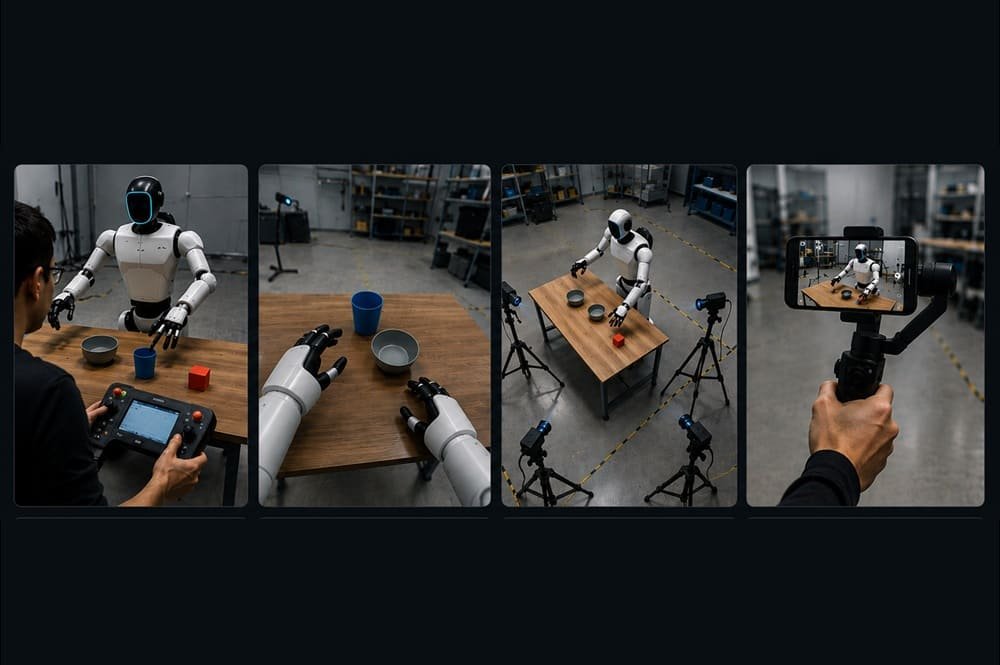
In February, we priced the same 5,000-hour manipulation corpus three different ways for one buyer: all bimanual teleoperation at a blended $44 per hour, a 65/35 egocentric-to-teleop mix at just under $30, and a handheld-gripper-heavy plan in between. Same task list, same acceptance spec. The spread between the first two plans came to roughly $70,000.

I build teleop cells for a living, so this is not an argument against teleoperation. It is the thesis that quoting exercise made unavoidable: modality selection is a budgeting decision, and the right modality for each training objective is the cheapest one that actually satisfies it. For plenty of what your model needs to learn, the premium teleop hour is simply the wrong purchase.

Teams get this wrong in both directions. Some buy 20,000 hours of premium teleop and burn budget teaching their encoder what a kitchen looks like, a job $18-per-hour egocentric video does fine. Others go all-in on cheap human video and then discover their policy has beautiful representations and no idea how to move an actual gripper.

The reason the mistake is so common is that modality costs and modality capabilities are usually discussed separately. Cost tables live in procurement decks; capability arguments live in arXiv papers. This post puts them in one place, with DexSet’s operating benchmarks attached, so you can match each dollar to the learning objective it actually serves.

By the end you will have per-hour costs for four collection approaches, an honest pros-and-cons list for each, and a decision matrix that maps training objectives to the cheapest modality that satisfies them.

Key Takeaways

  • Teleoperation ($28 to $60/hr) is the only approach that outputs executable robot actions natively. Pay for it where action supervision matters.
  • Egocentric human video ($15 to $40/hr) is the cheapest volume play, best for representation pretraining, worst for the embodiment gap.
  • Multi-view exocentric capture ($20 to $50/hr) buys scene context and cross-view consistency; calibration labor is its hidden cost.
  • UMI-style handheld grippers (under $1k per device by our estimates) collect gripper-centric data at near-egocentric labor cost, with heavier post-processing.
  • QA rejection (10 to 30 percent in our pipelines) and annotation ($8 to $25/hr per pass) apply to all four. Compare on cost per usable hour.

The Four Approaches, Defined

A data collection approach is the pairing of a capture device with a control source: robot teleoperation, head-mounted egocentric capture, calibrated exocentric camera arrays, or handheld instrumented grippers. Everything else, mono versus stereo, camera count, annotation depth, is a variation within these four.

Teleoperation: $28 to $60 per Hour

Teleoperation data is produced by a human driving a real robot through leader-follower arms or a VR interface, so every recorded frame pairs observations with executable actions in the robot’s own action space. The ALOHA project showed this could be done on a roughly $20k bimanual rig (https://arxiv.org/abs/2304.13705), and Mobile ALOHA extended it to whole-body mobile tasks on roughly $32k of hardware (https://arxiv.org/abs/2401.02117).

Pros

  • Native action labels; feeds imitation learning and VLA post-training directly
  • Matches your exact embodiment, gripper, and camera placement
  • Long-horizon, contact-rich tasks are demonstrable at production quality

Cons

  • Highest labor cost: trained operators at $18 to $38 per hour, plus rig amortization and QA
  • Throughput capped by operator skill and episode reset time
  • Data is embodiment-specific; switching robots strands some of its value

Egocentric Human Video: $15 to $40 per Hour

Egocentric data is first-person video from a head-mounted camera while a human performs tasks with their own hands, capturing human-level dexterity with no robot in the loop. Ego4D and EgoExo4D (https://arxiv.org/abs/2311.18259) made the research case; the commercial case is pure economics, since the collector works at natural speed on tasks they already know.

Pros

  • Cheapest per hour; scales to thousands of hours quickly
  • Enormous task and scene diversity, including real homes
  • Strong pretraining signal for visual encoders and hand-object interaction priors

Cons

  • No robot actions; the embodiment gap means it rarely supervises control directly
  • QA rejection skews high (motion blur, gaze drift, occlusion), 15 to 30 percent in our pipelines
  • Needs retargeting or paired data to transfer to a gripper

Multi-View Exocentric Capture: $20 to $50 per Hour

Exocentric data is third-person video from multiple calibrated, synchronized cameras observing the same task, giving models scene-level context and cross-view consistency that neither ego nor teleop streams provide alone. Stereo pairs add 15 to 25 percent over mono at the same view count and buy metric depth in return.

Pros

  • Full-scene coverage; occlusions in one view are recovered in another
  • Calibrated multi-view supports 3D reconstruction and world-model training
  • Pairs well with egocentric streams (the EgoExo4D recipe)

Cons

  • Calibration and synchronization labor at every scene change is the silent budget eater
  • Fixed arrays limit scene diversity; mobile arrays raise cost
  • Still no action labels without a paired control source

Handheld Instrumented Grippers (UMI-style): Near-Egocentric Cost, Gripper-Centric Output

Handheld gripper capture uses a portable, wrist-camera-equipped gripper operated by a human, producing gripper-centric trajectories without any robot present at collection time. The UMI paper (https://arxiv.org/abs/2402.10329) defined the category; our build estimate is under $1,000 per device including the camera.

Pros

  • Capex is trivial next to a $20k to $32k teleop cell
  • Collection happens anywhere a person can walk, at near-egocentric labor rates
  • Output is closer to robot action space than raw human video

Cons

  • Heavier post-processing to recover clean actions (SLAM drift, kinematic mismatch)
  • Gripper form factor constrains which tasks are demonstrable
  • QA tooling for this modality is younger; expect iteration

Master Comparison Table

Approach DexSet cost/raw hr Capex per station Action labels QA rejection Best use
Teleoperation $28 to $60 $20k to $32k Native 10 to 25% VLA post-training, imitation learning
Egocentric video $15 to $40 $300 to $3.5k None 15 to 30% Encoder pretraining, dexterity priors
Exocentric multi-view $20 to $50 $5k to $15k (3 to 8 cams) None 10 to 20% Scene context, world models, 3D
Handheld gripper (UMI-style) $18 to $42 (our estimate) Under $1k/device Recoverable 15 to 25% Diverse-scene manipulation at low capex

Annotation is additive to every row: $8 to $12 per hour for language instructions, up to $18 to $25 for dense masks and contact labels. And every row’s real price is its cost per usable hour: divide by (1 minus rejection rate). The full math, with a budget spreadsheet, lives in our robot training data costs and pricing guide.

Decision Matrix: Match the Dollar to the Objective

A modality decision matrix assigns each training objective the cheapest approach that actually satisfies it, instead of defaulting everything to the premium modality. Here is the one we use in scoping calls:

Your objective Buy this Not this Why
Post-train a VLA on your robot Teleoperation Egocentric You need native actions on your embodiment
Pretrain visual encoders at volume Egocentric Teleoperation Paying $42/hr for pixels is waste
Scene diversity across 100+ homes Handheld gripper or egocentric Fixed exo array Portability beats calibration
Depth-dependent manipulation Stereo exo + teleop Mono anything Metric depth earns its 15 to 25% premium
World-model or video-prediction training Exo multi-view + ego pairs Teleop only Cross-view consistency is the signal
Bimanual, contact-rich skills Teleoperation (ALOHA-class) Handheld gripper Two grippers, force-aware demos

The pattern behind the matrix: mix modalities and stage them. Open X-Embodiment’s 1M+ trajectories across 22 embodiments (https://arxiv.org/abs/2310.08864) and DROID’s 76k episodes (https://arxiv.org/abs/2403.12945) already prove cross-source data mixes train better generalists. Your budget should look like a portfolio, not a single line item. A 70/30 split of cheap pretraining hours to teleop post-training hours routinely cuts blended cost by a third in programs we run, with no loss on the action-supervised objectives.

Match the Modality to the Objective

Ready to scope your data program? Talk to our team.

Frequently Asked Questions

What is the cheapest way to collect robot training data?

Egocentric human video, at $15 to $40 per hour in our benchmarks, since hardware is a wearable camera and collectors work at natural speed. It is cheapest per hour but supplies no robot actions, so it cannot carry a program alone.

When you need executable actions on your specific embodiment: VLA post-training, imitation learning for contact-rich or bimanual skills. For those objectives nothing cheaper substitutes, which is exactly why you should not spend teleop dollars on anything else.

They are production-useful with caveats. Capex is under $1,000 per device by our estimates and scene diversity is the widest of the four approaches, but plan for heavier post-processing and a 15 to 25 percent rejection rate while the QA tooling matures.

Stereo adds 15 to 25 percent to exocentric capture cost and pays for itself on depth-dependent manipulation tasks. For pure representation pretraining, mono volume usually beats stereo precision per dollar.

Convert everything to cost per usable hour: quoted rate divided by (1 minus the measured QA rejection rate), plus annotation per pass. Our pricing guide includes the worked tables.

Start with the Robot Training Data Costs and Pricing Guide for the full benchmark tables, then book a scoping call and we will run your task list through the decision matrix above.
The Complete Guide to Exocentric & Multi-View Data for Robot Learning (2026)

You are three weeks from a milestone demo and the policy still drops the mug the moment the gripper crosses in front of it. The wrist camera looks perfect in the replay viewer, the demonstrations are clean, and none of it helps. The model never saw the scene from anywhere else, so the instant its one viewpoint goes blind, so does the policy.

The problem exists because most teams start with the camera that is easiest to mount, not the camera set that answers the questions their model will ask at inference time. A single egocentric or wrist view gives you fine-grained contact detail and nothing else: no scene context, no occlusion recovery, no spatial grounding for language-conditioned tasks. Fixing that after you have collected 400 hours of single-view teleoperation is expensive. Fixing it before you start costs a tripod and a calibration session.

The thesis of this guide is simple: camera geometry is a first-order training decision, not plumbing, and calibrated multi-view capture is the cheapest performance intervention most manipulation teams have not yet made. We will argue it three ways: with the published record (DROID, Ego-Exo4D, RoboMimic), with our own capture benchmarks and ablations, and with a worked customer example. This guide covers what exocentric and multi-view data actually is, which camera and rig configurations the major research datasets use, how to calibrate and synchronize multiple cameras without corrupting your dataset, and what all of it costs. The numbers come from our own capture operations at DexSet, where we run multi-camera teleoperation and human demonstration rigs daily for VLA and humanoid foundation model customers, plus the public dataset cards and papers we cite throughout.

TL;DR – Exocentric data is third-person footage of a robot or human performing a task; multi-view data captures the same episode from two or more calibrated, time-synchronized viewpoints at once. – The strongest public evidence for multi-view capture comes from DROID (two external stereo cameras plus a wrist camera on a Franka arm) and Ego-Exo4D (paired egocentric and exocentric video of skilled human activity). – Our benchmarks: a production-grade multi-view rig costs $2,500 to $12,000 to build, and calibrated multi-view capture runs $20 to $50 per hour depending on camera count, sync requirements, and QA depth. – The second camera delivers most of the benefit. In our ablations, going from one external view to two produced the largest jump in policy success; the fourth camera added little beyond storage cost. – Calibration drift and time sync are where multi-view datasets quietly die. Budget for recalibration checks every capture session, not every capture month.

What Is Exocentric Data for Robot Learning?

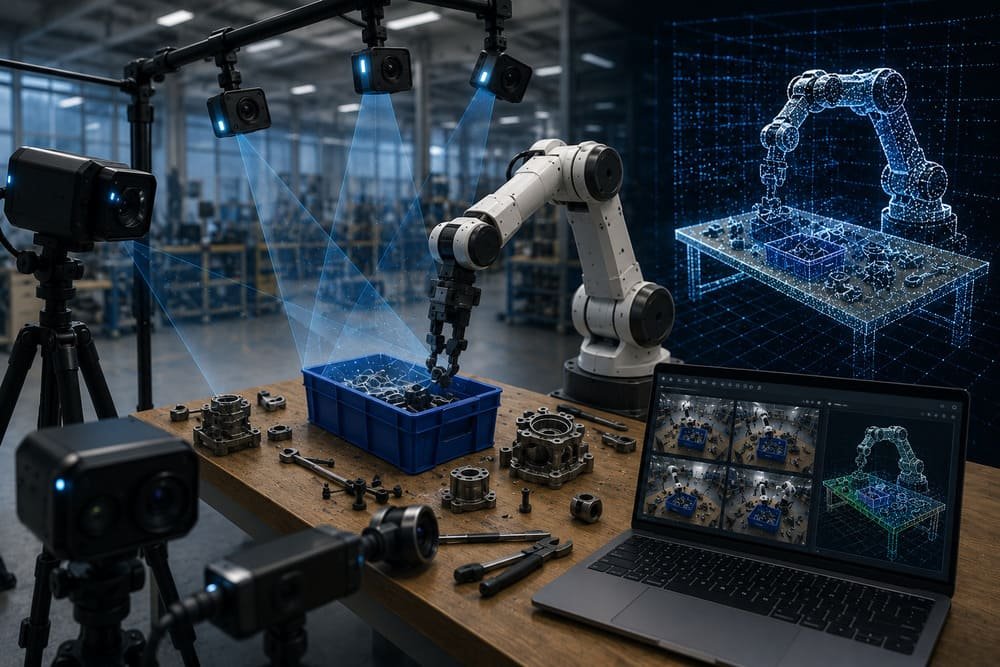
Exocentric data is visual data recorded from a third-person viewpoint that observes the robot or human demonstrator and the workspace from outside the body performing the task. A camera on a tripod behind the workbench, an overhead camera above a bin-picking cell, and a shoulder-height camera watching a humanoid fold towels are all exocentric views. The defining property is that the camera pose is independent of the actor’s motion.

Egocentric data is the complement: footage from the actor’s own perspective, such as smart glasses on a human demonstrator or a head-mounted camera on a humanoid. Wrist cameras sit in between; they move with the arm but do not share the actor’s gaze. Most serious manipulation stacks end up wanting both. The exocentric view supplies global scene context and object relationships, and the egocentric or wrist view supplies contact-level detail during grasps.

For a model, the practical difference shows up in failure modes. Policies trained only on exocentric views struggle with precise insertion because the interesting pixels are small and far away. Policies trained only on wrist views fail whenever the gripper blocks the object or the task requires reasoning about anything outside a 30 cm bubble. This is why datasets built for general-purpose policies pair the two rather than choosing.

What Is Multi-View Data?

Multi-view data captures a single episode from two or more cameras with known relative poses and aligned timestamps. Two properties separate a true multi-view dataset from a pile of videos that happen to point at the same table: calibrated extrinsics (each camera’s position and orientation relative to a shared frame, typically the robot base) and synchronization (frames across cameras correspond to the same instant, ideally within a few milliseconds).

Both properties are load-bearing. Without extrinsics, you cannot fuse views geometrically, project actions between frames, or train models that reason about 3D structure. Without sync, a policy learns from image pairs that show slightly different world states, which injects label noise you can never remove afterward. We reject capture sessions at DexSet when cross-camera timestamp skew exceeds 10 ms on manipulation tasks, because we have watched that skew turn into unexplainable policy failures downstream.

Multi-view is not the same as stereo. A stereo camera such as the ZED 2i is one viewpoint with two lenses on a fixed 12 cm baseline, built to estimate depth. A multi-view rig places whole cameras (mono, stereo, or RGB-D) at meaningfully different poses around the workspace. You can and often should combine them: two stereo cameras at different poses give you multi-view and per-view depth at once, which is exactly the configuration DROID chose.

What the Research Record Shows

The strongest public evidence for multi-view capture comes from three sources, and they agree with each other more than most robotics literature does.

DROID (arXiv:2403.12945, dataset) collected roughly 76,000 teleoperated episodes, about 350 hours, on Franka arms across 13 institutions and 564 distinct scenes. Every episode records two external ZED stereo cameras plus a wrist-mounted ZED Mini, with calibrated extrinsics. The authors made multi-view a hard requirement of the collection protocol, not an optional extra, because scene diversity only pays off if the model can see the scene.

Ego-Exo4D (arXiv:2311.18259, project page) is the largest paired ego-exo resource: over 1,200 hours of video of skilled human activity, captured simultaneously from Aria glasses on the participant and four or more stationary exocentric cameras, with camera calibration and time sync across the full rig. It exists because ego-only and exo-only datasets kept failing at cross-view tasks like translating “what I see” into “what the coach sees.” Robot learning inherits the same problem when transferring human video priors onto robot viewpoints.

Open X-Embodiment (arXiv:2310.08864, Hugging Face) aggregates over one million trajectories from 22 robot embodiments, and its per-dataset cards read like a natural experiment in camera configuration: some sources are wrist-only, some single-exo, some multi-view. Teams consuming it for VLA pretraining consistently report the friction of heterogeneous viewpoints, which is itself an argument for capturing calibrated multi-view from day one rather than harmonizing after the fact.

On the modeling side, the RoboMimic study (arXiv:2108.03298) found that observation space design, including which camera views feed the policy, materially changes imitation learning outcomes on the same demonstrations. Camera choice is a first-order hyperparameter, not plumbing.

Camera Hardware: What to Put on the Tripod

The camera decision is a trade between depth quality, shutter behavior, sync options, and price. These are the three units we deploy most, with the specs that actually matter for robot data capture.

Spec Intel RealSense D455 Stereolabs ZED 2i Luxonis OAK-D
Type Active IR stereo RGB-D Passive stereo + neural depth Stereo + RGB, on-device compute
Depth baseline 95 mm 120 mm 75 mm
Max RGB mode 1280x800 @ 30 fps 2208x1242 @ 15 fps (1080p @ 30) 4K RGB @ 30 fps (12 MP sensor)
Depth range (practical) 0.6 to 6 m 0.5 to 20 m (neural) 0.7 to 8 m
Shutter Global (depth), rolling RGB on some SKUs Rolling Global (OV9282 stereo pair)
IMU Yes Yes (9-DoF, barometer) Yes (on most variants)
Sync options External sync pin, multi-cam sync Timestamp-based, no genlock Hardware trigger via GPIO
Street price ~$420 ~$500 ~$250
Where it wins Tabletop manipulation, tight spaces Longer range, outdoor, mobile robots Budget rigs, embedded preprocessing

Two practical notes from our rigs. First, rolling shutter plus fast arm motion produces skewed geometry that quietly degrades any 3D supervision; if your task involves dynamic motion, weight global shutter heavily. Second, the D455 sync pin and the OAK-D hardware trigger let you drive frame capture from a shared signal, while the ZED relies on timestamp alignment, which is fine at 30 fps tabletop speeds and marginal for high-speed tasks.

Rig Geometry: Where the Cameras Go

Rig geometry is the arrangement of camera poses around the workspace, and it matters as much as the cameras themselves. The configurations below cover nearly everything we build.

Two external + wrist (the DROID pattern). One camera at roughly 45 degrees over each shoulder of the workspace, 0.8 to 1.2 m from the task center, plus a wrist camera. This is our default for tabletop manipulation. It gives occlusion recovery (when one external view is blocked, the other usually is not), stereo-of-stereos geometry for 3D checks, and contact detail from the wrist.

Overhead + front. An overhead camera looking straight down disambiguates object layout for pick-and-place and bin tasks; a front camera at torso height captures approach trajectories. Overhead mounts need rigid fixturing. A camera on a boom arm that sags 2 mm over a week of sessions will silently invalidate your extrinsics, which is one of the failure modes we cover in 5 Hidden Challenges in Exocentric & Multi-View Data.

Ego + exo paired (the Ego-Exo4D pattern). Glasses or head-mounted camera on the demonstrator plus stationary exocentric cameras. This is the configuration to choose when your training strategy includes human video pretraining, because it gives you the cross-view correspondence needed to transfer human priors to robot viewpoints.

Ring or arc arrays (4 to 8 cameras). Necessary for full-scene reconstruction, humanoid whole-body capture, or world-model training data. Expensive in sync engineering and storage, and in our experience unnecessary for most single-arm manipulation targets.

Calibration and Synchronization: The Unglamorous Core

Calibration is the process of estimating each camera’s intrinsics (lens and sensor parameters) and the rig’s extrinsics (relative camera poses, plus camera-to-robot-base transforms). Synchronization is making frame timestamps agree across cameras. Neither is hard the first time. Keeping both true across hundreds of capture hours is the actual job.

The standard toolchain is mature and free. OpenCV handles single and stereo calibration with checkerboard or ChArUco targets. Kalibr handles multi-camera and camera-IMU calibration, which you want the moment your rig has more than two cameras or a moving ego camera. ROS 2 ships camera_calibration in image_pipeline for in-place intrinsic calibration on live topics.

For sync, there are three tiers. Software timestamping (each camera stamps frames against system clocks) is free and drifts. PTP, the IEEE 1588 Precision Time Protocol, disciplines device clocks over Ethernet to sub-millisecond agreement and is the right answer for GigE machine vision cameras. Hardware genlock or trigger lines drive every sensor’s shutter from one signal and are the only way to get true same-instant exposure, which matters at high frame rates or with fast motion. Consumer RGB-D cameras mostly give you the first tier plus, on some units, a trigger pin; plan your rig around that constraint rather than discovering it later.

One more transform matters for robot data specifically: camera-to-robot-base, often called hand-eye calibration. Extrinsics between cameras tell you how views relate to each other; the camera-to-base transform tells you how all of them relate to the robot’s action space, which is what lets you project end-effector trajectories into any view or supervise 3D policies in the base frame. We estimate it by touching the arm’s end effector to known target points visible to the cameras, then verify against commanded poses. Skip this and your multi-view dataset is geometrically consistent with itself and disconnected from the robot.

Our operational rule: capture a 20-second calibration verification clip (a ChArUco board swept through the shared view volume) at the start of every session, and gate ingestion on reprojection error staying under 0.5 px and cross-camera skew under 10 ms. It costs two minutes per session and has saved entire capture weeks.

Cost and Economics: What Multi-View Actually Costs

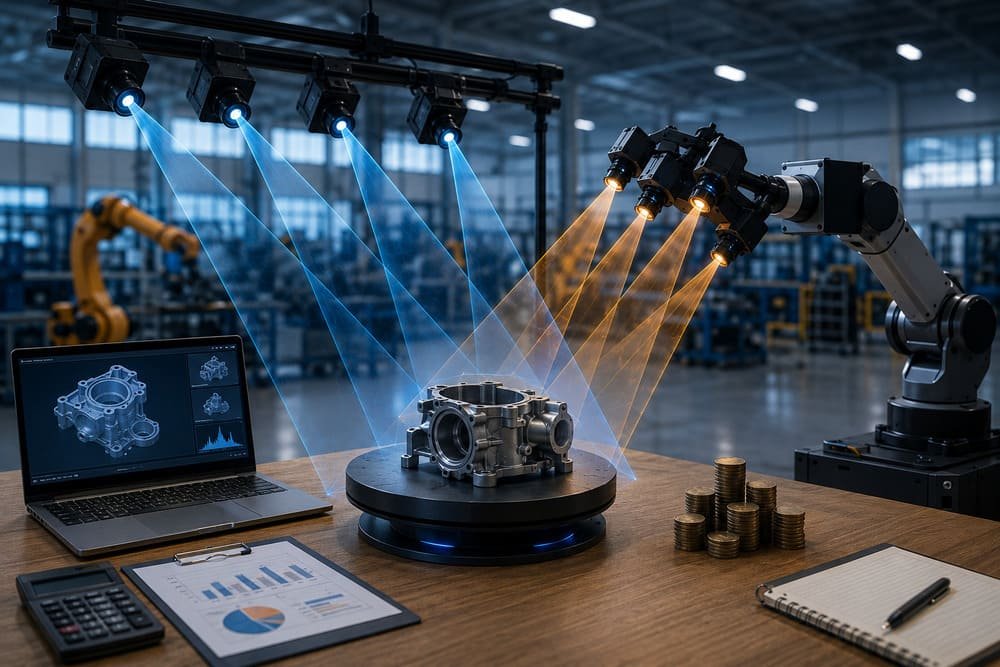
Multi-view capture costs break into rig build (one-time) and operated capture (per hour). The figures below are our own benchmarks from rigs we run at DexSet; treat them as typical ranges, not quotes.

Configuration Rig Build Cost Operated Capture Cost Typical Use
1 external RGB-D + wrist (baseline) $2,500 to $4,000 $20 to $28 / hr Prototyping, single-task policies
2 external stereo + wrist (DROID-style) $4,500 to $7,000 $26 to $38 / hr VLA training data, tabletop manipulation
Ego + 3 exo paired (Ego-Exo4D-style) $6,000 to $9,500 $32 to $44 / hr Human demo capture, cross-view learning
6-camera arc, hardware-triggered $9,000 to $12,000 $40 to $50 / hr Humanoid whole-body, reconstruction, world models

Rig build includes cameras, mounts and fixturing, sync hardware, a capture workstation, and the first calibration. Operated capture includes the operator, session calibration checks, QA review, and annotation-ready packaging; it excludes task design and annotation itself. Storage is the line item teams forget: a 4-camera rig at 1080p30 generates roughly 0.8 to 1.5 TB per capture day depending on codec, and multi-view triples or quadruples whatever single-view budget you had.

The marginal-value curve is the key economic fact. In our ablations on tabletop pick-place and insertion tasks, adding the second external view to a wrist-only setup produced the largest single improvement in policy success. The third camera helped mainly on occlusion-heavy tasks. The fourth was rarely distinguishable from noise while adding about 25 percent to storage and QA cost. Buy the second camera before you buy anything else; justify the fourth with an experiment, not a hunch. We break the per-configuration trade-offs down further in Comparing Exocentric & Multi-View Approaches: Pros, Cons & Costs.

Case Study: Multi-View at Scale for a VLA Team

A humanoid foundation model team came to us with a policy that plateaued at roughly 60 percent success on cluttered tabletop tasks, trained on single-view teleoperation data. Their failure analysis pointed at occlusion: success dropped sharply whenever the target object was blocked from the lone camera during the approach.

We rebuilt their capture around a DROID-style rig: two external stereo cameras plus wrist, hardware-checked calibration each session, sub-10 ms sync, and a QA gate on reprojection error. Over eight weeks we delivered several hundred hours of calibrated multi-view episodes across their task list. Retrained on the multi-view data with the same architecture and episode count, the policy’s success on the occlusion-heavy split improved by double digits, and their engineers stopped hand-labeling “camera blocked” failure cases entirely. The full pipeline detail is in How We Scaled Multi-View Data for a VLA Model, and the strategic version of the argument is in Why Multi-View Data Is the Biggest Bottleneck in Physical AI.

Downloadable: The Multi-View Rig RFP Scorecard

If you are evaluating data vendors or scoping an internal rig, the questions that separate real multi-view capability from marketing are specific: How are extrinsics verified per session? What is your cross-camera timestamp skew tolerance and how is it measured? What reprojection error gates ingestion? What is the storage format and per-hour deliverable size? We have packaged these into a one-page RFP scorecard with scoring weights you can hand to procurement. Download it below; it is the same rubric we hold our own rigs to.

Put This Guide to Work

If your current dataset is single-view and your policy failures cluster around occlusion or spatial grounding, the fix is a capture decision, not an architecture search. Download the Multi-View Rig RFP Scorecard to evaluate vendors or your own rig plan, or book a demo to see calibrated multi-view episodes from our production rigs, including sample data you can load the same day.

Frequently Asked Questions

What is exocentric data in robot learning?

Exocentric data is third-person visual data captured by cameras positioned outside the robot or demonstrator, observing the actor and workspace from fixed external viewpoints. It provides global scene context that egocentric and wrist cameras cannot, and it pairs with those views in most modern manipulation datasets.

Two calibrated external views plus a wrist camera cover most manipulation use cases; this is the configuration DROID used across 76,000 episodes. In our ablations the second external camera delivers the largest gain, while a fourth camera rarely improves policy success enough to justify its storage and QA cost.

Stereo is one viewpoint with two lenses on a fixed short baseline, designed to estimate depth. Multi-view places separate cameras at meaningfully different poses around the workspace with calibrated extrinsics. A rig can be both, for example two ZED 2i stereo cameras at different positions.

Based on our benchmarks at DexSet, multi-view rig builds run $2,500 to $12,000 depending on camera count and sync hardware, and operated calibrated capture runs $20 to $50 per hour including session calibration checks and QA. Storage adds roughly 0.8 to 1.5 TB per capture day for a 4-camera 1080p30 rig.

Three tiers: software timestamping (free, drifts), PTP / IEEE 1588 clock discipline over Ethernet (sub-millisecond, right for GigE machine vision cameras), and hardware genlock or trigger lines (true same-instant exposure). For tabletop manipulation at 30 fps, keep cross-camera skew under 10 ms and verify it every session.

Ego-Exo4D is the largest, with over 1,200 hours of simultaneously captured ego (Aria glasses) and exo (stationary camera) video of skilled human activity, with calibration and sync across the rig. In robot-collected data, DROID pairs a wrist (near-ego) view with two calibrated external stereo views.

VLA models benefit from multi-view data because language-conditioned tasks require scene-level grounding and manipulation requires contact-level detail, which no single viewpoint provides. The RoboMimic study showed observation space choices materially change imitation learning outcomes, and Open X-Embodiment’s heterogeneous camera setups are a recurring friction point for teams pretraining VLAs.

Comparing Exocentric & Multi-View Data Approaches for Robot Learning: Pros, Cons & Costs

A buyer on a scoping call last month put the field’s confusion into one sentence: everyone tells him to collect multi-view data, and nobody will tell him which multi-view. He was right to push. “Multi-view” describes at least five distinct capture strategies with different rig costs, different failure modes, and different value per training hour, and the honest answer, the thesis of this post, is that the right configuration is determined by your task list and training strategy, not by your budget or by whichever public dataset you read about first. Choosing the wrong one is not a small mistake. A team that builds a six-camera arc when their tasks needed a wrist camera and one tripod has burned rig budget, tripled their storage bill, and slowed capture throughput for nothing.

The confusion is understandable. Public datasets each embody one choice without explaining the alternatives: DROID picked two external stereo cameras plus wrist, Ego-Exo4D picked glasses plus stationary exo arrays, and Open X-Embodiment inherited whatever its 22 source labs happened to mount. The papers report what was captured, not the decision tree.

This post is that decision tree. We compare the five approaches we quote and build most often at DexSet, with honest pros, cons, and cost ranges from our own rigs, and end with a matrix mapping task types to configurations. For the underlying camera specs, calibration toolchain, and sync engineering, see the pillar guide: The Complete Guide to Exocentric & Multi-View Data for Robot Learning.

Key Takeaways – Five capture approaches dominate: single exo + wrist, DROID-style (2 exo + wrist), ego+exo paired human capture, dense arrays (4-8 cameras), and sim-rendered multi-view. – DROID-style is the default for tabletop manipulation and VLA training data: $4,500 to $7,000 rig, $26 to $38 per operated hour in our benchmarks. – Ego+exo paired capture is the only approach that supports human-video pretraining with cross-view transfer; it costs more in sync engineering than in cameras. – Sim-rendered views are nearly free per view but inherit the sim-to-real gap; they complement real capture, they do not replace it.

The Five Approaches, Defined

A capture approach is the combination of camera count, camera placement, actor type (robot or human), and sync method used to record training episodes. The five that cover almost every real program:

  • Single exocentric + wrist. One fixed external camera plus a wrist camera on the robot. The minimum viable multi-view setup.
  • DROID-style: two exocentric stereo + wrist. Two external stereo cameras (ZED 2i class) at distinct poses plus a wrist camera, calibrated extrinsics, as used across DROID’s 76,000 episodes (arXiv:2403.12945).
  • Ego + exo paired human capture. Glasses or head-mounted camera on a human demonstrator plus stationary exocentric cameras, the Ego-Exo4D pattern (arXiv:2311.18259).
  • Dense array (4-8 cameras). Hardware-triggered ring or arc around the workspace for reconstruction-grade coverage.
  • Sim-rendered multi-view. Arbitrary virtual cameras rendered from simulation, optionally mixed with real data.

Master Comparison Table

Approach Rig Build Capture Cost / Hr Sync Difficulty Occlusion Coverage Human-Video Pretraining Main Risk
Single exo + wrist $2,500 to $4,000 $20 to $28 Low Partial No Blind spots remain
DROID-style (2 exo + wrist) $4,500 to $7,000 $26 to $38 Moderate Good No Calibration upkeep
Ego + exo paired $6,000 to $9,500 $32 to $44 High (moving ego cam) Good Yes Ego-exo time alignment
Dense array (4-8 cams) $9,000 to $12,000 $40 to $50 High (trigger/genlock) Excellent No Storage, diminishing returns
Sim-rendered multi-view Compute only ~$1 to $5 equivalent None Perfect Limited Sim-to-real gap

Rig and capture figures are DexSet benchmarks, including session calibration checks and QA; sim figures are rough GPU-time equivalents.

Where Each Approach Wins and Loses

Single exo + wrist earns its place as a starting point. Pros: cheapest real multi-view, simple calibration (one extrinsic pair), enough to break the wrist-only occlusion ceiling for many tasks. Cons: one blocked view and you are back to single-view; no view redundancy for QA cross-checks. We recommend it for prototyping and single-task policies, and we recommend planning the mount points for camera two on day one.

DROID-style is the workhorse, and not by accident. Two external views mean occlusion of one is usually covered by the other; three total views give the RoboMimic-style observation flexibility that lets ML teams ablate view combinations later (arXiv:2108.03298). Cons: per-session calibration verification becomes mandatory, because three cameras drift three ways. In our operations the added QA overhead is roughly 5 percent of session time. This is what we quote when a VLA team asks for a default.

Ego + exo paired solves a different problem: it is the only configuration that produces the ego-exo correspondences needed to pretrain on human demonstration video and transfer to robot viewpoints, the exact gap Ego-Exo4D was built to close. Pros: human demonstrators are fast and cheap per episode; the data doubles as a bridge to large human-video corpora. Cons: the ego camera moves, so extrinsics to the world frame change every frame and must be recovered via SLAM or the glasses’ own tracking; time alignment between glasses and fixed cameras is the hardest sync problem on this list. Choose it when your training strategy explicitly includes human video.

Dense arrays buy near-complete coverage and reconstruction-grade geometry for humanoid whole-body work and world-model data. The cons compound quietly: hardware triggering or genlock is effectively mandatory, storage runs 3 to 4 TB per capture day at 1080p30 in our pipelines, and, in every ablation we have run on single-arm manipulation, cameras five through eight never moved the success metric. Buy this coverage for reconstruction, not for policy learning on tabletop tasks.

Sim-rendered multi-view costs almost nothing per additional view, which is genuinely useful for view-invariance augmentation and architecture prototyping. But every rendered view inherits the simulator’s gap in contact dynamics, materials, and lighting. Teams in the Open X-Embodiment consortium (arXiv:2310.08864) mix sim and real rather than substituting one for the other, and that matches our experience: sim views stretch a real multi-view dataset, they do not replace it.

Decision Matrix: Match the Approach to the Program

Your Situation Recommended Approach
Prototyping one task, tight budget Single exo + wrist, mounts pre-planned for a second exo
Training VLA / manipulation foundation data at scale DROID-style (2 exo + wrist)
Pretraining on human demonstrations or video Ego + exo paired
Humanoid whole-body, reconstruction, world models Dense array, hardware-triggered
Need view diversity beyond rig budget DROID-style real capture + sim-rendered augmentation

One category the table cannot capture: switching costs. Moving from single-exo to DROID-style mid-program is cheap if the mount points and calibration workflow were planned for it, and painful if they were not, because your existing episodes and your new episodes will differ in geometry and your training pipeline has to reconcile them. Moving from robot-only capture to ego+exo is a bigger jump; it changes your demonstrator pool, your sync architecture, and your annotation scheme at once. Teams that expect to make either move should write the target configuration into their schema now, even if the extra cameras arrive next quarter.

Two cross-cutting rules. First, whatever you choose, log extrinsics and sync metadata into every episode; the approach you pick today is the aggregation problem someone inherits in two years. Second, ablate before you scale: run 20 hours in the candidate configuration, train, and let the success metric pick the rig.

Turn the Matrix Into a Procurement Rubric

If you are scoping a capture program or comparing vendors, download the Multi-View Rig RFP Scorecard. It turns this decision matrix into weighted evaluation questions on calibration verification, sync tolerances, and deliverable formats, the same rubric we hold our own rigs to.

Frequently Asked Questions

What is the cheapest way to get multi-view robot data?

A single external camera plus a wrist camera, at roughly $2,500 to $4,000 for the rig and $20 to $28 per operated capture hour in DexSet benchmarks. It breaks the wrist-only occlusion ceiling for many tasks but leaves blind spots a second external view would cover.

For VLA training data and tabletop manipulation at scale, usually yes: the second external view covers occlusions the first misses and enables view ablations later. The premium over single-exo is about $2,000 to $3,000 in rig cost and $6 to $10 per hour.

No. Rendered views are nearly free and useful for view-invariance augmentation, but they inherit the simulator’s gaps in contact dynamics, materials, and lighting. Production programs mix sim views with real calibrated capture rather than substituting.

When your training plan includes learning from human demonstration video. Paired capture, as in Ego-Exo4D, provides the cross-view correspondences needed to transfer first-person human priors to third-person robot viewpoints.

Task-dependent, but in our single-arm manipulation ablations, cameras beyond the third stopped moving policy success while adding roughly 25 percent storage and QA cost per view. Dense arrays of 4 to 8 cameras are justified for reconstruction and whole-body humanoid work, not tabletop policies.