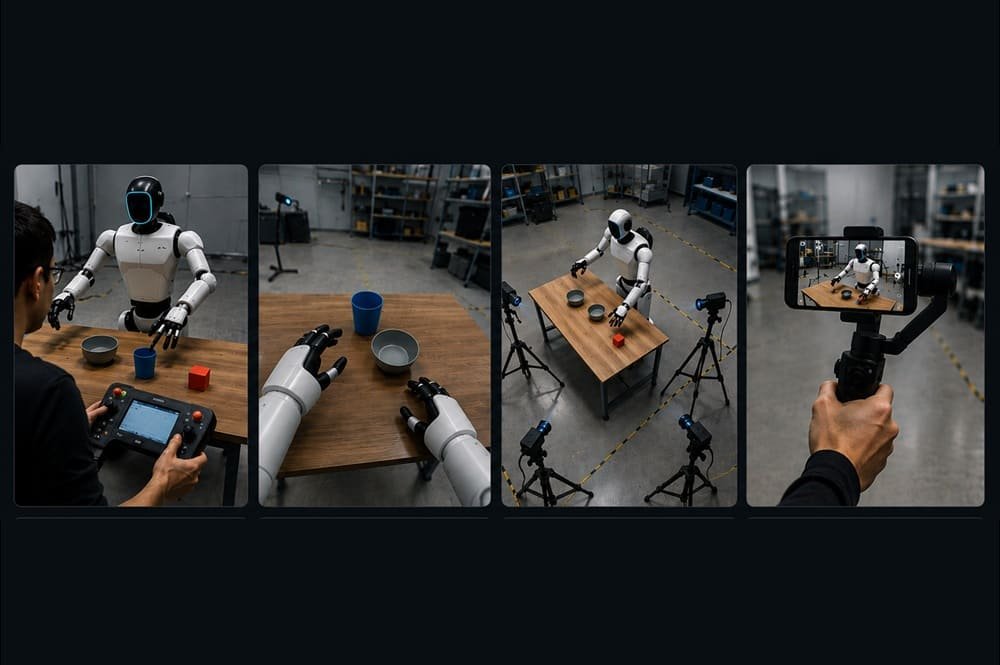
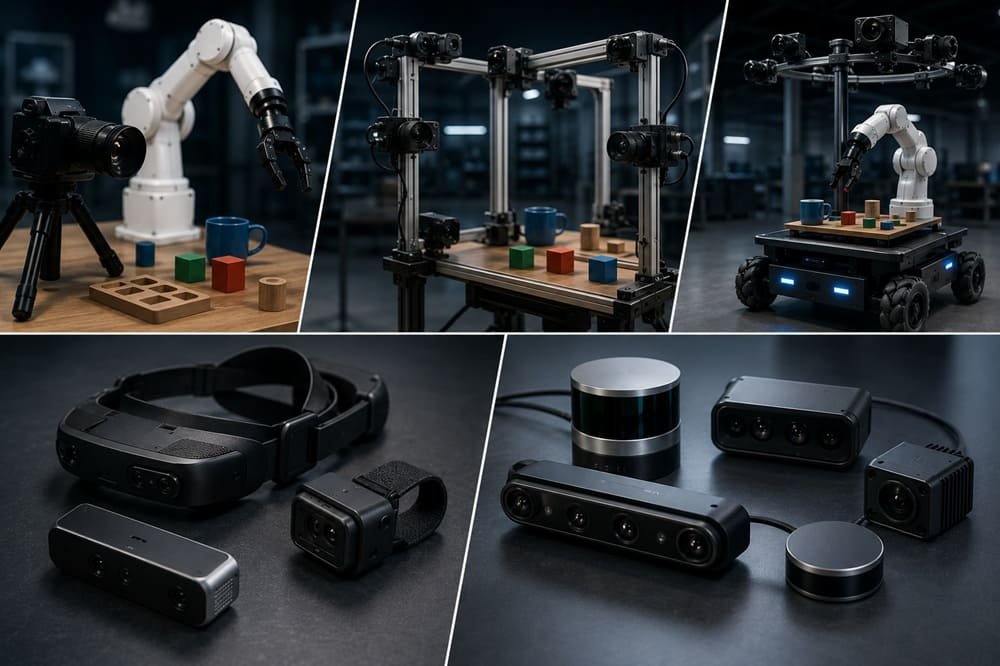
Our prediction, held at roughly 80 percent confidence: within two years, no serious VLA training stack will rely on a single capture approach, and the teams still arguing egocentric versus teleoperation will have lost the argument to “both.” That is an opinion, clearly flagged; the evidence behind it is not. Three camps currently give three confident, incompatible answers to the data collection question: strap cameras on humans, build teleop rigs, or ring the workspace with depth cameras. Each camp has papers proving its approach works, and none of the papers tell you what each approach costs per usable hour, or which one fits the model you are actually training.
The argument persists because these approaches produce different data, not the same data at different prices. That is the thesis this comparison argues: the four approaches are complements delivering different supervision signals, so the choice follows from your training objective. Egocentric human video has no robot actions in it. Teleoperation produces perfect action labels at real-time speed and real-time cost. Exocentric camera arrays see everything except the first-person view your humanoid will actually have. Choosing between them by hardware price alone is a category error.
This post compares the four capture approaches side by side: what hardware each needs, what data each yields, what each costs on our floors, and a decision matrix for matching approach to training objective. It condenses the hardware detail from our full guide to data capture hardware for embodied AI.
I run teleoperation systems at DexSet, where all four approaches operate in production, so the pros and cons below come from shift logs rather than spec sheets.
Key Takeaways – The four capture approaches are egocentric wearables, teleoperation, handheld demonstration devices (UMI-style), and multi-view exocentric arrays. They produce different modalities and are complements, not substitutes. – Egocentric capture is the cheapest per hour (a ~$400 GoPro seat) but carries no robot action labels; teleoperation is the most expensive but yields training-ready observation-action pairs. – Teleop hardware spans two orders of magnitude: ~$300 GELLO leader arms to $20,000+ ALOHA-class bimanual stations, with our delivered benchmarks at $28-60 per hour. – Most VLA training stacks want a blend: broad egocentric pretraining data plus targeted teleop fine-tuning data plus a small exo set for evaluation.
Approach 1: Egocentric Wearable Capture
Egocentric capture records first-person video and motion from devices worn by humans doing real tasks, no robot required. It is the approach behind Ego4D and Ego-Exo4D (arxiv.org/abs/2311.18259), and the standard source of large-scale pretraining data for humanoid perception.
Hardware options: GoPro head mounts (~$400, 5.3K/60, ~150 g), Meta Quest 3 (~$500, adds hand tracking and 6DoF pose), Apple Vision Pro ($3,499, adds eye tracking and LiDAR), and Project Aria research glasses (research access, best-in-class sensor sync at ~75 g).
Pros: lowest cost per hour of any approach; scales with people instead of robots; captures true task diversity in homes, kitchens, and warehouses; light devices sustain 6+ hour shifts.
Cons: no robot action labels, so it cannot train a policy by itself; consumer devices have weak cross-device sync; gaze and hand pose require the expensive end of the hardware range.
Approach 2: Teleoperation Capture
Teleoperation capture records a human operator controlling a real robot, producing synchronized observation-action pairs, which is exactly the supervision imitation learning consumes. The chain is direct: teleoperation produces demonstrations, demonstrations train ACT- and diffusion-policy-style models, and those methods feed VLA systems like OpenVLA and pi-0.
Hardware options: ALOHA-class leader-follower stations (~$20,000+ per bimanual cell, the platform behind ACT, arxiv.org/abs/2304.13705), GELLO printed leader arms (~$300 per arm on robots you already own, arxiv.org/abs/2309.13037), and VR teleop with a Quest 3 or Vision Pro streaming head and hand pose to the robot.
Pros: training-ready action labels at capture time; joint-space leader arms give fine bimanual control; output drops straight into LeRobot or HDF5 episode formats.
Cons: cost scales with robots, not just people; one real-time hour per data hour per rig; resets and calibration eat 30 to 40 percent of every shift; operator skill affects data quality.
Approach 3: Handheld Demonstration Devices
Handheld demonstration devices are robot-free grippers, UMI being the reference design, that a human carries through tasks while a wrist-mounted camera records; robot actions are recovered afterward via SLAM (arxiv.org/abs/2402.10329). The approach splits the difference between egocentric video and teleoperation.
Hardware: a 3D-printed UMI-style gripper plus a fisheye GoPro, roughly $400 per unit.
Pros: near-egocentric cost with usable action supervision; natural human motion, no retargeting latency; trivially parallel, ten grippers cost less than one robot arm.
Cons: no proprioception or force signal; action quality depends on SLAM post-processing, which becomes its own QA pipeline; single-gripper design limits bimanual tasks.
Approach 4: Multi-View Exocentric Arrays
Multi-view exocentric capture surrounds a workspace with synchronized third-person cameras, recording the scene from four to twelve angles at once. DROID standardized this pattern across labs (arxiv.org/abs/2403.12945), and it is the default source of evaluation and cross-view data.
Hardware options: Intel RealSense D435i (~$300-350) or D455 (~$420-450, wider baseline, hardware sync pin), Stereolabs ZED 2i (~$500, neural depth, needs an NVIDIA GPU per node), Luxonis OAK-D (~$250-350, on-device compute).
Pros: metric depth and full-scene coverage; hardware sync solves the alignment problem RealSense-style; fixed rigs need no operator wearables at all.
Cons: not the robot’s viewpoint; per-studio infrastructure (sync wiring, lighting, terabyte-per-shift storage) roughly doubles the camera bill; useless for capturing task diversity outside the cell.
What the Landmark Datasets Chose
The published datasets that shaped this field each committed to one of these approaches, and their choices are useful evidence. Ego4D collected thousands of hours of unscripted daily activity on head-mounted cameras because egocentric scale was the objective and action labels were not. ALOHA and Mobile ALOHA (arxiv.org/abs/2401.02117) went all-in on leader-follower teleoperation because fine bimanual action supervision was the entire point. DROID distributed identical RealSense-based exocentric rigs to dozens of labs to get multi-view consistency across sites. And Ego-Exo4D deliberately paired Aria glasses with stationary cameras, an explicit bet that ego plus exo beats either alone.
None of these teams picked their hardware by price. They picked by the supervision signal their research needed, then engineered the cost down. That is the right order of operations for a production pipeline too.
The Master Comparison Table
| Approach | Typical Hardware | Capex per Seat/Cell | Data Yielded | Action Labels | Our Delivered Cost Benchmarks | Best For |
|---|---|---|---|---|---|---|
| Egocentric wearable | GoPro ~$400, Quest 3 ~$500, Vision Pro $3,499, Aria (research) | $400-4,000 | First-person RGB, IMU, pose, gaze (device-dependent) | None | Lowest per hour (one third to one half of teleop) | Pretraining scale, humanoid viewpoint priors |
| Teleoperation | GELLO ~$300/arm, ALOHA ~$20k station, VR teleop $500-3,499 + robot | $600-30,000 | Obs-action pairs, proprioception, 50 Hz control | Native, highest quality | $28-60/hr | Policy fine-tuning, bimanual manipulation |
| Handheld (UMI-style) | Printed gripper + GoPro, ~$400 | $400-600 | Wrist-cam RGB + SLAM-recovered trajectories | Recovered, no force/proprio | Between egocentric and teleop | Cheap single-arm demos at volume |
| Exocentric array | 4-8x D455/ZED 2i/OAK-D | $2,500-12,000 per studio | Multi-view RGB-D, synced | None (pairs with teleop) | Studio amortizes across every episode captured inside it | Evaluation, cross-view consistency, world models |
Decision Matrix: Matching Approach to Training Objective
The right capture approach is determined by what your model consumes, and the mapping is more stable than hardware fashion.
- Pretraining a humanoid perception backbone: egocentric wearables first. Buy GoPro seats for volume; add Aria or Vision Pro only where gaze labels earn their cost.
- Fine-tuning a VLA policy on manipulation tasks: teleoperation. GELLO on existing arms if you own robots; an ALOHA-class cell if bimanual dexterity is the product.
- Thousands of single-arm demos on a budget: UMI-style handheld grippers, with a budgeted SLAM QA pass.
- Evaluation sets and world-model data: an exo array of hardware-synced D455s wrapped around one teleop cell, so every episode is captured ego and exo simultaneously.
- All of the above on a deadline: that blend is precisely what a data vendor amortizes across clients; the build-versus-buy arithmetic is in the full hardware guide.
Frequently Asked Questions
Which robot data collection approach is cheapest?
Egocentric wearable capture. A ~$400 GoPro head-mount seat produces first-person video at one third to one half the per-hour cost of teleoperation in our benchmarks, but it yields no robot action labels.
Is teleoperation data worth the higher cost?
For policy training, yes. Teleoperation is the only approach that natively records synchronized observation-action pairs with proprioception, which is the supervision imitation learning and VLA fine-tuning require.
What is a UMI gripper and when should I use one?
UMI is a handheld, robot-free gripper design with a wrist-mounted fisheye GoPro; actions are recovered by SLAM in post-processing. Use it when you need thousands of single-arm demonstrations at near-egocentric cost and can accept the absence of force and proprioception data.
Do I need an exocentric camera array if I already collect teleop data?
For evaluation and cross-view generalization, a small one helps. Wrapping four to six hardware-synced RealSense D455s around one teleop cell gives you paired ego-exo episodes, the structure Ego-Exo4D demonstrated matters for viewpoint generalization.
Can I mix data from all four approaches in one training set?
Yes, and most serious VLA stacks do: broad egocentric data for pretraining, teleop episodes for fine-tuning, and exo views for evaluation. The practical requirement is one shared episode format and honest per-source metadata.
Want to see the difference instead of reading about it?
[Download Sample Data] from all four capture approaches, or start with the complete guide to data capture hardware for embodied AI.