
Dexset

5 Hidden Challenges in Data Capture Hardware for Embodied AI and How to Solve Them

Printing your timestamps is the checklist item almost every capture team skips, and skipping it is how a ten-thousand-episode dataset dies without a symptom. We watched it happen. The dataset looked perfect: clean video, complete joint logs, delivered on time. Then the client’s policy trained to a success rate barely above random, and three weeks of forensics traced it to a 60 ms clock offset between the wrist camera and the robot controller. Every action label in the dataset was stale by two frames, and a five-line timestamp check would have caught it before the first shift ended.

Failures like this stay hidden because capture hardware fails silently, and that is the argument this post makes: silent failure is the defining property of this hardware category, so the five failure modes below must be designed out before capture, not caught after it. A camera that stops recording is obvious. A camera whose clock drifts, whose calibration decays, or whose operator quietly degrades over an eight-hour shift produces data that looks fine and trains badly. Spec sheets describe none of this, because spec sheets describe devices, not fleets running sixty-hour weeks.

This post catalogs the five failure modes my QA team catches most often, what each one costs, and the specific fix for each. All five are hardware-level problems you can design out before your first episode is recorded; the device-by-device background lives in our full guide to data capture hardware for embodied AI.

I lead data quality at DexSet, where these checks run against every egocentric, teleoperation, and multi-view batch we deliver. The thresholds below are the ones on our own QA gates.

Key Takeaways – The five hidden challenges are clock drift, calibration decay, operator fatigue, offload bandwidth, and data format lock-in. None appear on a spec sheet. – Clock drift is the most expensive: tens of milliseconds of offset silently corrupts every action label in an episode. Our QA gate rejects episodes beyond 25 ms of cross-stream misalignment. – Calibration decays with heat and handling; we re-verify extrinsics on a fixed cadence (per shift for moved rigs) rather than trusting installation-day values. – Each challenge has a cheap hardware-stage fix and an expensive post-hoc one. The table below prices both.

Challenge 1: Clock Drift and Cross-Sensor Sync

Clock drift is the gradual divergence of independent device clocks, and it corrupts the observation-action alignment that imitation learning depends on. Consumer devices drift by seconds per day; even good oscillators disagree by milliseconds per hour. A dataset can pass every visual inspection while every frame’s action label describes what the robot did 60 ms later.

The fix is architectural. Prefer hardware with a native sync story: RealSense sync pins for camera arrays, Project Aria’s shared-clock VRS recordings for wearables, robot-side timestamping for teleop streams. Where hardware sync is impossible, inject a common observable event (a strobe, an audible clap, a scripted gripper snap) at episode boundaries and align in post. Our gate rejects any episode whose residual cross-stream misalignment exceeds 25 ms.

Challenge 2: Calibration Decay

Calibration decay is the slow invalidation of a rig’s intrinsic and extrinsic parameters through heat cycles, vibration, and handling. The extrinsics you measured at installation describe a rig that no longer exists three weeks later, once a camera mount has been bumped twice and a headset has been dropped once. Depth reprojection then smears by centimeters, which is fatal for grasp-point supervision.

The fix is cadence, not heroics. We re-verify extrinsics per shift on any rig that moves (headsets, handheld UMI-style grippers) and weekly on fixed studios, using a 60-second checkerboard or AprilTag routine baked into shift startup. Rigs that fail re-verification capture nothing until they pass. The routine costs about one percent of shift time and removes our second-largest historical rejection cause.

Challenge 3: Operator Fatigue as a Data Quality Variable

Operator fatigue is the degradation of demonstration quality over a shift, and it is a hardware property as much as a human one. A 600-plus-gram headset with an external battery pack produces different data at hour six than at hour one: slower corrections, shakier trajectories, more aborted grasps. The episodes still pass automated checks. The policy trained on them inherits the sloppiness.

The fix starts at procurement. Weigh the device; anything worn for full shifts should sit near action-camera weight (~150 g) rather than headset weight (500-650 g). For teleop, seated leader-arm designs in the ALOHA style (arxiv.org/abs/2304.13705) outlast free-space VR control on repetitive tasks. Then instrument for it: we track per-operator trajectory smoothness by shift-hour, and rotate stations when the curve bends.

Challenge 4: Offload Bandwidth and Storage Starvation

Offload bandwidth is the rate at which captured data moves off devices into storage, and when it is undersized the capture floor throttles itself. A six-camera RGB-D studio generates on the order of a terabyte per shift. Teams that budget for cameras but not for the offload path end a shift early to copy files, every day, forever, and consumer devices with slow card readers make it worse.

The fix is to size the pipe with the fleet: NVMe-based ingest per capture cell, hot-swappable media so devices never wait for uploads, and compression decisions made deliberately (lossless for depth and proprioception, visually lossless for RGB) rather than by device default. As a rule we budget storage-and-offload spend at 30 to 50 percent of camera spend; audits of stalled floors usually find it under 10 percent.

Challenge 5: Data Format Lock-In

Data format lock-in is dependence on a device’s proprietary recording format, and it converts every future pipeline change into a migration project. GoPro telemetry lives in GPMF tracks, ZED records SVO files, Aria writes VRS, every teleop stack invents an HDF5 layout, and none of them agree. The cost appears later, as engineer-weeks of converters and silent unit mismatches.

The fix is to normalize at ingest, on the same day the data is captured. Pick one canonical episode schema, the LeRobot dataset format (github.com/huggingface/lerobot) is the emerging community default, and treat device-native files as transient. Keep raw originals archived, but never let a training pipeline read a vendor format directly.

How to Audit Your Own Floor This Week

A capture audit is a one-week measurement pass that scores an existing pipeline against these five failure modes, and it needs no new hardware to run. The version we use internally:

  • Day 1: Print timestamps. Sample 50 random episodes and compute the median camera-to-proprioception offset per episode. Anything past 25 ms goes on the findings list.
  • Day 2: Re-run calibration on every rig and record the delta from stored values. Deltas above your reprojection tolerance mean decay is already in your data.
  • Day 3: Plot per-operator trajectory smoothness by shift-hour. A visible bend after hour four is a hardware ergonomics finding, not a staffing one.
  • Day 4: Time one full offload cycle per cell. Any cell where offload competes with capture time loses roughly a data hour per day.
  • Day 5: Count the distinct file formats between device and training job. More than one canonical format plus archived originals means converter debt is accruing.

Most teams find at least three of the five on the first pass. That is not an indictment; it is the baseline this hardware category imposes on everyone.

The Five Challenges at a Glance

Challenge Silent Symptom Cost If Ignored Fix at Hardware Stage Fix After the Fact
Clock drift Policies underperform despite clean-looking data Entire batches rejected or retrained Sync pins, shared clocks, boundary strobes (~$0-200/rig) Manual event alignment; often unrecoverable
Calibration decay Depth smears, grasp labels off by centimeters 10-20% rejection creep Per-shift AprilTag re-verification (1% of shift time) Re-calibration + partial batch salvage
Operator fatigue Quality slides after hour 4 Sloppy trajectories baked into the policy Buy light (~150 g worn), seated leader arms, rotation Filter late-shift episodes, lose volume
Offload bandwidth Shifts end early to copy files ~1 lost data hour/day per cell NVMe ingest, hot-swap media (30-50% of camera spend) Retrofit storage, disrupt operations
Format lock-in Converter scripts multiply Engineer-weeks per pipeline change Normalize to one schema at ingest Migration project across archived data

Next Step

Ready to scope your data program? Talk to our team.

Frequently Asked Questions

What is the most common hidden failure in robot data capture hardware?

Cross-sensor clock drift. Independent device clocks diverge by milliseconds per hour, silently misaligning observations and action labels. It is the failure mode least visible in review and most damaging in training.

Our QA gates reject episodes with more than 25 ms of residual cross-stream misalignment for manipulation data. At 50-60 ms, action labels lag observations by one to two frames at 30 fps, which measurably degrades imitation learning.

Per shift for any rig that moves or is worn (headsets, handheld grippers), and weekly for fixed camera studios. A 60-second AprilTag verification at shift start catches decay before it contaminates a batch.

Yes, measurably. On our floors, trajectory smoothness and correction latency degrade in the back half of shifts on heavy worn devices, which is why device weight and seated leader-arm ergonomics are QA concerns, not comfort perks.

Normalize everything to one canonical episode schema at ingest; the LeRobot dataset format is the strongest community default in 2026. Archive device-native files (GPMF, SVO, VRS) but never train from them directly.

Every DexSet delivery passes the five gates above before it ships. [Download Sample Data] with the QA report attached, or start with the full guide to data capture hardware for embodied AI.
Comparing Data Capture Hardware for Embodied AI Approaches: Pros, Cons and Costs

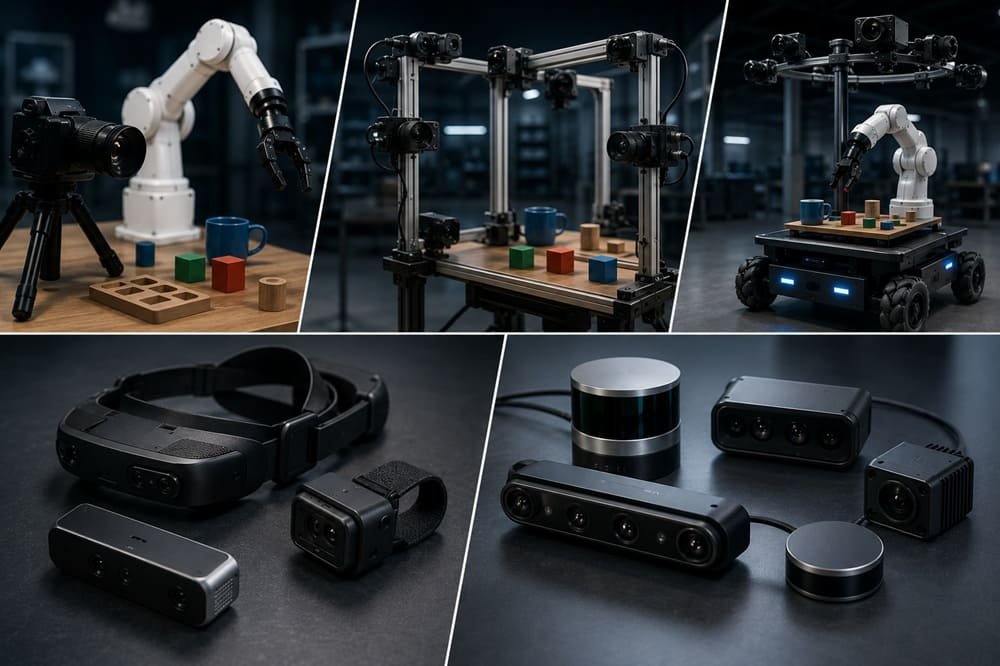
Our prediction, held at roughly 80 percent confidence: within two years, no serious VLA training stack will rely on a single capture approach, and the teams still arguing egocentric versus teleoperation will have lost the argument to “both.” That is an opinion, clearly flagged; the evidence behind it is not. Three camps currently give three confident, incompatible answers to the data collection question: strap cameras on humans, build teleop rigs, or ring the workspace with depth cameras. Each camp has papers proving its approach works, and none of the papers tell you what each approach costs per usable hour, or which one fits the model you are actually training.

The argument persists because these approaches produce different data, not the same data at different prices. That is the thesis this comparison argues: the four approaches are complements delivering different supervision signals, so the choice follows from your training objective. Egocentric human video has no robot actions in it. Teleoperation produces perfect action labels at real-time speed and real-time cost. Exocentric camera arrays see everything except the first-person view your humanoid will actually have. Choosing between them by hardware price alone is a category error.

This post compares the four capture approaches side by side: what hardware each needs, what data each yields, what each costs on our floors, and a decision matrix for matching approach to training objective. It condenses the hardware detail from our full guide to data capture hardware for embodied AI.
I run teleoperation systems at DexSet, where all four approaches operate in production, so the pros and cons below come from shift logs rather than spec sheets.

Key Takeaways – The four capture approaches are egocentric wearables, teleoperation, handheld demonstration devices (UMI-style), and multi-view exocentric arrays. They produce different modalities and are complements, not substitutes. – Egocentric capture is the cheapest per hour (a ~$400 GoPro seat) but carries no robot action labels; teleoperation is the most expensive but yields training-ready observation-action pairs. – Teleop hardware spans two orders of magnitude: ~$300 GELLO leader arms to $20,000+ ALOHA-class bimanual stations, with our delivered benchmarks at $28-60 per hour. – Most VLA training stacks want a blend: broad egocentric pretraining data plus targeted teleop fine-tuning data plus a small exo set for evaluation.

Approach 1: Egocentric Wearable Capture

Egocentric capture records first-person video and motion from devices worn by humans doing real tasks, no robot required. It is the approach behind Ego4D and Ego-Exo4D (arxiv.org/abs/2311.18259), and the standard source of large-scale pretraining data for humanoid perception.

Hardware options: GoPro head mounts (~$400, 5.3K/60, ~150 g), Meta Quest 3 (~$500, adds hand tracking and 6DoF pose), Apple Vision Pro ($3,499, adds eye tracking and LiDAR), and Project Aria research glasses (research access, best-in-class sensor sync at ~75 g).

Pros: lowest cost per hour of any approach; scales with people instead of robots; captures true task diversity in homes, kitchens, and warehouses; light devices sustain 6+ hour shifts.

Cons: no robot action labels, so it cannot train a policy by itself; consumer devices have weak cross-device sync; gaze and hand pose require the expensive end of the hardware range.

Approach 2: Teleoperation Capture

Teleoperation capture records a human operator controlling a real robot, producing synchronized observation-action pairs, which is exactly the supervision imitation learning consumes. The chain is direct: teleoperation produces demonstrations, demonstrations train ACT- and diffusion-policy-style models, and those methods feed VLA systems like OpenVLA and pi-0.

Hardware options: ALOHA-class leader-follower stations (~$20,000+ per bimanual cell, the platform behind ACT, arxiv.org/abs/2304.13705), GELLO printed leader arms (~$300 per arm on robots you already own, arxiv.org/abs/2309.13037), and VR teleop with a Quest 3 or Vision Pro streaming head and hand pose to the robot.

Pros: training-ready action labels at capture time; joint-space leader arms give fine bimanual control; output drops straight into LeRobot or HDF5 episode formats.

Cons: cost scales with robots, not just people; one real-time hour per data hour per rig; resets and calibration eat 30 to 40 percent of every shift; operator skill affects data quality.

Approach 3: Handheld Demonstration Devices

Handheld demonstration devices are robot-free grippers, UMI being the reference design, that a human carries through tasks while a wrist-mounted camera records; robot actions are recovered afterward via SLAM (arxiv.org/abs/2402.10329). The approach splits the difference between egocentric video and teleoperation.

Hardware: a 3D-printed UMI-style gripper plus a fisheye GoPro, roughly $400 per unit.

Pros: near-egocentric cost with usable action supervision; natural human motion, no retargeting latency; trivially parallel, ten grippers cost less than one robot arm.

Cons: no proprioception or force signal; action quality depends on SLAM post-processing, which becomes its own QA pipeline; single-gripper design limits bimanual tasks.

Approach 4: Multi-View Exocentric Arrays

Multi-view exocentric capture surrounds a workspace with synchronized third-person cameras, recording the scene from four to twelve angles at once. DROID standardized this pattern across labs (arxiv.org/abs/2403.12945), and it is the default source of evaluation and cross-view data.

Hardware options: Intel RealSense D435i (~$300-350) or D455 (~$420-450, wider baseline, hardware sync pin), Stereolabs ZED 2i (~$500, neural depth, needs an NVIDIA GPU per node), Luxonis OAK-D (~$250-350, on-device compute).

Pros: metric depth and full-scene coverage; hardware sync solves the alignment problem RealSense-style; fixed rigs need no operator wearables at all.

Cons: not the robot’s viewpoint; per-studio infrastructure (sync wiring, lighting, terabyte-per-shift storage) roughly doubles the camera bill; useless for capturing task diversity outside the cell.

What the Landmark Datasets Chose

The published datasets that shaped this field each committed to one of these approaches, and their choices are useful evidence. Ego4D collected thousands of hours of unscripted daily activity on head-mounted cameras because egocentric scale was the objective and action labels were not. ALOHA and Mobile ALOHA (arxiv.org/abs/2401.02117) went all-in on leader-follower teleoperation because fine bimanual action supervision was the entire point. DROID distributed identical RealSense-based exocentric rigs to dozens of labs to get multi-view consistency across sites. And Ego-Exo4D deliberately paired Aria glasses with stationary cameras, an explicit bet that ego plus exo beats either alone.

None of these teams picked their hardware by price. They picked by the supervision signal their research needed, then engineered the cost down. That is the right order of operations for a production pipeline too.

The Master Comparison Table

Approach Typical Hardware Capex per Seat/Cell Data Yielded Action Labels Our Delivered Cost Benchmarks Best For
Egocentric wearable GoPro ~$400, Quest 3 ~$500, Vision Pro $3,499, Aria (research) $400-4,000 First-person RGB, IMU, pose, gaze (device-dependent) None Lowest per hour (one third to one half of teleop) Pretraining scale, humanoid viewpoint priors
Teleoperation GELLO ~$300/arm, ALOHA ~$20k station, VR teleop $500-3,499 + robot $600-30,000 Obs-action pairs, proprioception, 50 Hz control Native, highest quality $28-60/hr Policy fine-tuning, bimanual manipulation
Handheld (UMI-style) Printed gripper + GoPro, ~$400 $400-600 Wrist-cam RGB + SLAM-recovered trajectories Recovered, no force/proprio Between egocentric and teleop Cheap single-arm demos at volume
Exocentric array 4-8x D455/ZED 2i/OAK-D $2,500-12,000 per studio Multi-view RGB-D, synced None (pairs with teleop) Studio amortizes across every episode captured inside it Evaluation, cross-view consistency, world models

Decision Matrix: Matching Approach to Training Objective

The right capture approach is determined by what your model consumes, and the mapping is more stable than hardware fashion.

  • Pretraining a humanoid perception backbone: egocentric wearables first. Buy GoPro seats for volume; add Aria or Vision Pro only where gaze labels earn their cost.
  • Fine-tuning a VLA policy on manipulation tasks: teleoperation. GELLO on existing arms if you own robots; an ALOHA-class cell if bimanual dexterity is the product.
  • Thousands of single-arm demos on a budget: UMI-style handheld grippers, with a budgeted SLAM QA pass.
  • Evaluation sets and world-model data: an exo array of hardware-synced D455s wrapped around one teleop cell, so every episode is captured ego and exo simultaneously.
  • All of the above on a deadline: that blend is precisely what a data vendor amortizes across clients; the build-versus-buy arithmetic is in the full hardware guide.

Next Step

Ready to scope your data program? Talk to our team.

Frequently Asked Questions

Which robot data collection approach is cheapest?

Egocentric wearable capture. A ~$400 GoPro head-mount seat produces first-person video at one third to one half the per-hour cost of teleoperation in our benchmarks, but it yields no robot action labels.

For policy training, yes. Teleoperation is the only approach that natively records synchronized observation-action pairs with proprioception, which is the supervision imitation learning and VLA fine-tuning require.

UMI is a handheld, robot-free gripper design with a wrist-mounted fisheye GoPro; actions are recovered by SLAM in post-processing. Use it when you need thousands of single-arm demonstrations at near-egocentric cost and can accept the absence of force and proprioception data.

For evaluation and cross-view generalization, a small one helps. Wrapping four to six hardware-synced RealSense D455s around one teleop cell gives you paired ego-exo episodes, the structure Ego-Exo4D demonstrated matters for viewpoint generalization.

Yes, and most serious VLA stacks do: broad egocentric data for pretraining, teleop episodes for fine-tuning, and exo views for evaluation. The practical requirement is one shared episode format and honest per-source metadata.

[Download Sample Data] from all four capture approaches, or start with the complete guide to data capture hardware for embodied AI.

Why Data Capture Hardware for Embodied AI Is the Biggest Bottleneck in Physical AI

There is a rule on our capture floor that surprises every visitor: no rig purchase gets approved until someone writes down, and signs, the usable hours per shift it is expected to deliver. The rule exists because of a ratio most teams meet too late. A training cluster can process a million episodes a day; a capture floor produces a few hundred. That ratio, not model architecture, is the thesis of this post: capture hardware throughput is the binding constraint in physical AI, and almost every team we work with discovers it after they have already hired the ML engineers.

The gap exists for a structural reason. Language models scaled on data that already existed; the internet was captured for free, decades in advance, by billions of people. Robot data does not exist until someone straps on a camera or sits down at a teleoperation rig and creates it, one real-time hour at a time. Open X-Embodiment, the largest cross-robot dataset effort to date, pooled contributions from more than 20 institutions to assemble on the order of a million trajectories (arxiv.org/abs/2310.08864). GPT-class text corpora are trillions of tokens. The disparity is not a funding problem. It is a hardware throughput problem.

This post breaks down where the bottleneck actually sits: capture-rate physics, sync failure, operator throughput, and fleet reliability. You will get the numbers we use to size capture floors, and a checklist for finding your own pipeline’s binding constraint.

DexSet runs egocentric, teleoperation, and multi-view exocentric capture lines in production for robotics foundation model teams, so the failure modes below are ones we have paid for personally.

Key Takeaways – Robot data must be created in real time; one hour of demonstrations costs one hour of human effort plus overhead, which makes capture hardware throughput the binding constraint in physical AI. – The bottleneck has four layers: capture-rate physics, cross-sensor synchronization, operator ergonomics, and fleet reliability. Most teams only budget for the first. – In our production benchmarks, a well-run teleop cell yields 4 to 5 usable data hours per 8-hour operator shift; a badly specified one yields under 2. – Scaling is a parallelism problem: 10 cheap synchronized seats beat 2 premium ones on delivered hours per dollar, every time we have measured it.

The Bottleneck Is Physical, Not Computational

The core constraint in embodied AI is that demonstration data is generated at the speed of physical reality, one wall-clock hour per data hour, per rig. No compiler optimization changes this. A capture floor’s output is seats multiplied by shift hours multiplied by yield, and hardware choices control two of those three factors.

Consider the arithmetic that surprised one of our clients. They wanted 10,000 hours of teleop demonstrations in six months. At a realistic 4.5 usable hours per operator shift, that is roughly 2,200 shifts, or 18 rigs running double shifts for the full period with zero downtime. Their plan had budgeted 6 rigs. The model roadmap slipped a quarter before a single GPU was misused.

Where Hardware Throughput Actually Dies

Capture throughput is lost in four places, and each maps to a hardware decision made months earlier.

1. Capture-Rate Physics

Capture-rate physics is the raw sensor and storage arithmetic of a rig: resolution times frame rate times stream count. A six-camera RealSense D455 studio recording depth plus RGB produces on the order of a terabyte per shift before compression. Teams that bought cameras without buying the matching NVMe offload path spend the last hour of every shift copying files instead of capturing. The camera was $450; the missing storage architecture costs a data hour per day, forever.

2. Synchronization Failure

Synchronization failure is misalignment between sensor clocks, and it converts captured hours into rejected hours during QA. A 40 ms drift between headset pose and robot joint states is invisible to the operator and disqualifying for action-labeled training data. Hardware with a sync story (RealSense sync pins, Project Aria’s shared-clock VRS recordings) keeps yield around 90 percent in our pipelines. Hardware without one (consumer action cams in multi-view arrays) can silently push rejection rates past 30 percent, and you find out weeks later.

3. Operator Ergonomics

Operator ergonomics is the human sustainability of a rig across a full shift, and it is the most under-priced axis in hardware selection. A 600-plus-gram headset with an external battery is fine for a 20-minute demo and brutal at hour six. On our floors, moving long-shift egocentric work from headsets to ~150 g head-mounted action cameras raised sustained weekly output per operator by a third, purely because breaks got shorter and turnover dropped. ALOHA-style seated leader arms (arxiv.org/abs/2304.13705) similarly outlast handheld free-space teleop for repetitive tabletop tasks.

4. Fleet Reliability

Fleet reliability is the fraction of seats actually capturing at any moment, and it decays with device fragility and SDK churn. Consumer devices were not designed for 60-hour weeks: straps wear out, USB ports loosen, batteries lose capacity by month four, and a firmware update can strand a whole fleet’s capture app on a Tuesday morning. Budget spare units at 15 to 20 percent of fleet size and pin firmware versions the way you pin Python dependencies. A $3,499 spare hurts, which is one more argument for $500 seats.

There is a fifth, quieter drain worth naming: calibration and QA overhead. Every worn or moved device needs its extrinsics re-verified regularly, and every captured hour needs review before it counts. On a healthy floor this overhead runs 10 to 15 percent of shift time. On a floor that skips it, the overhead appears anyway, relocated into next month’s rejection rate.

The Throughput Table

The numbers below are typical ranges from our own capture operations. Treat them as planning figures.

Capture Setup Capex per Seat Usable Hours per 8h Shift Common Bottleneck Delivered Cost Range (our benchmarks)
GoPro head-mount egocentric (~$400) $400-700 5.5-6.5 Offload bandwidth, battery swaps Lowest per hour of any modality
Quest 3 VR teleop (~$500 + robot) $1,200-5,500 4-5 Passthrough latency fatigue, resets $28-45/hr
Vision Pro VR teleop ($3,499 + robot) $4,500-8,000 3.5-4.5 Comfort, battery, spare cost $40-60/hr
ALOHA-class bimanual (~$20k station) $22,000-30,000 4-5 Task resets, arm maintenance $35-60/hr
GELLO leaders on existing arms (~$300/arm) $600-1,000 incremental 4-5 Follower robot availability $28-45/hr
UMI handheld grippers (~$400) $400-600 5-6 SLAM post-processing QA Below teleop, above raw egocentric

Read the table columns together, not in isolation. The cheapest capex row is not automatically the cheapest delivered hour once yield and QA rejection enter, but the pattern holds: parallel cheap seats with a real sync plan dominate small fleets of premium hardware.

How to Scale Past the Bottleneck

Scaling data capture hardware for embodied AI means adding synchronized parallel seats while holding per-seat yield constant, and the order of operations matters.

  • Instrument yield first. Measure usable hours per shift per seat before buying anything. Most teams cannot answer this today.
  • Fix sync before adding seats. Ten unsynced rigs scale your rejection rate, not your dataset.
  • Standardize on one episode format. LeRobot’s dataset format (github.com/huggingface/lerobot) or a fixed HDF5 schema; converters eat engineer-weeks.
  • Buy for the shift, not the demo. Weigh the device, check the battery swap time, and price spares at 15-20 percent of fleet.
  • Then parallelize. Cheap identical seats, one calibration procedure, one QA gate.

The order matters more than the shopping list. Teams that parallelize first and fix sync second end up owning ten rigs that produce ten streams of mutually misaligned data, and the “scaling” project quietly becomes a salvage project.

Or skip the capital expenditure entirely: this bottleneck is exactly why data vendors exist. A vendor amortizes rigs, operators, calibration routines, and QA gates across many clients, which is how delivered hours can cost less than an in-house floor’s fully loaded rate even before you count the hiring time. The build-versus-buy math is covered in our full guide to data capture hardware for embodied AI, including per-device comparison tables and a decision matrix.

Next Step

Ready to scope your data program? Talk to our team.

Frequently Asked Questions

Why is data capture the bottleneck in physical AI rather than compute?

Because robot demonstrations must be created in real time by humans and hardware, one wall-clock hour per data hour per rig. Compute scales by purchase order; capture scales only by adding synchronized seats and operators.

In our production benchmarks, a well-specified teleop cell yields 4 to 5 usable hours per 8-hour shift after resets, calibration, and QA rejection. Poorly synchronized or ergonomically bad rigs can drop below 2.

Fix synchronization and episode formats first, then add cheap parallel seats. Ten ~$500 synchronized capture seats reliably outdeliver two premium seats on hours per dollar.

Published systems give the scale: Open X-Embodiment pooled roughly one million trajectories across institutions, and fine-tuning a VLA for a task family typically consumes hundreds to thousands of targeted demonstrations. The practical answer is more than one team’s ad-hoc rig produces, which is why capture throughput planning matters.

Not by itself. Throughput follows seats, sync, ergonomics, and reliability. A $3,499 headset that fatigues operators faster than a $500 one lowers delivered hours per dollar despite better optics.

Start with the full guide to data capture hardware for embodied AI, or book a demo and we will walk you through the throughput math on your task list with real DexSet sample data.

The Complete Guide to Data Capture Hardware for Embodied AI (2026)

A Head of Data on a scoping call last quarter asked us which single capture device her team should standardize on, and for the first time in months, we had no quick answer. We had run every device she named in production. The problem was the question: it has no device-shaped answer, because a capture device is not a purchase, it is a commitment. The hardware you choose locks your pipeline into what that device can timestamp, sync, and survive, and teams that fail on data usually failed at that moment, months before anyone touched a model. That is this guide’s thesis: capture hardware is a data-strategy decision, judged on seven axes and on cost per delivered hour, never on spec sheets.

The reason the question stumps buyers is that capture hardware for embodied AI sits in a gap between consumer electronics and lab equipment. A Quest 3 was built for gaming, not for exporting synchronized RGB, IMU, and hand pose at training quality. A RealSense was built for prototyping, not for 40 units running ten hours a day. Vendor spec sheets answer none of the questions that matter for foundation model training, so teams learn the hard lessons after the purchase order clears.

This guide gives you the full picture: every major hardware category (headsets, research glasses, action cameras, stereo depth cameras, teleoperation rigs, handheld grippers, tactile sensors), compared on the seven axes that decide whether your dataset trains a VLA model or fills a hard drive. You will leave with real prices, a cost-per-hour model, and a decision matrix mapped to the three capture strategies that matter: egocentric human data, teleoperation, and multi-view exocentric capture.

At DexSet we run these devices in production. Our teams operate teleop cells, headset fleets, and multi-camera capture studios that deliver egocentric, exocentric, mono, and stereo data to robotics foundation model teams. Every number in this guide comes from our own rigs, published research, or a linked primary source.

TL;DR: Key Takeaways – Data capture hardware for embodied AI spans four categories: wearable egocentric devices ($350 to $3,499), stereo depth cameras ($250 to $500 per unit), teleoperation rigs ($300 per arm to $20,000+ per station), and tactile sensors. – The seven evaluation axes are price, resolution/fps, depth quality, sync capability, wearability, SDK maturity, and data formats. Sync capability is the axis teams most often ignore and most often regret. – A Meta Quest 3 at ~$500 covers most teleoperation UI needs; the Apple Vision Pro at $3,499 earns its price only for eye tracking and high-resolution passthrough research. – Teleop capex is lower than most CTOs assume: a GELLO leader arm costs roughly $300 per arm, against $20,000+ for a full ALOHA-class bimanual station. – In our production benchmarks, delivered teleop data runs $28 to $60 per hour depending on rig and task complexity; egocentric human data runs meaningfully cheaper per hour but trains different capabilities.

What Is Data Capture Hardware for Embodied AI?

Data capture hardware for embodied AI is the set of physical devices, wearables, cameras, teleoperation interfaces, and sensors, used to record the visual, spatial, inertial, tactile, and action data that trains robots and vision-language-action (VLA) models. It is the acquisition layer of the robot learning stack: everything between the physical world and your training dataset.

The category matters because embodied AI models learn from demonstrations, not from text scraped off the internet. A VLA model like OpenVLA (arxiv.org/abs/2406.09246) or Physical Intelligence’s pi-0 (arxiv.org/abs/2410.24164) consumes synchronized streams of camera frames, proprioception, and actions. The hardware that records those streams sets a hard ceiling on model quality. No amount of post-processing recovers depth a sensor never measured or a timestamp a device never wrote.

Core Concepts and Data Modalities

Data modalities are the distinct sensor streams a capture device records, and every hardware decision starts by listing which modalities your model actually needs. The main ones for embodied AI are RGB video, stereo pairs, depth, IMU, eye gaze, hand and body pose, robot proprioception, and tactile signal.

Mono vs. Stereo RGB

Mono RGB is a single camera stream; stereo RGB is a calibrated pair that allows depth to be recovered by triangulation. Mono is cheaper and lighter and dominates large egocentric datasets like Ego4D (arxiv.org/abs/2110.07058). Stereo gives your model, or your post-processing pipeline, metric 3D structure, which matters for manipulation policies that must reason about distance to a grasp point. On our rigs, stereo roughly doubles storage and calibration workload, so we specify it only when the downstream model consumes it.

Depth

Depth is a per-pixel distance measurement, produced either by active sensors (structured light, time-of-flight) or by stereo matching. Active depth from a RealSense-class sensor works well indoors at 0.3 to 6 meters but degrades in sunlight and on reflective surfaces. Neural stereo depth (ZED 2i class) extends range but requires a GPU at capture time or in post.

IMU and Time Synchronization

An IMU (inertial measurement unit) records acceleration and angular velocity, typically at 200 Hz to 1,000 Hz, and it is only useful if its clock aligns with the camera clock. Cross-device sync is the silent killer of embodied AI datasets: a 40 ms offset between video and proprioception is invisible in playback and fatal for action-labeled training data. Devices differ enormously here. Project Aria timestamps all sensors on a shared clock; a GoPro gives you a self-consistent file but no native way to sync with a robot’s ROS 2 clock without an external signal.

Proprioception and Action Data

Proprioception is the robot’s own joint state (positions, velocities, torques), and action data is the command stream sent to the robot. These come from the robot or the teleoperation interface, not from cameras, which is why teleop rigs are capture hardware in their own right. Imitation learning methods like ACT, introduced with the ALOHA rig (arxiv.org/abs/2304.13705), train directly on this stream. The entity chain to keep straight: teleoperation produces demonstrations, demonstrations feed imitation learning, imitation learning trains the VLA policies that run on robots.

Tactile

Tactile sensing records contact geometry and force at the gripper, usually via vision-based sensors in the GelSight style, where a camera watches a deformable gel pad. Tactile is the newest modality in production pipelines and the least standardized; we cover the hardware below.

The Four Hardware Categories

Capture hardware for embodied AI falls into four categories: wearable egocentric devices, stereo and depth cameras for exocentric capture, teleoperation rigs, and handheld or tactile interfaces. Most production pipelines combine at least two.

Category 1: Wearable Egocentric Devices

Wearable egocentric devices are head-mounted cameras and headsets that record the world from a human’s first-person viewpoint, the same viewpoint a humanoid robot’s head camera will have. This category powers egocentric pretraining datasets like Ego-Exo4D (arxiv.org/abs/2311.18259) and doubles as the operator interface for immersive teleoperation systems like Open-TeleVision (arxiv.org/abs/2407.01512).

Device Price Sensors & Resolution Depth Sync Wearability (8h shift) SDK Maturity Native Data Formats
Meta Quest 3 ~$500 Color passthrough cameras, 6DoF inside-out tracking, hand tracking, IMU Passthrough depth estimate, not export-grade Good within headset; WebXR/OpenXR timestamps for teleop Moderate; 515 g, front-heavy after ~2h Strong (OpenXR, Meta SDK, large dev community) App-level capture; pose + hand joints via OpenXR
Apple Vision Pro $3,499 High-res micro-OLED displays, high-quality color passthrough, eye tracking, hand tracking, LiDAR LiDAR scene depth Excellent within device; ARKit timestamps Poor for long shifts; 600-650 g, external battery Strong but restrictive (visionOS, ARKit); raw camera access gated ARKit poses, hand skeletons; limited raw sensor export
Project Aria / Aria Gen 2 Research access (not retail) RGB camera, 2 mono SLAM cameras, eye tracking cameras, spatial mics, dual IMUs (Gen 2 adds PPG, improved compute) No active depth; SLAM-derived Best in class; all sensors on shared clock, VRS format Excellent; ~75 g glasses form factor Good (Project Aria Tools, MPS cloud services) VRS files, MPS trajectories, gaze (projectaria.com)
GoPro head mount (Hero-class) ~$400 Single wide FOV RGB, 5.3K/60 or 4K/120, IMU telemetry None Weak across devices; GPMF telemetry internal only Good; ~150 g with mount Moderate (GPMF parsers, no live SDK) MP4 + GPMF metadata track

The pattern to notice: the $3,499 device is not seven times better than the $500 device for data capture. Vision Pro wins when you need eye gaze and the highest-fidelity passthrough for perception research or premium teleop. Quest 3 wins on fleet economics: at our scale, one damaged Vision Pro costs the same as seven Quest 3 replacements. Aria wins on data quality per gram but is research-access only, which makes it a partnership decision rather than a purchasing decision. The GoPro remains the workhorse for raw egocentric video volume, and it is the camera inside the UMI gripper stack discussed below.

Category 2: Stereo Depth Cameras for Exocentric Capture

Stereo depth cameras are fixed or tripod-mounted sensors that record a scene from outside the actor, providing the third-person views used in multi-view exocentric datasets and in robot workspace monitoring. Datasets like DROID (arxiv.org/abs/2403.12945) standardized on this class of sensor.

Device Price RGB / Depth Resolution & FPS Depth Quality Sync Capability SDK Maturity Data Formats
Intel RealSense D435i ~$300-350 Depth 1280x720 @ up to 90 fps; RGB 1080p @ 30; IMU Good 0.3-3 m; global-shutter depth sensors Hardware sync pin across units Mature (librealsense, ROS 2 wrapper) ROS 2 bags, .bag/.ply, raw streams
Intel RealSense D455 ~$420-450 Depth 1280x720 @ 90 fps; wider 95 mm baseline; global-shutter RGB; IMU Better than D435i at 4-6 m range Hardware sync pin Mature (same stack) Same as D435i
Stereolabs ZED 2i ~$500 Stereo 2K @ 15, 1080p @ 30, 720p @ 60; IMU, barometer, magnetometer Neural stereo depth, usable 0.3-20 m Software sync; multi-cam via ZED Hub Mature but GPU-dependent (ZED SDK, needs NVIDIA) SVO recordings, ROS 2 wrapper
Luxonis OAK-D ~$250-350 4K RGB + 2x mono stereo pair; on-device compute Good short-range stereo depth Hardware FSYNC on some variants Growing (DepthAI, ROS 2 driver) DepthAI streams, ROS 2

For multi-view exo capture, the deciding axis is sync. RealSense’s hardware sync pin lets you drive eight cameras off one trigger, which is why it still dominates academic capture cells despite Intel’s on-again-off-again commitment to the product line. ZED 2i buys you longer range and better outdoor behavior at the cost of an NVIDIA GPU per capture node. OAK-D is the value play when you want on-device neural inference to filter or annotate at capture time.

Category 3: Teleoperation Rigs

Teleoperation rigs are the leader-follower arm pairs, exoskeletons, and VR-based control systems through which a human operator produces robot action data. This is the category where hardware choice most directly sets your cost per demonstration.

System Price What It Is Action Fidelity Operator Fatigue SDK / Ecosystem Data Formats
ALOHA / ALOHA 2 rig ~$20,000+ per bimanual station Two leader + two follower arms, joint-space mapping, 50 Hz High; fine bimanual tasks Moderate; seated, arms supported Strong research ecosystem (ACT, Mobile ALOHA, LeRobot support) HDF5 episodes; LeRobot dataset format
GELLO ~$300 per arm (plus follower robot) 3D-printed, Dynamixel-based kinematic-twin leader arm (arxiv.org/abs/2309.13037) High for the matched follower Low-moderate Open source, LeRobot-compatible Joint streams to ROS 2 / LeRobot
UMI gripper ~$400 build (printed gripper + GoPro) Handheld gripper with wrist-mounted fisheye GoPro; robot-free demonstrations (arxiv.org/abs/2402.10329) Good; SLAM-recovered actions, no proprioception Low; natural human motion Open source, active community MP4 + GPMF, post-processed to episodes
VR teleop (Quest 3 / Vision Pro + arms) $500-$3,499 + robot Headset streams head/hand pose to robot controller (Open-TeleVision style) Good; depends on retargeting Moderate; passthrough latency drives fatigue Growing; OpenXR + custom stacks Pose streams + robot logs
Tactile (DIGIT / GelSight-style) A few hundred dollars per fingertip (DIGIT-class); research-grade GelSight units cost thousands Vision-based tactile sensor in gripper fingertips Adds contact-rich signal N/A (robot-mounted) Moderate (open DIGIT designs; PyTouch-era tooling) Compressed tactile image streams

The $20,000 ALOHA figure and the $300 GELLO figure describe different points on the same curve, not competing products. ALOHA is a complete bimanual station including four arms. GELLO is a leader-arm design you bolt onto follower robots you already own. UMI removes the robot from data collection entirely, which is why it produces the cheapest demonstrations and the weakest proprioception. Every serious pipeline we run mixes at least two of these.

Category 4: Multi-View Exocentric Studios

A multi-view exocentric studio is an array of four to twelve synchronized cameras surrounding a workspace, recording the same manipulation from multiple third-person angles. Ego-Exo4D paired Aria glasses with four to five stationary GoPros per scene precisely because models trained on both viewpoints generalize better than either alone. Budget $2,500 to $6,000 per studio in cameras and mounts, then double it for the sync, lighting, and storage infrastructure that spec sheets never mention.

Decision Matrix: Which Hardware for Which Use Case

The right hardware follows from the capture strategy, and there are three dominant strategies: egocentric human data, teleoperation, and multi-view exocentric capture.

Use Case First Choice Budget Alternative Premium Option Avoid
Egocentric human data at scale (pretraining) GoPro head mounts (~$400/operator) Used Hero-class cameras Project Aria via research partnership Vision Pro (cost, battery, comfort)
Egocentric with gaze + trajectories Project Aria / Aria Gen 2 Quest 3 with logging app Aria Gen 2 GoPro (no gaze, no shared clock)
Immersive teleoperation UI Quest 3 (~$500) Quest 3 Vision Pro (eye tracking, passthrough fidelity) GoPro (not a display)
Bimanual fine manipulation demos ALOHA-class station (~$20k) GELLO leaders on existing arms (~$300/arm) ALOHA 2 with tactile fingertips UMI (no bimanual joint coupling)
Cheap single-arm demonstrations at volume UMI grippers (~$400 each) GELLO + one follower arm ALOHA station Vision Pro teleop (capex per seat)
Multi-view exo studio 4-8x RealSense D455, hardware-synced OAK-D array ZED 2i array with GPU nodes Unsynced consumer webcams
Contact-rich tasks DIGIT-class fingertips on any rig above Single tactile finger + RGB GelSight-style research sensors Skipping tactile, then labeling contact by eye

Cost, Economics, and ROI

Capture hardware economics are dominated by throughput and operator time, not by device price, so the correct unit of analysis is cost per delivered data hour. This is the section competitors leave out, so here are the numbers we actually use.

Capex per seat, typical ranges:

  • Egocentric human capture seat: $400 to $700 (camera, mount, spare batteries, storage cards)
  • VR teleop seat: $1,200 to $5,500 (headset, workstation, networking; excludes the robot)
  • GELLO teleop seat: $600 to $1,000 on top of an existing follower arm
  • ALOHA-class bimanual cell: $22,000 to $30,000 fully commissioned
  • Exo studio (6 cameras): $2,500 to $6,000 in sensors, roughly the same again in sync, mounting, lighting, and storage

Cost per delivered hour, our production benchmarks: teleoperation data lands at $28 to $60 per hour depending on rig type, task complexity, and QA depth. Egocentric human data typically lands at one third to one half of that, because a human wearing a camera needs no robot, no retargeting stack, and far less resets-per-hour overhead. These are the typical ranges we see across our own pipelines; treat them as planning numbers, not quotes.

The ROI logic is straightforward. A $20,000 ALOHA cell running two shifts amortizes to under $2 per data hour within a year; the operators cost ten times that. Buying cheaper hardware that cuts operator throughput by 20 percent is a false economy. Buying $3,499 headsets when $500 ones sustain the same demonstrations per hour is the opposite mistake.

Case Study: A Humanoid Foundation Model Team’s Capture Stack

The proof is in a deployment, so here is an anonymized configuration from our own work. A humanoid foundation model team came to us needing three data types simultaneously: egocentric human video for pretraining, bimanual teleop demonstrations for fine-tuning, and multi-view exo recordings for evaluation.

We stood up three lines. Line one: 30 GoPro head-mount seats for kitchen and warehouse egocentric capture, delivering several hundred hours per week. Line two: four ALOHA-class stations plus six GELLO-equipped single-arm cells, producing task-labeled demonstrations in LeRobot format (github.com/huggingface/lerobot). Line three: a six-camera RealSense D455 studio, hardware-synced, wrapped around one teleop cell for paired ego-exo evaluation episodes.

Two hardware lessons generalized. First, the D455’s wider baseline halved our depth QA rejections at 2 to 4 meters compared with the D435i units we started with. Second, moving VR teleop from Vision Pro pilots to Quest 3 fleet units cut capex per seat by 85 percent with no measurable drop in demonstrations per operator-hour on pick-and-place classes of tasks. The Vision Pros stayed in service for the subset of tasks where gaze labels earned their cost.

Get the RFP Scorecard

A hardware decision this size deserves a structured evaluation, so we built one you can reuse. The DexSet Data Capture Hardware RFP Scorecard is a one-page matrix that scores any device or vendor on the seven axes in this guide (price, resolution/fps, depth quality, sync, wearability, SDK maturity, data formats) plus delivery terms and QA guarantees. Teams use it to compare quotes on equal footing instead of vendor spec sheets. Download it below, and if you want the comparison done for you, that is literally our job.

Related reading from this series:

Next Step

Ready to scope your data program? Talk to our team.

Frequently Asked Questions

What is data capture hardware for embodied AI?

Data capture hardware for embodied AI is the set of wearable cameras, headsets, depth sensors, teleoperation rigs, and tactile sensors used to record the synchronized visual, inertial, action, and contact data that trains robot policies and vision-language-action models.

Only for specific needs. The Vision Pro’s eye tracking and passthrough fidelity justify its $3,499 price for gaze-labeled data and premium teleoperation research. For fleet teleop and general egocentric capture, the ~$500 Quest 3 delivers comparable demonstrations per operator-hour at one seventh the capex.

Between $300 and $30,000 depending on class. A GELLO leader arm costs roughly $300 per arm on top of a follower robot you already own; a UMI handheld gripper builds for about $400; a complete ALOHA-class bimanual station runs $20,000 or more fully commissioned.

Egocentric capture records from the actor’s first-person viewpoint using head-mounted devices; exocentric capture records the actor from external, third-person cameras. Datasets like Ego-Exo4D pair both because policies trained on combined viewpoints generalize better.

Because embodied AI models train on aligned observation-action pairs. A clock offset of tens of milliseconds between camera, IMU, and robot proprioception silently corrupts action labels, and it cannot be fixed after the fact without shared timestamps or an external sync signal.

For hardware-synchronized multi-view rigs, the Intel RealSense D455 (~$420-450) is the default choice because of its sync pin, 95 mm baseline, and mature ROS 2 support. The ZED 2i suits longer-range or outdoor scenes if each node has an NVIDIA GPU.

DexSet already runs the rigs in this guide at production scale. [Download the RFP Scorecard] to evaluate vendors on equal terms, or [Book a Demo] to see sample egocentric, teleop, and multi-view datasets from these exact devices. [Download Sample Data] is one click away.