
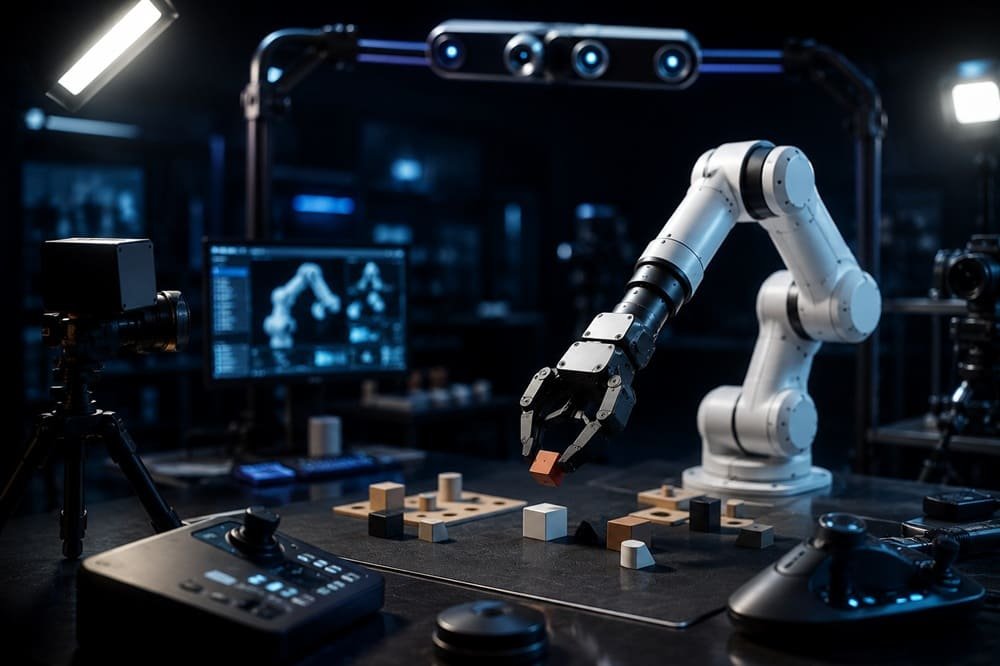
There is a rule on our capture floor that surprises every visitor: no rig purchase gets approved until someone writes down, and signs, the usable hours per shift it is expected to deliver. The rule exists because of a ratio most teams meet too late. A training cluster can process a million episodes a day; a capture floor produces a few hundred. That ratio, not model architecture, is the thesis of this post: capture hardware throughput is the binding constraint in physical AI, and almost every team we work with discovers it after they have already hired the ML engineers.
The gap exists for a structural reason. Language models scaled on data that already existed; the internet was captured for free, decades in advance, by billions of people. Robot data does not exist until someone straps on a camera or sits down at a teleoperation rig and creates it, one real-time hour at a time. Open X-Embodiment, the largest cross-robot dataset effort to date, pooled contributions from more than 20 institutions to assemble on the order of a million trajectories (arxiv.org/abs/2310.08864). GPT-class text corpora are trillions of tokens. The disparity is not a funding problem. It is a hardware throughput problem.
This post breaks down where the bottleneck actually sits: capture-rate physics, sync failure, operator throughput, and fleet reliability. You will get the numbers we use to size capture floors, and a checklist for finding your own pipeline’s binding constraint.
DexSet runs egocentric, teleoperation, and multi-view exocentric capture lines in production for robotics foundation model teams, so the failure modes below are ones we have paid for personally.
Key Takeaways – Robot data must be created in real time; one hour of demonstrations costs one hour of human effort plus overhead, which makes capture hardware throughput the binding constraint in physical AI. – The bottleneck has four layers: capture-rate physics, cross-sensor synchronization, operator ergonomics, and fleet reliability. Most teams only budget for the first. – In our production benchmarks, a well-run teleop cell yields 4 to 5 usable data hours per 8-hour operator shift; a badly specified one yields under 2. – Scaling is a parallelism problem: 10 cheap synchronized seats beat 2 premium ones on delivered hours per dollar, every time we have measured it.
The Bottleneck Is Physical, Not Computational
The core constraint in embodied AI is that demonstration data is generated at the speed of physical reality, one wall-clock hour per data hour, per rig. No compiler optimization changes this. A capture floor’s output is seats multiplied by shift hours multiplied by yield, and hardware choices control two of those three factors.
Consider the arithmetic that surprised one of our clients. They wanted 10,000 hours of teleop demonstrations in six months. At a realistic 4.5 usable hours per operator shift, that is roughly 2,200 shifts, or 18 rigs running double shifts for the full period with zero downtime. Their plan had budgeted 6 rigs. The model roadmap slipped a quarter before a single GPU was misused.
Where Hardware Throughput Actually Dies
Capture throughput is lost in four places, and each maps to a hardware decision made months earlier.
1. Capture-Rate Physics
Capture-rate physics is the raw sensor and storage arithmetic of a rig: resolution times frame rate times stream count. A six-camera RealSense D455 studio recording depth plus RGB produces on the order of a terabyte per shift before compression. Teams that bought cameras without buying the matching NVMe offload path spend the last hour of every shift copying files instead of capturing. The camera was $450; the missing storage architecture costs a data hour per day, forever.
2. Synchronization Failure
Synchronization failure is misalignment between sensor clocks, and it converts captured hours into rejected hours during QA. A 40 ms drift between headset pose and robot joint states is invisible to the operator and disqualifying for action-labeled training data. Hardware with a sync story (RealSense sync pins, Project Aria’s shared-clock VRS recordings) keeps yield around 90 percent in our pipelines. Hardware without one (consumer action cams in multi-view arrays) can silently push rejection rates past 30 percent, and you find out weeks later.
3. Operator Ergonomics
Operator ergonomics is the human sustainability of a rig across a full shift, and it is the most under-priced axis in hardware selection. A 600-plus-gram headset with an external battery is fine for a 20-minute demo and brutal at hour six. On our floors, moving long-shift egocentric work from headsets to ~150 g head-mounted action cameras raised sustained weekly output per operator by a third, purely because breaks got shorter and turnover dropped. ALOHA-style seated leader arms (arxiv.org/abs/2304.13705) similarly outlast handheld free-space teleop for repetitive tabletop tasks.
4. Fleet Reliability
Fleet reliability is the fraction of seats actually capturing at any moment, and it decays with device fragility and SDK churn. Consumer devices were not designed for 60-hour weeks: straps wear out, USB ports loosen, batteries lose capacity by month four, and a firmware update can strand a whole fleet’s capture app on a Tuesday morning. Budget spare units at 15 to 20 percent of fleet size and pin firmware versions the way you pin Python dependencies. A $3,499 spare hurts, which is one more argument for $500 seats.
There is a fifth, quieter drain worth naming: calibration and QA overhead. Every worn or moved device needs its extrinsics re-verified regularly, and every captured hour needs review before it counts. On a healthy floor this overhead runs 10 to 15 percent of shift time. On a floor that skips it, the overhead appears anyway, relocated into next month’s rejection rate.
The Throughput Table
The numbers below are typical ranges from our own capture operations. Treat them as planning figures.
| Capture Setup | Capex per Seat | Usable Hours per 8h Shift | Common Bottleneck | Delivered Cost Range (our benchmarks) |
|---|---|---|---|---|
| GoPro head-mount egocentric (~$400) | $400-700 | 5.5-6.5 | Offload bandwidth, battery swaps | Lowest per hour of any modality |
| Quest 3 VR teleop (~$500 + robot) | $1,200-5,500 | 4-5 | Passthrough latency fatigue, resets | $28-45/hr |
| Vision Pro VR teleop ($3,499 + robot) | $4,500-8,000 | 3.5-4.5 | Comfort, battery, spare cost | $40-60/hr |
| ALOHA-class bimanual (~$20k station) | $22,000-30,000 | 4-5 | Task resets, arm maintenance | $35-60/hr |
| GELLO leaders on existing arms (~$300/arm) | $600-1,000 incremental | 4-5 | Follower robot availability | $28-45/hr |
| UMI handheld grippers (~$400) | $400-600 | 5-6 | SLAM post-processing QA | Below teleop, above raw egocentric |
Read the table columns together, not in isolation. The cheapest capex row is not automatically the cheapest delivered hour once yield and QA rejection enter, but the pattern holds: parallel cheap seats with a real sync plan dominate small fleets of premium hardware.
How to Scale Past the Bottleneck
Scaling data capture hardware for embodied AI means adding synchronized parallel seats while holding per-seat yield constant, and the order of operations matters.
- Instrument yield first. Measure usable hours per shift per seat before buying anything. Most teams cannot answer this today.
- Fix sync before adding seats. Ten unsynced rigs scale your rejection rate, not your dataset.
- Standardize on one episode format. LeRobot’s dataset format (github.com/huggingface/lerobot) or a fixed HDF5 schema; converters eat engineer-weeks.
- Buy for the shift, not the demo. Weigh the device, check the battery swap time, and price spares at 15-20 percent of fleet.
- Then parallelize. Cheap identical seats, one calibration procedure, one QA gate.
The order matters more than the shopping list. Teams that parallelize first and fix sync second end up owning ten rigs that produce ten streams of mutually misaligned data, and the “scaling” project quietly becomes a salvage project.
Or skip the capital expenditure entirely: this bottleneck is exactly why data vendors exist. A vendor amortizes rigs, operators, calibration routines, and QA gates across many clients, which is how delivered hours can cost less than an in-house floor’s fully loaded rate even before you count the hiring time. The build-versus-buy math is covered in our full guide to data capture hardware for embodied AI, including per-device comparison tables and a decision matrix.
Frequently Asked Questions
Why is data capture the bottleneck in physical AI rather than compute?
Because robot demonstrations must be created in real time by humans and hardware, one wall-clock hour per data hour per rig. Compute scales by purchase order; capture scales only by adding synchronized seats and operators.
How many usable data hours does one teleoperation rig produce per day?
In our production benchmarks, a well-specified teleop cell yields 4 to 5 usable hours per 8-hour shift after resets, calibration, and QA rejection. Poorly synchronized or ergonomically bad rigs can drop below 2.
What is the fastest way to scale robot data collection?
Fix synchronization and episode formats first, then add cheap parallel seats. Ten ~$500 synchronized capture seats reliably outdeliver two premium seats on hours per dollar.
How much data do VLA models need?
Published systems give the scale: Open X-Embodiment pooled roughly one million trajectories across institutions, and fine-tuning a VLA for a task family typically consumes hundreds to thousands of targeted demonstrations. The practical answer is more than one team’s ad-hoc rig produces, which is why capture throughput planning matters.
Does buying more expensive capture hardware increase throughput?
Not by itself. Throughput follows seats, sync, ergonomics, and reliability. A $3,499 headset that fatigues operators faster than a $500 one lowers delivered hours per dollar despite better optics.
Sizing a capture floor?
Start with the full guide to data capture hardware for embodied AI, or book a demo and we will walk you through the throughput math on your task list with real DexSet sample data.