
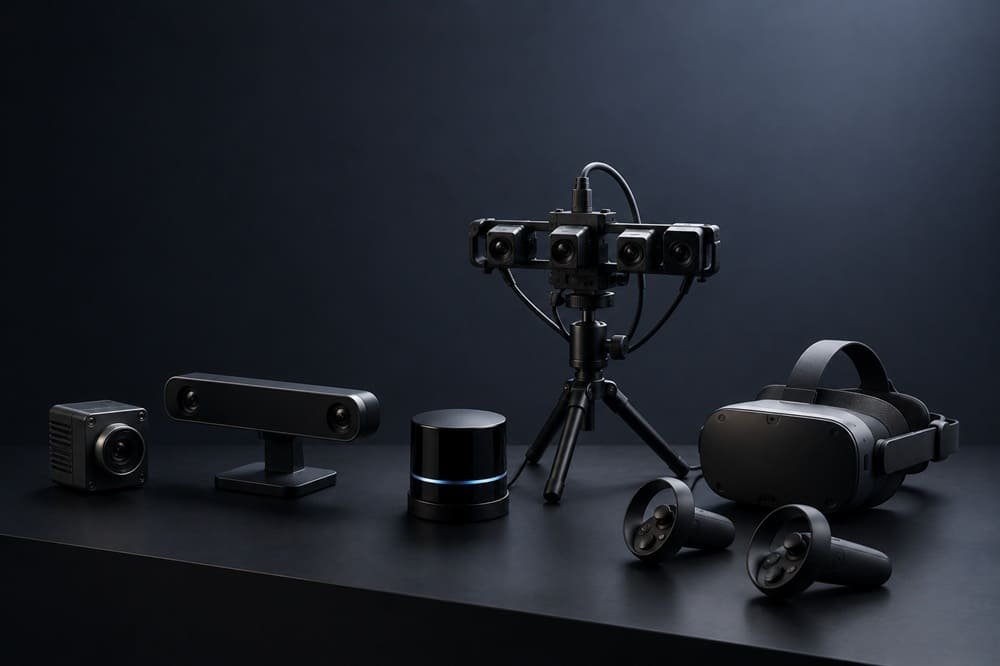
A Head of Data on a scoping call last quarter asked us which single capture device her team should standardize on, and for the first time in months, we had no quick answer. We had run every device she named in production. The problem was the question: it has no device-shaped answer, because a capture device is not a purchase, it is a commitment. The hardware you choose locks your pipeline into what that device can timestamp, sync, and survive, and teams that fail on data usually failed at that moment, months before anyone touched a model. That is this guide’s thesis: capture hardware is a data-strategy decision, judged on seven axes and on cost per delivered hour, never on spec sheets.
The reason the question stumps buyers is that capture hardware for embodied AI sits in a gap between consumer electronics and lab equipment. A Quest 3 was built for gaming, not for exporting synchronized RGB, IMU, and hand pose at training quality. A RealSense was built for prototyping, not for 40 units running ten hours a day. Vendor spec sheets answer none of the questions that matter for foundation model training, so teams learn the hard lessons after the purchase order clears.
This guide gives you the full picture: every major hardware category (headsets, research glasses, action cameras, stereo depth cameras, teleoperation rigs, handheld grippers, tactile sensors), compared on the seven axes that decide whether your dataset trains a VLA model or fills a hard drive. You will leave with real prices, a cost-per-hour model, and a decision matrix mapped to the three capture strategies that matter: egocentric human data, teleoperation, and multi-view exocentric capture.
At DexSet we run these devices in production. Our teams operate teleop cells, headset fleets, and multi-camera capture studios that deliver egocentric, exocentric, mono, and stereo data to robotics foundation model teams. Every number in this guide comes from our own rigs, published research, or a linked primary source.
TL;DR: Key Takeaways – Data capture hardware for embodied AI spans four categories: wearable egocentric devices ($350 to $3,499), stereo depth cameras ($250 to $500 per unit), teleoperation rigs ($300 per arm to $20,000+ per station), and tactile sensors. – The seven evaluation axes are price, resolution/fps, depth quality, sync capability, wearability, SDK maturity, and data formats. Sync capability is the axis teams most often ignore and most often regret. – A Meta Quest 3 at ~$500 covers most teleoperation UI needs; the Apple Vision Pro at $3,499 earns its price only for eye tracking and high-resolution passthrough research. – Teleop capex is lower than most CTOs assume: a GELLO leader arm costs roughly $300 per arm, against $20,000+ for a full ALOHA-class bimanual station. – In our production benchmarks, delivered teleop data runs $28 to $60 per hour depending on rig and task complexity; egocentric human data runs meaningfully cheaper per hour but trains different capabilities.
What Is Data Capture Hardware for Embodied AI?
Data capture hardware for embodied AI is the set of physical devices, wearables, cameras, teleoperation interfaces, and sensors, used to record the visual, spatial, inertial, tactile, and action data that trains robots and vision-language-action (VLA) models. It is the acquisition layer of the robot learning stack: everything between the physical world and your training dataset.
The category matters because embodied AI models learn from demonstrations, not from text scraped off the internet. A VLA model like OpenVLA (arxiv.org/abs/2406.09246) or Physical Intelligence’s pi-0 (arxiv.org/abs/2410.24164) consumes synchronized streams of camera frames, proprioception, and actions. The hardware that records those streams sets a hard ceiling on model quality. No amount of post-processing recovers depth a sensor never measured or a timestamp a device never wrote.
Core Concepts and Data Modalities
Data modalities are the distinct sensor streams a capture device records, and every hardware decision starts by listing which modalities your model actually needs. The main ones for embodied AI are RGB video, stereo pairs, depth, IMU, eye gaze, hand and body pose, robot proprioception, and tactile signal.
Mono vs. Stereo RGB
Mono RGB is a single camera stream; stereo RGB is a calibrated pair that allows depth to be recovered by triangulation. Mono is cheaper and lighter and dominates large egocentric datasets like Ego4D (arxiv.org/abs/2110.07058). Stereo gives your model, or your post-processing pipeline, metric 3D structure, which matters for manipulation policies that must reason about distance to a grasp point. On our rigs, stereo roughly doubles storage and calibration workload, so we specify it only when the downstream model consumes it.
Depth
Depth is a per-pixel distance measurement, produced either by active sensors (structured light, time-of-flight) or by stereo matching. Active depth from a RealSense-class sensor works well indoors at 0.3 to 6 meters but degrades in sunlight and on reflective surfaces. Neural stereo depth (ZED 2i class) extends range but requires a GPU at capture time or in post.
IMU and Time Synchronization
An IMU (inertial measurement unit) records acceleration and angular velocity, typically at 200 Hz to 1,000 Hz, and it is only useful if its clock aligns with the camera clock. Cross-device sync is the silent killer of embodied AI datasets: a 40 ms offset between video and proprioception is invisible in playback and fatal for action-labeled training data. Devices differ enormously here. Project Aria timestamps all sensors on a shared clock; a GoPro gives you a self-consistent file but no native way to sync with a robot’s ROS 2 clock without an external signal.
Proprioception and Action Data
Proprioception is the robot’s own joint state (positions, velocities, torques), and action data is the command stream sent to the robot. These come from the robot or the teleoperation interface, not from cameras, which is why teleop rigs are capture hardware in their own right. Imitation learning methods like ACT, introduced with the ALOHA rig (arxiv.org/abs/2304.13705), train directly on this stream. The entity chain to keep straight: teleoperation produces demonstrations, demonstrations feed imitation learning, imitation learning trains the VLA policies that run on robots.
Tactile
Tactile sensing records contact geometry and force at the gripper, usually via vision-based sensors in the GelSight style, where a camera watches a deformable gel pad. Tactile is the newest modality in production pipelines and the least standardized; we cover the hardware below.
The Four Hardware Categories
Capture hardware for embodied AI falls into four categories: wearable egocentric devices, stereo and depth cameras for exocentric capture, teleoperation rigs, and handheld or tactile interfaces. Most production pipelines combine at least two.
Category 1: Wearable Egocentric Devices
Wearable egocentric devices are head-mounted cameras and headsets that record the world from a human’s first-person viewpoint, the same viewpoint a humanoid robot’s head camera will have. This category powers egocentric pretraining datasets like Ego-Exo4D (arxiv.org/abs/2311.18259) and doubles as the operator interface for immersive teleoperation systems like Open-TeleVision (arxiv.org/abs/2407.01512).
| Device | Price | Sensors & Resolution | Depth | Sync | Wearability (8h shift) | SDK Maturity | Native Data Formats |
|---|---|---|---|---|---|---|---|
| Meta Quest 3 | ~$500 | Color passthrough cameras, 6DoF inside-out tracking, hand tracking, IMU | Passthrough depth estimate, not export-grade | Good within headset; WebXR/OpenXR timestamps for teleop | Moderate; 515 g, front-heavy after ~2h | Strong (OpenXR, Meta SDK, large dev community) | App-level capture; pose + hand joints via OpenXR |
| Apple Vision Pro | $3,499 | High-res micro-OLED displays, high-quality color passthrough, eye tracking, hand tracking, LiDAR | LiDAR scene depth | Excellent within device; ARKit timestamps | Poor for long shifts; 600-650 g, external battery | Strong but restrictive (visionOS, ARKit); raw camera access gated | ARKit poses, hand skeletons; limited raw sensor export |
| Project Aria / Aria Gen 2 | Research access (not retail) | RGB camera, 2 mono SLAM cameras, eye tracking cameras, spatial mics, dual IMUs (Gen 2 adds PPG, improved compute) | No active depth; SLAM-derived | Best in class; all sensors on shared clock, VRS format | Excellent; ~75 g glasses form factor | Good (Project Aria Tools, MPS cloud services) | VRS files, MPS trajectories, gaze (projectaria.com) |
| GoPro head mount (Hero-class) | ~$400 | Single wide FOV RGB, 5.3K/60 or 4K/120, IMU telemetry | None | Weak across devices; GPMF telemetry internal only | Good; ~150 g with mount | Moderate (GPMF parsers, no live SDK) | MP4 + GPMF metadata track |
The pattern to notice: the $3,499 device is not seven times better than the $500 device for data capture. Vision Pro wins when you need eye gaze and the highest-fidelity passthrough for perception research or premium teleop. Quest 3 wins on fleet economics: at our scale, one damaged Vision Pro costs the same as seven Quest 3 replacements. Aria wins on data quality per gram but is research-access only, which makes it a partnership decision rather than a purchasing decision. The GoPro remains the workhorse for raw egocentric video volume, and it is the camera inside the UMI gripper stack discussed below.
Category 2: Stereo Depth Cameras for Exocentric Capture
Stereo depth cameras are fixed or tripod-mounted sensors that record a scene from outside the actor, providing the third-person views used in multi-view exocentric datasets and in robot workspace monitoring. Datasets like DROID (arxiv.org/abs/2403.12945) standardized on this class of sensor.
| Device | Price | RGB / Depth Resolution & FPS | Depth Quality | Sync Capability | SDK Maturity | Data Formats |
|---|---|---|---|---|---|---|
| Intel RealSense D435i | ~$300-350 | Depth 1280x720 @ up to 90 fps; RGB 1080p @ 30; IMU | Good 0.3-3 m; global-shutter depth sensors | Hardware sync pin across units | Mature (librealsense, ROS 2 wrapper) | ROS 2 bags, .bag/.ply, raw streams |
| Intel RealSense D455 | ~$420-450 | Depth 1280x720 @ 90 fps; wider 95 mm baseline; global-shutter RGB; IMU | Better than D435i at 4-6 m range | Hardware sync pin | Mature (same stack) | Same as D435i |
| Stereolabs ZED 2i | ~$500 | Stereo 2K @ 15, 1080p @ 30, 720p @ 60; IMU, barometer, magnetometer | Neural stereo depth, usable 0.3-20 m | Software sync; multi-cam via ZED Hub | Mature but GPU-dependent (ZED SDK, needs NVIDIA) | SVO recordings, ROS 2 wrapper |
| Luxonis OAK-D | ~$250-350 | 4K RGB + 2x mono stereo pair; on-device compute | Good short-range stereo depth | Hardware FSYNC on some variants | Growing (DepthAI, ROS 2 driver) | DepthAI streams, ROS 2 |
For multi-view exo capture, the deciding axis is sync. RealSense’s hardware sync pin lets you drive eight cameras off one trigger, which is why it still dominates academic capture cells despite Intel’s on-again-off-again commitment to the product line. ZED 2i buys you longer range and better outdoor behavior at the cost of an NVIDIA GPU per capture node. OAK-D is the value play when you want on-device neural inference to filter or annotate at capture time.
Category 3: Teleoperation Rigs
Teleoperation rigs are the leader-follower arm pairs, exoskeletons, and VR-based control systems through which a human operator produces robot action data. This is the category where hardware choice most directly sets your cost per demonstration.
| System | Price | What It Is | Action Fidelity | Operator Fatigue | SDK / Ecosystem | Data Formats |
|---|---|---|---|---|---|---|
| ALOHA / ALOHA 2 rig | ~$20,000+ per bimanual station | Two leader + two follower arms, joint-space mapping, 50 Hz | High; fine bimanual tasks | Moderate; seated, arms supported | Strong research ecosystem (ACT, Mobile ALOHA, LeRobot support) | HDF5 episodes; LeRobot dataset format |
| GELLO | ~$300 per arm (plus follower robot) | 3D-printed, Dynamixel-based kinematic-twin leader arm (arxiv.org/abs/2309.13037) | High for the matched follower | Low-moderate | Open source, LeRobot-compatible | Joint streams to ROS 2 / LeRobot |
| UMI gripper | ~$400 build (printed gripper + GoPro) | Handheld gripper with wrist-mounted fisheye GoPro; robot-free demonstrations (arxiv.org/abs/2402.10329) | Good; SLAM-recovered actions, no proprioception | Low; natural human motion | Open source, active community | MP4 + GPMF, post-processed to episodes |
| VR teleop (Quest 3 / Vision Pro + arms) | $500-$3,499 + robot | Headset streams head/hand pose to robot controller (Open-TeleVision style) | Good; depends on retargeting | Moderate; passthrough latency drives fatigue | Growing; OpenXR + custom stacks | Pose streams + robot logs |
| Tactile (DIGIT / GelSight-style) | A few hundred dollars per fingertip (DIGIT-class); research-grade GelSight units cost thousands | Vision-based tactile sensor in gripper fingertips | Adds contact-rich signal | N/A (robot-mounted) | Moderate (open DIGIT designs; PyTouch-era tooling) | Compressed tactile image streams |
The $20,000 ALOHA figure and the $300 GELLO figure describe different points on the same curve, not competing products. ALOHA is a complete bimanual station including four arms. GELLO is a leader-arm design you bolt onto follower robots you already own. UMI removes the robot from data collection entirely, which is why it produces the cheapest demonstrations and the weakest proprioception. Every serious pipeline we run mixes at least two of these.
Category 4: Multi-View Exocentric Studios
A multi-view exocentric studio is an array of four to twelve synchronized cameras surrounding a workspace, recording the same manipulation from multiple third-person angles. Ego-Exo4D paired Aria glasses with four to five stationary GoPros per scene precisely because models trained on both viewpoints generalize better than either alone. Budget $2,500 to $6,000 per studio in cameras and mounts, then double it for the sync, lighting, and storage infrastructure that spec sheets never mention.
Decision Matrix: Which Hardware for Which Use Case
The right hardware follows from the capture strategy, and there are three dominant strategies: egocentric human data, teleoperation, and multi-view exocentric capture.
| Use Case | First Choice | Budget Alternative | Premium Option | Avoid |
|---|---|---|---|---|
| Egocentric human data at scale (pretraining) | GoPro head mounts (~$400/operator) | Used Hero-class cameras | Project Aria via research partnership | Vision Pro (cost, battery, comfort) |
| Egocentric with gaze + trajectories | Project Aria / Aria Gen 2 | Quest 3 with logging app | Aria Gen 2 | GoPro (no gaze, no shared clock) |
| Immersive teleoperation UI | Quest 3 (~$500) | Quest 3 | Vision Pro (eye tracking, passthrough fidelity) | GoPro (not a display) |
| Bimanual fine manipulation demos | ALOHA-class station (~$20k) | GELLO leaders on existing arms (~$300/arm) | ALOHA 2 with tactile fingertips | UMI (no bimanual joint coupling) |
| Cheap single-arm demonstrations at volume | UMI grippers (~$400 each) | GELLO + one follower arm | ALOHA station | Vision Pro teleop (capex per seat) |
| Multi-view exo studio | 4-8x RealSense D455, hardware-synced | OAK-D array | ZED 2i array with GPU nodes | Unsynced consumer webcams |
| Contact-rich tasks | DIGIT-class fingertips on any rig above | Single tactile finger + RGB | GelSight-style research sensors | Skipping tactile, then labeling contact by eye |
Cost, Economics, and ROI
Capture hardware economics are dominated by throughput and operator time, not by device price, so the correct unit of analysis is cost per delivered data hour. This is the section competitors leave out, so here are the numbers we actually use.
Capex per seat, typical ranges:
- Egocentric human capture seat: $400 to $700 (camera, mount, spare batteries, storage cards)
- VR teleop seat: $1,200 to $5,500 (headset, workstation, networking; excludes the robot)
- GELLO teleop seat: $600 to $1,000 on top of an existing follower arm
- ALOHA-class bimanual cell: $22,000 to $30,000 fully commissioned
- Exo studio (6 cameras): $2,500 to $6,000 in sensors, roughly the same again in sync, mounting, lighting, and storage
Cost per delivered hour, our production benchmarks: teleoperation data lands at $28 to $60 per hour depending on rig type, task complexity, and QA depth. Egocentric human data typically lands at one third to one half of that, because a human wearing a camera needs no robot, no retargeting stack, and far less resets-per-hour overhead. These are the typical ranges we see across our own pipelines; treat them as planning numbers, not quotes.
The ROI logic is straightforward. A $20,000 ALOHA cell running two shifts amortizes to under $2 per data hour within a year; the operators cost ten times that. Buying cheaper hardware that cuts operator throughput by 20 percent is a false economy. Buying $3,499 headsets when $500 ones sustain the same demonstrations per hour is the opposite mistake.
Case Study: A Humanoid Foundation Model Team’s Capture Stack
The proof is in a deployment, so here is an anonymized configuration from our own work. A humanoid foundation model team came to us needing three data types simultaneously: egocentric human video for pretraining, bimanual teleop demonstrations for fine-tuning, and multi-view exo recordings for evaluation.
We stood up three lines. Line one: 30 GoPro head-mount seats for kitchen and warehouse egocentric capture, delivering several hundred hours per week. Line two: four ALOHA-class stations plus six GELLO-equipped single-arm cells, producing task-labeled demonstrations in LeRobot format (github.com/huggingface/lerobot). Line three: a six-camera RealSense D455 studio, hardware-synced, wrapped around one teleop cell for paired ego-exo evaluation episodes.
Two hardware lessons generalized. First, the D455’s wider baseline halved our depth QA rejections at 2 to 4 meters compared with the D435i units we started with. Second, moving VR teleop from Vision Pro pilots to Quest 3 fleet units cut capex per seat by 85 percent with no measurable drop in demonstrations per operator-hour on pick-and-place classes of tasks. The Vision Pros stayed in service for the subset of tasks where gaze labels earned their cost.
Get the RFP Scorecard
A hardware decision this size deserves a structured evaluation, so we built one you can reuse. The DexSet Data Capture Hardware RFP Scorecard is a one-page matrix that scores any device or vendor on the seven axes in this guide (price, resolution/fps, depth quality, sync, wearability, SDK maturity, data formats) plus delivery terms and QA guarantees. Teams use it to compare quotes on equal footing instead of vendor spec sheets. Download it below, and if you want the comparison done for you, that is literally our job.
Related reading from this series:
Frequently Asked Questions
What is data capture hardware for embodied AI?
Data capture hardware for embodied AI is the set of wearable cameras, headsets, depth sensors, teleoperation rigs, and tactile sensors used to record the synchronized visual, inertial, action, and contact data that trains robot policies and vision-language-action models.
Is the Apple Vision Pro worth it over the Meta Quest 3 for robotics data capture?
Only for specific needs. The Vision Pro’s eye tracking and passthrough fidelity justify its $3,499 price for gaze-labeled data and premium teleoperation research. For fleet teleop and general egocentric capture, the ~$500 Quest 3 delivers comparable demonstrations per operator-hour at one seventh the capex.
How much does a teleoperation rig cost?
Between $300 and $30,000 depending on class. A GELLO leader arm costs roughly $300 per arm on top of a follower robot you already own; a UMI handheld gripper builds for about $400; a complete ALOHA-class bimanual station runs $20,000 or more fully commissioned.
What is the difference between egocentric and exocentric data capture?
Egocentric capture records from the actor’s first-person viewpoint using head-mounted devices; exocentric capture records the actor from external, third-person cameras. Datasets like Ego-Exo4D pair both because policies trained on combined viewpoints generalize better.
Why does time synchronization matter so much in capture hardware?
Because embodied AI models train on aligned observation-action pairs. A clock offset of tens of milliseconds between camera, IMU, and robot proprioception silently corrupts action labels, and it cannot be fixed after the fact without shared timestamps or an external sync signal.
Which stereo depth camera is best for a multi-camera robotics capture studio?
For hardware-synchronized multi-view rigs, the Intel RealSense D455 (~$420-450) is the default choice because of its sync pin, 95 mm baseline, and mature ROS 2 support. The ZED 2i suits longer-range or outdoor scenes if each node has an NVIDIA GPU.
Ready to skip the hardware learning curve?
DexSet already runs the rigs in this guide at production scale. [Download the RFP Scorecard] to evaluate vendors on equal terms, or [Book a Demo] to see sample egocentric, teleop, and multi-view datasets from these exact devices. [Download Sample Data] is one click away.