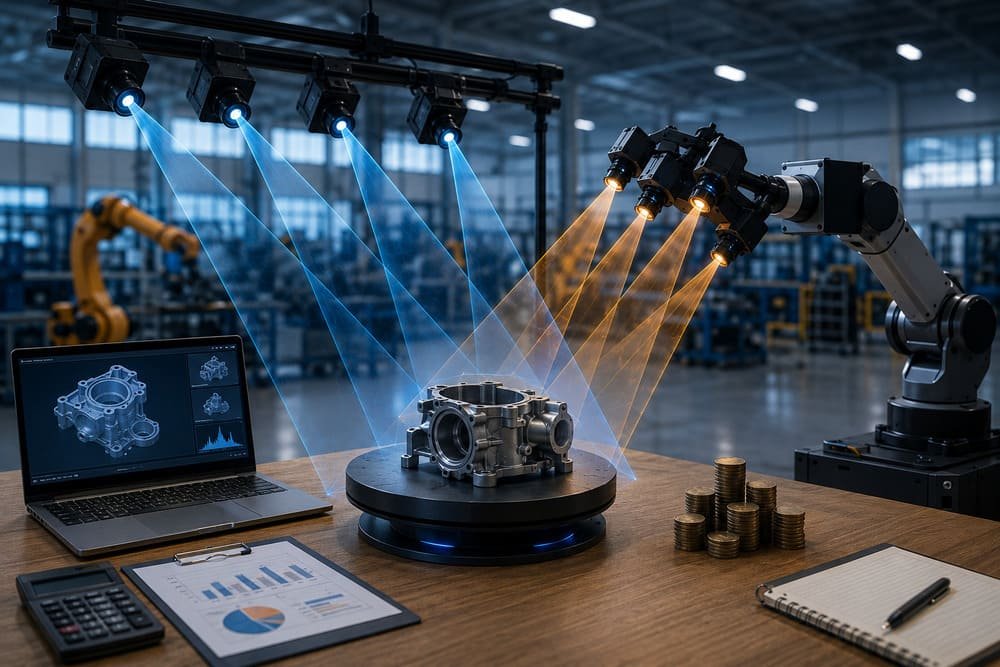
In February, we priced the same 5,000-hour manipulation corpus three different ways for one buyer: all bimanual teleoperation at a blended $44 per hour, a 65/35 egocentric-to-teleop mix at just under $30, and a handheld-gripper-heavy plan in between. Same task list, same acceptance spec. The spread between the first two plans came to roughly $70,000.
I build teleop cells for a living, so this is not an argument against teleoperation. It is the thesis that quoting exercise made unavoidable: modality selection is a budgeting decision, and the right modality for each training objective is the cheapest one that actually satisfies it. For plenty of what your model needs to learn, the premium teleop hour is simply the wrong purchase.
Teams get this wrong in both directions. Some buy 20,000 hours of premium teleop and burn budget teaching their encoder what a kitchen looks like, a job $18-per-hour egocentric video does fine. Others go all-in on cheap human video and then discover their policy has beautiful representations and no idea how to move an actual gripper.
The reason the mistake is so common is that modality costs and modality capabilities are usually discussed separately. Cost tables live in procurement decks; capability arguments live in arXiv papers. This post puts them in one place, with DexSet’s operating benchmarks attached, so you can match each dollar to the learning objective it actually serves.
By the end you will have per-hour costs for four collection approaches, an honest pros-and-cons list for each, and a decision matrix that maps training objectives to the cheapest modality that satisfies them.
Key Takeaways
- Teleoperation ($28 to $60/hr) is the only approach that outputs executable robot actions natively. Pay for it where action supervision matters.
- Egocentric human video ($15 to $40/hr) is the cheapest volume play, best for representation pretraining, worst for the embodiment gap.
- Multi-view exocentric capture ($20 to $50/hr) buys scene context and cross-view consistency; calibration labor is its hidden cost.
- UMI-style handheld grippers (under $1k per device by our estimates) collect gripper-centric data at near-egocentric labor cost, with heavier post-processing.
- QA rejection (10 to 30 percent in our pipelines) and annotation ($8 to $25/hr per pass) apply to all four. Compare on cost per usable hour.
The Four Approaches, Defined
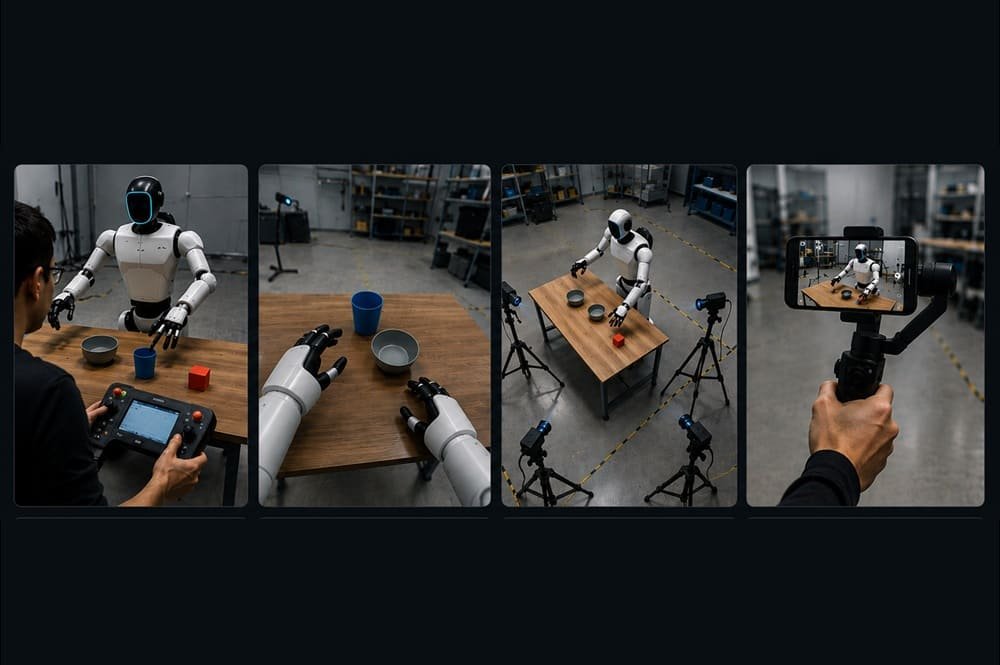
A data collection approach is the pairing of a capture device with a control source: robot teleoperation, head-mounted egocentric capture, calibrated exocentric camera arrays, or handheld instrumented grippers. Everything else, mono versus stereo, camera count, annotation depth, is a variation within these four.
Teleoperation: $28 to $60 per Hour
Teleoperation data is produced by a human driving a real robot through leader-follower arms or a VR interface, so every recorded frame pairs observations with executable actions in the robot’s own action space. The ALOHA project showed this could be done on a roughly $20k bimanual rig (https://arxiv.org/abs/2304.13705), and Mobile ALOHA extended it to whole-body mobile tasks on roughly $32k of hardware (https://arxiv.org/abs/2401.02117).
Pros
- Native action labels; feeds imitation learning and VLA post-training directly
- Matches your exact embodiment, gripper, and camera placement
- Long-horizon, contact-rich tasks are demonstrable at production quality
Cons
- Highest labor cost: trained operators at $18 to $38 per hour, plus rig amortization and QA
- Throughput capped by operator skill and episode reset time
- Data is embodiment-specific; switching robots strands some of its value
Egocentric Human Video: $15 to $40 per Hour
Egocentric data is first-person video from a head-mounted camera while a human performs tasks with their own hands, capturing human-level dexterity with no robot in the loop. Ego4D and EgoExo4D (https://arxiv.org/abs/2311.18259) made the research case; the commercial case is pure economics, since the collector works at natural speed on tasks they already know.
Pros
- Cheapest per hour; scales to thousands of hours quickly
- Enormous task and scene diversity, including real homes
- Strong pretraining signal for visual encoders and hand-object interaction priors
Cons
- No robot actions; the embodiment gap means it rarely supervises control directly
- QA rejection skews high (motion blur, gaze drift, occlusion), 15 to 30 percent in our pipelines
- Needs retargeting or paired data to transfer to a gripper
Multi-View Exocentric Capture: $20 to $50 per Hour
Exocentric data is third-person video from multiple calibrated, synchronized cameras observing the same task, giving models scene-level context and cross-view consistency that neither ego nor teleop streams provide alone. Stereo pairs add 15 to 25 percent over mono at the same view count and buy metric depth in return.
Pros
- Full-scene coverage; occlusions in one view are recovered in another
- Calibrated multi-view supports 3D reconstruction and world-model training
- Pairs well with egocentric streams (the EgoExo4D recipe)
Cons
- Calibration and synchronization labor at every scene change is the silent budget eater
- Fixed arrays limit scene diversity; mobile arrays raise cost
- Still no action labels without a paired control source
Handheld Instrumented Grippers (UMI-style): Near-Egocentric Cost, Gripper-Centric Output
Handheld gripper capture uses a portable, wrist-camera-equipped gripper operated by a human, producing gripper-centric trajectories without any robot present at collection time. The UMI paper (https://arxiv.org/abs/2402.10329) defined the category; our build estimate is under $1,000 per device including the camera.
Pros
- Capex is trivial next to a $20k to $32k teleop cell
- Collection happens anywhere a person can walk, at near-egocentric labor rates
- Output is closer to robot action space than raw human video
Cons
- Heavier post-processing to recover clean actions (SLAM drift, kinematic mismatch)
- Gripper form factor constrains which tasks are demonstrable
- QA tooling for this modality is younger; expect iteration
Master Comparison Table
| Approach | DexSet cost/raw hr | Capex per station | Action labels | QA rejection | Best use |
|---|---|---|---|---|---|
| Teleoperation | $28 to $60 | $20k to $32k | Native | 10 to 25% | VLA post-training, imitation learning |
| Egocentric video | $15 to $40 | $300 to $3.5k | None | 15 to 30% | Encoder pretraining, dexterity priors |
| Exocentric multi-view | $20 to $50 | $5k to $15k (3 to 8 cams) | None | 10 to 20% | Scene context, world models, 3D |
| Handheld gripper (UMI-style) | $18 to $42 (our estimate) | Under $1k/device | Recoverable | 15 to 25% | Diverse-scene manipulation at low capex |
Annotation is additive to every row: $8 to $12 per hour for language instructions, up to $18 to $25 for dense masks and contact labels. And every row’s real price is its cost per usable hour: divide by (1 minus rejection rate). The full math, with a budget spreadsheet, lives in our robot training data costs and pricing guide.
Decision Matrix: Match the Dollar to the Objective
A modality decision matrix assigns each training objective the cheapest approach that actually satisfies it, instead of defaulting everything to the premium modality. Here is the one we use in scoping calls:
| Your objective | Buy this | Not this | Why |
|---|---|---|---|
| Post-train a VLA on your robot | Teleoperation | Egocentric | You need native actions on your embodiment |
| Pretrain visual encoders at volume | Egocentric | Teleoperation | Paying $42/hr for pixels is waste |
| Scene diversity across 100+ homes | Handheld gripper or egocentric | Fixed exo array | Portability beats calibration |
| Depth-dependent manipulation | Stereo exo + teleop | Mono anything | Metric depth earns its 15 to 25% premium |
| World-model or video-prediction training | Exo multi-view + ego pairs | Teleop only | Cross-view consistency is the signal |
| Bimanual, contact-rich skills | Teleoperation (ALOHA-class) | Handheld gripper | Two grippers, force-aware demos |
The pattern behind the matrix: mix modalities and stage them. Open X-Embodiment’s 1M+ trajectories across 22 embodiments (https://arxiv.org/abs/2310.08864) and DROID’s 76k episodes (https://arxiv.org/abs/2403.12945) already prove cross-source data mixes train better generalists. Your budget should look like a portfolio, not a single line item. A 70/30 split of cheap pretraining hours to teleop post-training hours routinely cuts blended cost by a third in programs we run, with no loss on the action-supervised objectives.
Match the Modality to the Objective
Ready to scope your data program? Talk to our team.
Frequently Asked Questions
What is the cheapest way to collect robot training data?
Egocentric human video, at $15 to $40 per hour in our benchmarks, since hardware is a wearable camera and collectors work at natural speed. It is cheapest per hour but supplies no robot actions, so it cannot carry a program alone.
When is teleoperation worth its cost?
When you need executable actions on your specific embodiment: VLA post-training, imitation learning for contact-rich or bimanual skills. For those objectives nothing cheaper substitutes, which is exactly why you should not spend teleop dollars on anything else.
Are UMI-style handheld grippers production-ready?
They are production-useful with caveats. Capex is under $1,000 per device by our estimates and scene diversity is the widest of the four approaches, but plan for heavier post-processing and a 15 to 25 percent rejection rate while the QA tooling matures.
Should I collect mono or stereo?
Stereo adds 15 to 25 percent to exocentric capture cost and pays for itself on depth-dependent manipulation tasks. For pure representation pretraining, mono volume usually beats stereo precision per dollar.
How do I compare vendor quotes across modalities?
Convert everything to cost per usable hour: quoted rate divided by (1 minus the measured QA rejection rate), plus annotation per pass. Our pricing guide includes the worked tables.
Scoping a mixed-modality program?
Start with the Robot Training Data Costs and Pricing Guide for the full benchmark tables, then book a scoping call and we will run your task list through the decision matrix above.