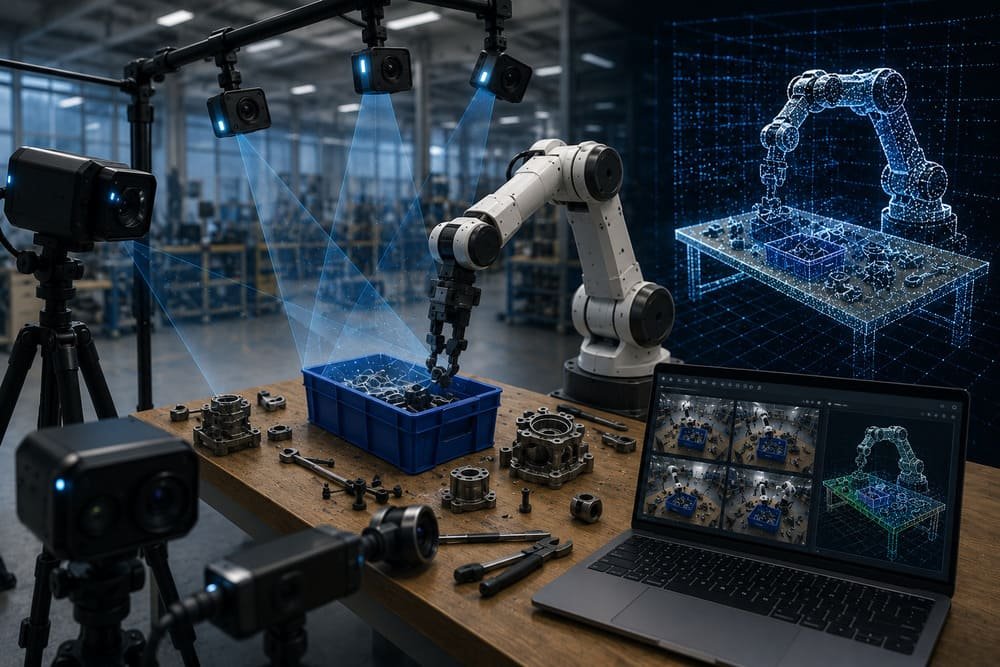
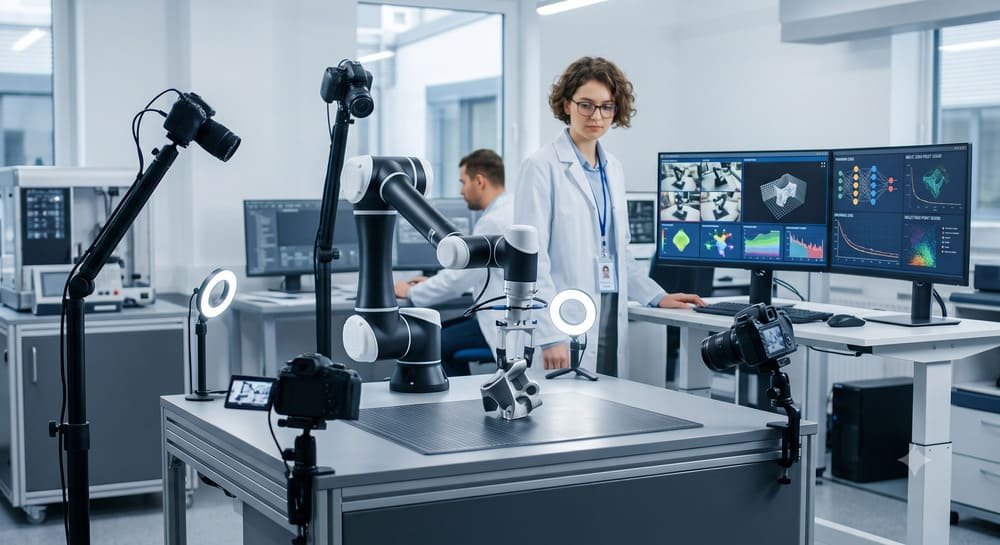
Multi-view data is usually defined as episodes recorded from several calibrated, synchronized cameras. That definition hides the real problem: calibration and synchronization are not properties you establish, they are properties you maintain, and every mechanism that breaks them is invisible on the day it happens. A dead camera stops a capture session; everyone notices, everyone fixes it. A tripod nudged 4 millimeters by a cleaning crew stops nothing. Capture continues for three weeks, the extrinsics in the metadata quietly stop matching reality, and the first symptom appears a month later as a training curve that will not converge, in a building the data team does not work in.
That gap between when multi-view data breaks and when anyone finds out is what makes these challenges “hidden,” and it is the thesis of this post: detection latency, not defect rate, is what actually determines the cost of a multi-view failure. Single-view pipelines fail loudly. Multi-view pipelines add cross-camera dependencies (shared clocks, relative poses, matched exposure) that fail silently, and the cost of the failure scales with how long it goes undetected.
I run data quality at DexSet, which means my job is finding these failures before customers do. This post covers the five that account for nearly every multi-view escalation we have handled, each with the fix we actually use, not the fix that sounds good in a slide. Rig geometry, camera selection, and cost context live in the pillar: The Complete Guide to Exocentric & Multi-View Data for Robot Learning.
Key Takeaways – The five silent killers: calibration drift, time sync skew, storage blowup, viewpoint overfitting, and lost extrinsics metadata. – Every fix is procedural, not exotic: per-session verification sweeps, PTP or hardware triggering, codec decisions before capture, view dropout in training, and extrinsics embedded per episode. – Our gates: reprojection error under 0.5 px and cross-camera skew under 10 ms, checked every session. Sessions that fail do not ship. – Detection latency is the real enemy. A defect caught same-day costs minutes; caught post-training, it costs a recollection.
Challenge 1: Calibration Drift
Calibration drift is the gradual or sudden divergence between a rig’s recorded extrinsics and its physical camera poses, caused by bumped mounts, sagging booms, thermal cycles, or fixture swaps. It is the most common defect we see in incoming third-party datasets, and the most expensive, because every frame captured after the drift event carries wrong geometry.
The failed solution is calibrating on install and trusting the mounts. Mounts do not deserve trust. Our fix has three parts: rigid fixturing over convenient fixturing (no friction-arm boom mounts on anything that ships), a 20-second ChArUco verification sweep at the start of every session, and a hard ingestion gate at 0.5 px reprojection error. The sweep costs two minutes. In one recent engagement it caught a sagged mount at 1.3 px the morning after a fixture swap; 25 minutes of recalibration instead of weeks of poisoned data. The toolchain is standard: OpenCV calibration for intrinsics and stereo pairs, Kalibr for full multi-camera rigs, ROS 2 camera_calibration for live-topic workflows.
Challenge 2: Time Synchronization Skew
Sync skew is disagreement between cameras about when a frame was captured, and it turns multi-view supervision into contradiction: two views of “the same instant” showing the gripper in two different places. At 30 fps, a one-frame offset is 33 ms of world-state disagreement, injected into every training sample, unremovable after the fact.
Software timestamps drift because independent device clocks drift; that is not a bug, it is physics. The fix is choosing a sync tier deliberately. PTP (IEEE 1588) disciplines clocks over Ethernet to sub-millisecond agreement and is the right default for GigE cameras. Hardware trigger lines or genlock drive shutters from one signal and are mandatory for fast motion. Consumer RGB-D units vary: the RealSense D455 exposes a sync pin, the OAK-D accepts GPIO triggering, the ZED 2i relies on timestamps. Two operational rules: put every sensor on the same clock domain, including wrist cameras running off arm controllers (we once shipped a pilot with an 18 ms wrist offset from exactly that mistake), and verify skew every session against a shared event, gated at 10 ms for manipulation work.
Challenge 3: Storage and Throughput Blowup
The storage blowup is the 3x to 4x multiplication of data volume that multi-view imposes on every downstream system: disks, network links, ingestion jobs, QA review time, and cloud egress bills. A 4-camera rig at 1080p30 produces 0.8 to 1.5 TB per capture day in our pipelines. Teams that budgeted storage for single-view discover this at the worst possible moment, mid-program.
The fix is making format decisions before the first capture day. Choose the codec deliberately (we deliver H.265 for RGB streams; raw or lightly compressed depth where the training plan needs it), define retention tiers so raw footage does not live on hot storage forever, and, most importantly, decide camera count with an ablation instead of ambition. DROID shipped roughly 76,000 episodes with three views, not eight (arXiv:2403.12945); in our own ablations the fourth camera adds about 25 percent to storage and QA cost while rarely moving policy success.
Challenge 4: Viewpoint Overfitting
Viewpoint overfitting is a policy’s silent dependence on the exact camera poses it was trained with, so that a deployment camera mounted 10 cm off the training pose degrades performance without any visible domain shift. It is the mirror image of the problem multi-view was supposed to solve, and fixed rigs make it worse: perfectly consistent extrinsics are perfectly consistent spurious features.
The solution operates on both sides of the pipeline. On capture: introduce controlled pose variation across stations and sessions (a few degrees and centimeters, logged in the extrinsics, never random and unrecorded). On training: view dropout and view shuffling, so the model cannot rely on any single camera being present, a practice consistent with RoboMimic’s finding that observation space composition materially shifts outcomes (arXiv:2108.03298). Ego-Exo4D’s paired design (arXiv:2311.18259) shows the research-grade version: cross-view correspondence learned explicitly rather than avoided.
Challenge 5: Lost Extrinsics and Metadata Decay
Metadata decay is the separation of calibration and sync records from the episodes they describe, until the dataset becomes multi-view footage with no usable geometry. The classic form: extrinsics live in a wiki page or a calib_final_v3.yaml on someone’s laptop, the rig changes, the file does not, and two years later nobody can say which episodes match which calibration. Much of the viewpoint friction in aggregated corpora like Open X-Embodiment (arXiv:2310.08864) traces back to exactly this: heterogeneous sources where camera geometry was never packaged with the data.
The fix is structural: embed per-camera intrinsics, extrinsics, sync offsets, and the calibration verification result inside every episode’s metadata, written by the capture software, not by a human. An episode should be self-describing forever. We also version calibrations with timestamps and station IDs, so any historical episode can be traced to the exact calibration event that produced its geometry.
The Five Challenges at a Glance
| Challenge | Silent Symptom | Fix | Our Gate |
|---|---|---|---|
| Calibration drift | Training noise weeks later | Per-session ChArUco sweep, rigid mounts | < 0.5 px reprojection error |
| Sync skew | Cross-view label contradiction | PTP / hardware trigger, shared clock domain | < 10 ms cross-camera skew |
| Storage blowup | Budget collapse mid-program | Codec + retention decided pre-capture; ablate camera count | ~1 TB/day per 4-cam rig planned |
| Viewpoint overfitting | Deployment-time degradation | Logged pose variation + view dropout in training | Pose deltas recorded per session |
| Metadata decay | Unusable geometry years later | Extrinsics embedded per episode, versioned | Episode self-describing, machine-written |
Audit Your Rig Before It Audits You
Every one of these five failures has a one-line question that exposes it in a vendor conversation, and we have collected them into the Multi-View Rig RFP Scorecard. Download it before your next data procurement call, or use it to audit your own rig. Either way, ask the reprojection error question first.
Frequently Asked Questions
What is the most common failure in multi-view robot datasets?
Calibration drift: physical camera poses diverging from recorded extrinsics after bumps, sag, or fixture changes. It is silent at capture time and surfaces later as training noise, which is why per-session verification with a reprojection error gate is the standard fix.
How much sync error is acceptable between cameras?
For tabletop manipulation at 30 fps, DexSet gates at 10 ms cross-camera skew; a full frame of offset (33 ms) injects visible world-state contradiction into training pairs. Fast or dynamic tasks need hardware triggering rather than timestamp alignment.
How do I stop a policy from overfitting to camera positions?
Combine controlled, logged pose variation across capture sessions with view dropout during training, so the model cannot depend on any exact camera pose or on every view being present.
How much storage does multi-view capture need?
Plan for 3x to 4x your single-view volume: roughly 0.8 to 1.5 TB per capture day for a 4-camera 1080p30 rig with H.265 RGB, more if depth streams are kept raw. Decide codecs and retention tiers before capture begins.
Where should calibration data be stored?
Inside every episode’s metadata, written automatically by the capture software: per-camera intrinsics, extrinsics, sync offsets, and the session’s verification result. External calibration files decay; self-describing episodes do not.