
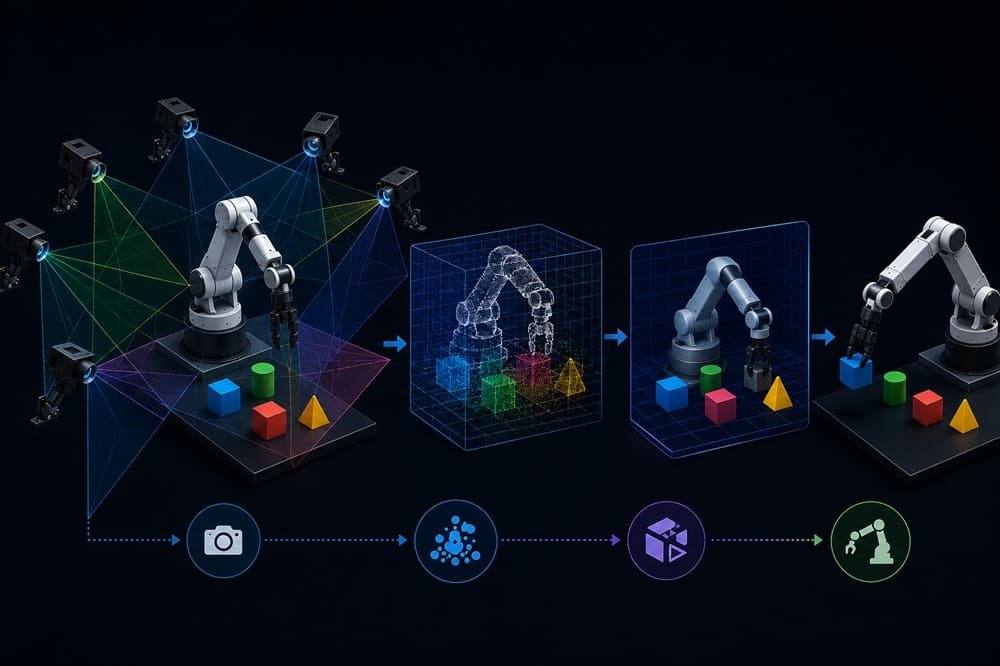
“Training data” is usually defined as something you gather. That definition hides the economic fact that decides robotics budgets: robot demonstration data cannot be gathered at all. Language models scraped trillions of tokens the internet had already produced for free. A robot demonstration has to be manufactured, one episode at a time, by a person and a machine in a room, and manufactured goods have unit costs that scraping never did.
That manufacturing has a price, and the price is the thesis of this post: the binding constraint on physical AI progress is the unit economics of demonstration data, not model architecture. Our benchmarks put teleoperation at $28 to $60 per hour, egocentric human video at $15 to $40, and multi-view exocentric capture at $20 to $50, before annotation adds another $8 to $25 per pass. Multiply any of those by the hundreds of thousands of hours that scaling curves suggest, and the number stops looking like a data budget and starts looking like a Series B.
Compute costs fall on a curve you can plan around. GPU-hours get cheaper every year; teleoperator-hours do not, because they are wages plus hardware plus QA. So while everyone argues about architectures, the teams actually shipping robot foundation models are constrained by a much less glamorous question: how many usable demonstration hours can we afford this quarter?
This post breaks down why the bottleneck is economic rather than algorithmic, what the per-hour math actually looks like, and where the cost curve is bending. It draws on DexSet’s own capture operations, so the numbers are operating benchmarks, not estimates.
Key Takeaways
- Robot data is manufactured, not scraped. Teleop costs $28 to $60 per hour; egocentric video $15 to $40; multi-view exo $20 to $50 (DexSet benchmarks).
- QA rejection of 10 to 30 percent inflates every quoted rate. Budget on cost per usable hour.
- Open X-Embodiment needed 21 institutions to pool 1M+ trajectories across 22 embodiments; no single lab could afford that collection alone.
- Rig capex is the small part: an ALOHA-class station is roughly $20k and amortizes fast. Labor and QA dominate.
- The cost curve bends through cheaper capture devices (UMI-style grippers), human video pretraining, and better data selection, not through cheaper wages.
The Bottleneck Is Economic, Not Algorithmic
The physical AI bottleneck is the gap between the demonstration volume that current methods need and the demonstration volume that current budgets can buy. Imitation learning works. ACT on ALOHA hardware showed fine bimanual manipulation from a rig that cost roughly $20k (Zhao et al., https://arxiv.org/abs/2304.13705). VLA models generalize further as data grows. The recipe is not the mystery; funding the recipe is.
Look at what it took to build the field’s reference datasets. Open X-Embodiment pooled data from 21 institutions to reach more than 1 million trajectories across 22 robot embodiments (https://arxiv.org/abs/2310.08864). DROID took a multi-lab consortium collecting across 52 buildings for a year to produce 76,000 episodes (https://arxiv.org/abs/2403.12945). These are consortium projects because the economics forced them to be. When the leading academic labs in the world have to carpool, the per-hour cost of data is the constraint worth studying.
Contrast that with a startup’s position. A humanoid company that wants 50,000 proprietary teleop hours at a blended $42 per hour is staring at a $2.1M capture bill before annotation, before storage, and before the 10 to 30 percent QA rejection rate we measure in our own pipelines pushes the real figure higher. That is the bottleneck in one sentence: the marginal trajectory costs real money, and scaling laws demand a lot of margins.
Where the Money Actually Goes
A fully loaded data cost is the sum of hardware amortization, collection labor, QA review, annotation, and infrastructure, and its composition explains why the bottleneck resists quick fixes. Hardware is the layer everyone obsesses over and the one that matters least.
| Cost layer | Teleoperation | Egocentric video | Share of total (typical) |
|---|---|---|---|
| Hardware amortization | $4 to $9/hr | $1 to $4/hr | 10 to 15% |
| Collection labor | $18 to $38/hr | $10 to $26/hr | 55 to 65% |
| QA and recollection | $6 to $12/hr | $5 to $10/hr | 20 to 30% |
| Total (raw hour) | $28 to $60/hr | $15 to $40/hr | 100% |
Two things jump out of that table. Labor dominates, and labor does not follow Moore’s law. A teleoperator in year three costs what a teleoperator cost in year one, adjusted upward for wages. The only labor lever is throughput: in our programs, operator productivity improves 30 to 50 percent over their first 200 hours, which is real but bounded.
The second thing: QA is a fifth to a third of the bill, and it is the layer buyers most often forget. An episode fails for dropped frames, a desynced camera, an occluded gripper, or a task that did not actually complete. At a 25 percent rejection rate, a $40 quote is really $53.33 per usable hour. We walk through that math, with tables, in our full robot training data costs and pricing guide.
Why Compute Got Cheap and Data Did Not
Compute costs fall because silicon improves and utilization tooling matures, while demonstration data costs stay flat because their main input is human time in physical space. This asymmetry is the strategic fact of the next five years of robotics.
A training run you could not afford in 2023 is routine in 2026. But the demonstration hour you collected in 2023 cost about what it costs today, and the scene setup, the resets between episodes, and the review pass all still happen at human speed. Physics does not batch. You cannot checkpoint a kitchen.
The practical consequence: data spend is becoming the durable moat while compute spend becomes a commodity line item. Teams that treat their data budget with the same rigor as their compute budget, tracking cost per usable hour, rejection rates, and hours-to-policy-improvement, compound an advantage that a bigger cluster cannot erase.
Where the Cost Curve Actually Bends
Cost-curve bending in robot data comes from cheaper capture devices, cheaper modalities for pretraining, and better data selection, not from paying people less. Three developments are doing real work right now.
- Handheld capture devices. UMI-style grippers (Chi et al., https://arxiv.org/abs/2402.10329) put a wrist camera on a portable gripper, so collection happens in real homes without a robot present. Our build estimate is under $1,000 per unit. Labor cost drops toward egocentric rates while output stays gripper-centric.
- Human video for pretraining. Egocentric data at $15 to $40 per hour can carry representation learning, reserving expensive teleop for post-training. A 70/30 ego-to-teleop mix can cut blended cost per hour by a third without giving up action supervision where it counts.
- Data selection over data volume. Deduplication, difficulty-aware sampling, and rejecting low-information episodes before annotation mean you pay $8 to $25 per hour of labels only on data that earns it.
None of these eliminate the bottleneck. They move the ratio of usable hours per dollar, which is the correct objective.
What This Means for Your Budget
A defensible data plan starts from cost per usable hour and works backward to volume, rather than starting from a raw-hour quote and hoping. If you take one action from this post, make it this checklist:
- Get every vendor quote itemized across hardware, labor, QA, annotation, and infrastructure.
- Demand a measured QA rejection rate from a comparable program, and pilot before committing volume.
- Split your pipeline: cheap modalities for pretraining volume, teleop for action-supervised post-training.
- Track cost per usable hour monthly. It is your burn rate’s most honest line.
Frequently Asked Questions
Why is robot training data more expensive than language data?
Language data was scraped from the internet at near-zero marginal cost. Robot data is manufactured: a person, a rig, and a physical scene produce one episode at a time, at $15 to $60 per hour depending on modality, plus QA and annotation.
What is the biggest driver of robot data cost?
Collection labor, at 55 to 65 percent of the fully loaded hourly rate in our programs. Hardware amortization is only 10 to 15 percent, which is why cheaper rigs alone do not fix the bottleneck.
How much do VLA models’ datasets cost to build?
As a reference point, 50,000 teleop hours at a blended $42 per hour is $2.1M before annotation and before QA rejection losses of 10 to 30 percent. Consortium datasets like Open X-Embodiment exist precisely because no single lab wanted to carry that cost.
Can synthetic or simulation data remove the bottleneck?
It reduces it for some skills, but sim-to-real transfer still needs real-world demonstrations for contact-rich manipulation, and mixed pipelines still budget significant real capture. Treat sim as a multiplier on real data, not a replacement.
How do I lower my cost per usable hour?
Tighten task specs to cut QA rejections, mix cheaper egocentric or UMI-style capture into pretraining, annotate only selected data, and measure rejection rates continuously. The full cost model is in our pricing guide.
Want the full cost model?
The Robot Training Data Costs and Pricing Guide publishes our complete per-hour benchmarks, rig capex table, and a downloadable budget spreadsheet. No sales call required to see the numbers.