
Dexset

Why Teleoperation Data Is the Biggest Bottleneck in Physical AI

In a budget review we sat in on last quarter, a founder approved a seven-figure compute reservation in about ten minutes, then spent the next hour interrogating a $70k line for demonstration data. The compute felt legible: dollars per GPU-hour, a market price. The data line had no equivalent, because nobody in the room could say what an hour of human demonstration work actually yields.

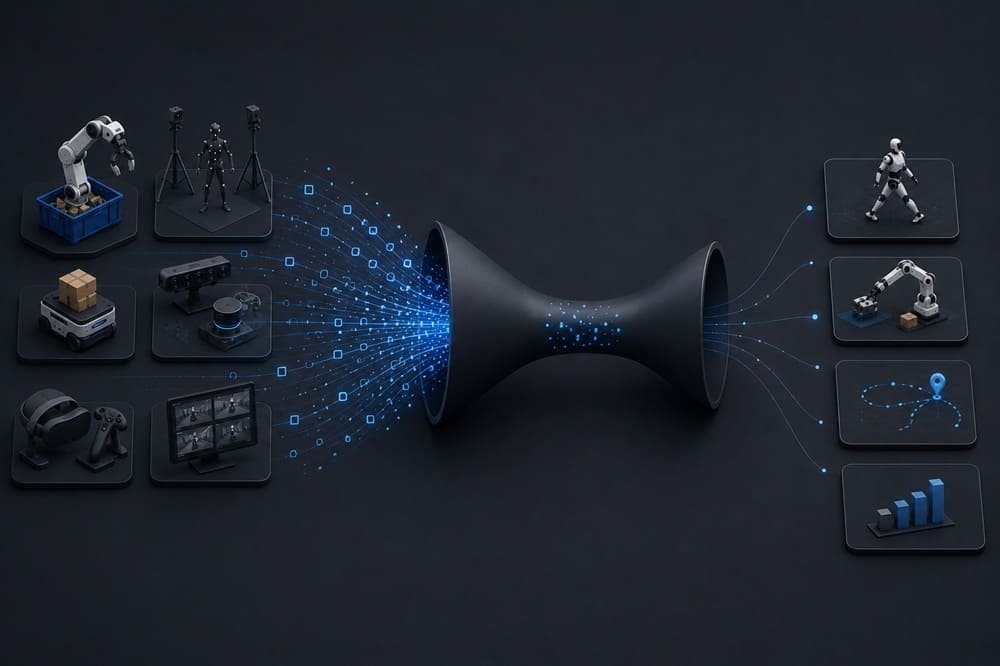
That asymmetry is the subject of this post, and the thesis is blunt: physical AI is not compute-bound, it is demo-bound. Language models trained on the internet. Vision models trained on the internet. Robot foundation models have no internet of action-labeled data, so every demonstration a VLA model consumes had to be manufactured: a person, at a rig, doing a task, one episode at a time. That production rate, not FLOPs, sets the pace of the field.

The gap exists because physical interaction data cannot be scraped. YouTube shows what hands do but not the joint torques, gripper commands, and proprioceptive states a policy needs as action labels. Simulation helps but leaks reality at every contact. That leaves teleoperation as the primary source of ground-truth action data, and teleoperation runs at human speed.

This post puts numbers on the bottleneck: how slow collection actually is, where the throughput hides, and the three levers that move it. The benchmarks are first-hand from our collection floors; the dataset math comes from published sources.

Key Takeaways – DROID, one of the largest open manipulation datasets, is 76,000 episodes and about 350 hours of interaction collected across 13 institutions (arxiv.org/abs/2403.12945). An LLM ingests more tokens than that dataset’s total information content in seconds. – A trained operator produces 25 to 40 usable episodes per hour. A novice produces 8 to 12. The ramp takes two to three weeks. – QA rejects 10 to 30 percent of episodes. Most teams forget to budget for it. – The three scaling levers, in order of impact: operator retention, task and rig ergonomics, automated QA at ingest.

The Bottleneck, Quantified

The teleoperation bottleneck is the mismatch between how fast foundation models can consume demonstration data and how fast humans can produce it. Consider what “large” means in robotics. Open X-Embodiment pooled over one million trajectories from 22 embodiments, drawing on years of collection by dozens of labs (arxiv.org/abs/2310.08864). DROID took 76,000 episodes across 564 scenes and stands as a landmark effort. Meanwhile a single humanoid program we support wants 50,000 episodes per quarter, for one product.

Run the arithmetic. At 30 usable episodes per operator-hour, 50,000 episodes is roughly 1,700 operator-hours before rejection. Add a realistic 15 percent QA rejection and you are near 2,000 hours: one operator working full-time for a year, or ten operators for five weeks, assuming every one of them is already trained. They will not be.

Where the Throughput Actually Goes

Throughput loss in teleoperation programs comes from three places: the operator ramp curve, episode overhead, and QA rejection. Each one quietly halves your effective rate if ignored.

The operator ramp curve is the two-to-three-week climb from novice to trained throughput. Our benchmarks are consistent: new operators deliver 8 to 12 usable episodes per hour in weeks one and two, then 25 to 40 once bimanual coordination and reset discipline become automatic. That is a 3x difference, which makes operator churn the most expensive line item nobody tracks. Lose a trained operator and you do not lose a salary; you lose three weeks of peak yield.

Episode overhead is everything between demonstrations: scene resets, object randomization, rig checks, breaks. On contact-rich tasks with careful resets, overhead can consume 40 percent of a shift. Task card design and reset tooling (marked object regions, reset jigs) pull that down more than exhortation ever will.

QA rejection runs 20 to 30 percent on a new task or rig and 10 to 15 percent in a mature pipeline. Sync skew between the 50 Hz action log and 30 fps cameras is the top rejection reason we see, followed by hesitant trajectories and failed completions. Rejection discovered at training time, weeks after collection, is pure loss; rejection at ingest is a correctable signal.

The Three Levers That Move the Number

Scaling teleoperation data collection means attacking retention, ergonomics, and ingest QA, in that order.

Lever Typical gain Cost to implement
Operator retention and certification program Sustains 25 to 40 eps/hr vs repeated novice resets Low: pay, scheduling, progression path
Rig and task ergonomics (leader-follower feel, reset jigs) 20 to 40 percent throughput on contact-rich tasks Medium: GELLO-class leaders ~$300/arm, jig fabrication
Automated QA at ingest (sync, smoothness, completion gates) Recovers the 10 to 30 percent otherwise lost silently Medium: one engineer-month, then near-zero marginal

A note on hardware, since teams often reach for it first. Moving from a $500 VR setup to a $20k ALOHA-class station improves fidelity on fine manipulation, and the original ACT results (80 to 90 percent success from about 50 demos, arxiv.org/abs/2304.13705) show what a well-matched rig enables. But hardware does not fix churn, and it does not fix silent QA loss. We have seen $300 GELLO leaders outproduce premium stations purely because the operators stayed.

A Worked Example: Sizing a 25,000-Episode Program

Program sizing is the exercise of converting an episode target into stations, headcount, and calendar time, with ramp and rejection built in rather than bolted on. Here is the arithmetic for a representative target of 25,000 QA-passed episodes in one quarter.

Start from the end. With a 15 percent rejection buffer, 25,000 passed episodes means collecting about 29,400. A trained operator averaging 30 usable episodes per hour, working six productive hours per shift, yields 180 episodes per day. Naively that is 164 operator-days, or three operators for the quarter. The naive answer is wrong in three ways.

First, ramp. If all three operators start as novices at 10 episodes per hour, the first three weeks produce a third of plan, which costs you roughly 5,000 episodes against the target. Either hire ahead of need or extend the calendar. Second, absence and churn. Floors run at 80 to 90 percent of rostered capacity over a quarter; one resignation among three operators is a 33 percent capacity event plus a new ramp curve. Third, task mix. Contact-rich bimanual tasks run at the bottom of the throughput range, and new tasks spike rejection to 20 to 30 percent for their first two weeks regardless of operator skill.

The sizing that actually holds: five operators across three stations (stations can run staggered shifts), a certification cohort starting two weeks before production, and a rejection buffer that starts at 25 percent for week one of each new task and decays to 15 percent. At $28 to $60 per all-in operator hour, the labor line for the quarter lands between roughly $27k and $70k depending on region and task complexity. That is the honest shape of the bottleneck: not impossible, just physical.

What This Means for Your Roadmap

The practical conclusion is that demonstration data needs the same planning rigor as compute. If your model roadmap says “100k episodes by Q2,” the collection plan behind it should specify stations, operator headcount with ramp assumptions, a rejection buffer of at least 15 percent, and an ingest QA gate that runs nightly. Teams that treat collection as an afterthought discover the bottleneck at the worst possible time: after the training cluster is reserved.

The full playbook, including rig selection tables and per-episode cost math, is in our complete guide to teleoperation data collection.

Next Step

Ready to scope your data program? Talk to our team.

Frequently Asked Questions

Why is teleoperation data the bottleneck in physical AI?

Because action-labeled interaction data cannot be scraped from the web; it must be produced by human operators at 25 to 40 usable episodes per hour at best. Model capacity and compute scale far faster than human demonstration throughput.

Our benchmarks: 8 to 12 usable episodes per hour for a novice, rising to 25 to 40 after two to three weeks of ramp. Contact-rich bimanual tasks sit at the low end, simple pick-place at the high end.

Multi-task training typically needs thousands of episodes per skill family. For reference, Open X-Embodiment pooled over one million trajectories from 22 embodiments, and single-task ACT policies can succeed with about 50 clean demonstrations.

Expect 20 to 30 percent rejection on new tasks or rigs and 10 to 15 percent in a mature pipeline. The top causes are timestamp skew between streams, dropped frames, and failed task completions.

Not yet for contact-rich manipulation. Simulation supplements real data and helps with evaluation, but sim-to-real gaps in contact dynamics and perception mean most production policies still train primarily on real teleoperated demonstrations.
Why Egocentric Data Collection for Robotics Is the Biggest Bottleneck in Physical AI

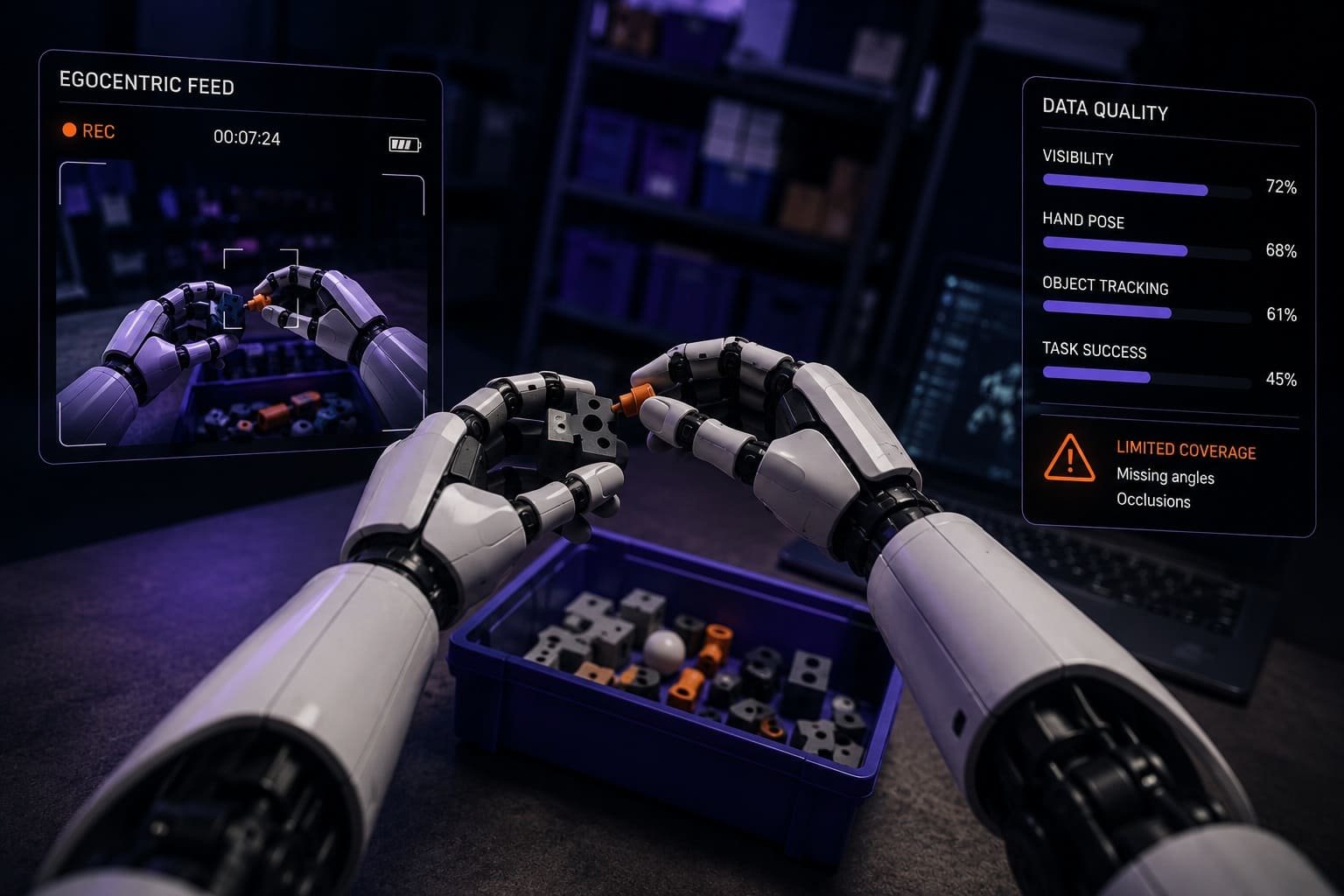
In the kitchen bay of our capture floor, a collector claps once in front of her helmet camera, waits for the sync check to pass on the wall monitor, and begins unloading a dishwasher using only grasps a parallel-jaw gripper could copy. By the end of her shift she will have produced more usable first-person manipulation data than one of our bimanual teleoperation stations yields in a week. Nothing about that scene is exotic. The exotic thing is how rare it still is.

It is rare for a structural reason. Text and images were exhaust from human activity; someone else already paid to produce them. First-person manipulation data is not exhaust. Nobody films their hands doing the dishes with calibrated stereo cameras and synchronized IMUs, so every hour has to be manufactured deliberately, by someone wearing a rig or driving a teleoperation station, and then inspected before it is fit to train on. The largest open robot manipulation dataset, Open X-Embodiment, took 21 institutions pooling 22 embodiments to reach roughly a million trajectories (arXiv:2310.08864), while language models trained on trillions of tokens.

This post argues one thesis: the binding constraint on physical AI right now is the supply of QA-passed egocentric hours, not compute and not architecture. You will get the arithmetic behind that claim, our cost benchmarks for the three ways teams try to break the constraint, and a checklist for scaling collection without torching your budget.

We spend our days at DexSet manufacturing exactly this data: egocentric, exocentric, and teleoperation streams for VLA and humanoid teams. The numbers below come from our production logs, not analyst reports.

Key Takeaways

  • Robot learning is data-bound: internet-scale text corpora dwarf the largest robot manipulation datasets by many orders of magnitude, and almost no internet video is first-person with recoverable actions.
  • Teleoperation alone cannot close the gap. A well-run bimanual station yields roughly 15 to 25 usable episode-hours per week; at $28 to $60 per hour, 10,000 hours is a multi-year, seven-figure program.
  • Egocentric human capture shifts the curve: $15 to $40 per hour in our benchmarks, 3 to 5x the collection rate per operator, and it scales with people instead of robot fleets.
  • The constraint is not raw hours, it is QA-passed hours. Plan for 15 to 25 percent of captured footage to fail quality gates.
  • Scaling works when you treat collection as a manufacturing process: fixed protocols, instrumented rigs, sampled QA, and annotation depth matched to the training objective.

Why Data, Not Compute, Is the Binding Constraint

The binding constraint in a training pipeline is the input you cannot buy more of at market price, and for physical AI that input is embodiment-relevant data. Compute is rentable by the hour. Architectures are published within months of working. But there is no marketplace where you can order 10,000 hours of first-person manipulation with hand pose annotations for next quarter, because until recently the industry that manufactures it did not exist.

Look at what the flagship models actually consumed. RT-2 leaned on internet-scale vision-language pretraining precisely because robot data was scarce (arXiv:2307.15818). OpenVLA trained on 970K robot episodes from Open X-Embodiment (arXiv:2406.09246). π0 combined internet-scale pretraining with a proprietary dexterous manipulation corpus (arXiv:2410.24164). The pattern across all three: model capability tracked data supply, and every team supplemented public data with expensive private collection.

Meanwhile the largest first-person video corpus in existence, Ego4D, holds 3,670 hours (arXiv:2110.07058). Impressive for a research effort, and still less footage than a single mid-size YouTube channel uploads in a year. For robotics, most of it lacks the calibration and action annotations that policy learning needs. The shelf is nearly empty. Whoever wants the data has to make it.

The Teleoperation Ceiling

The teleoperation ceiling is the practical throughput limit of collecting robot demonstrations through human-controlled rigs, and it is lower than most roadmaps assume. ALOHA-style bimanual stations (arXiv:2304.13705) made teleop dramatically cheaper to build; the ALOHA rig famously targeted a ~$20K bill of materials against six-figure predecessors. What they did not change is the physics of throughput.

In our teleop operations, a trained operator on a healthy rig produces 15 to 25 usable episode-hours per week once you subtract resets, calibration, failed episodes, and operator fatigue. Push operators harder and quality drops before throughput rises; fine manipulation under fatigue produces exactly the jerky, hesitant trajectories you do not want a policy imitating.

Now run the arithmetic for a 10,000-hour corpus, which is a modest target by foundation model standards:

ApproachCost per QA-passed hour (our benchmarks)Realistic throughputTime to 10,000 hoursProgram cost
Teleoperation, 5 bimanual rigs$28 to $6075 to 125 hrs/week1.5 to 2.5 years$280K to $600K
Teleoperation, 20 rigs$28 to $60300 to 500 hrs/week5 to 8 months$280K to $600K + fleet capex
Egocentric human capture, 20 collectors$15 to $40400 to 700 hrs/week4 to 6 months$150K to $400K

The 20-rig teleop row hides the real problem: rig fleets need robot hardware, lab space, maintenance engineers, and operator pipelines. Twenty humans wearing $500 to $1,200 capture rigs need a protocol document and a QA queue. That asymmetry is the entire argument for egocentric capture as the scaling layer, with teleop reserved for the embodiment-matched fine-tuning set. Systems like EgoMimic have shown the combined recipe outperforms robot data alone (arXiv:2410.24221).

Why Egocentric Capture Is Hard to Scale Anyway

Scaling egocentric collection means turning a research-style capture activity into a manufacturing process with yield metrics, and most attempts stall on the same four problems.

Yield, not volume. Raw hours are easy; QA-passed hours are the product. Across our programs, 15 to 25 percent of captured footage fails gates for motion blur, dropped IMU packets, sync drift, or off-protocol behavior. Teams that do not measure yield discover it at training time, which is the most expensive place to discover it.

Calibration debt. Every uncalibrated GoPro hour you collect today is an hour of 3D lifting problems you inherit later. Devices like Aria carry factory calibration and machine perception services (projectaria.com); consumer rigs need per-unit calibration routines and periodic re-checks, and skipping them is the most common false economy we see.

Annotation as the cost center. Capture at $15 to $22 per hour feels cheap until hand pose and object tracks push finished cost to $30 to $40. The fix is not cheaper annotation; it is refusing to annotate hours your training plan does not need at that depth.

Protocol drift. Thirty collectors interpret “tidy the workspace” thirty ways. Without scripted task cards, fixed start states, and outcome labels, you end up with footage instead of episodes. The LeRobot dataset conventions (github.com/huggingface/lerobot) are a useful forcing function here: if a capture cannot be expressed as episodes with consistent schema, it probably was not collected with enough discipline.

A Scaling Checklist That Survives Contact With Reality

A scaling checklist is only useful if each item maps to a failure we have actually watched happen, so here is ours:

  • Define the training mechanism first (encoder pretraining, retargeting, co-training), then derive modalities and annotation depth from it.
  • Set a QA yield target (we hold vendors, including ourselves, to 80 percent+ first-pass) and sample-inspect every batch.
  • Match camera height and field of view to the deployment embodiment before collecting hour one.
  • Script tasks as episodes: start state, goal, outcome label, retry policy.
  • Calibrate on a schedule, not on failure.
  • Track cost per QA-passed hour weekly; it is the only number that predicts your budget.
  • Pilot 50 to 100 hours and train on them before committing to thousands.

If you want the full treatment of rigs, modalities, and economics behind this checklist, it lives in our pillar guide: The Complete Guide to Egocentric Data Collection for Robotics.

Frequently Asked Questions

Why is data the bottleneck in physical AI rather than compute?

Compute and architectures are purchasable and published, while first-person manipulation data with recoverable actions barely exists on the internet and must be manufactured deliberately. The largest robot datasets hold on the order of a million trajectories, orders of magnitude below the corpora that trained large language models.

In DexSet’s operations, a trained operator on a bimanual rig produces roughly 15 to 25 usable episode-hours per week after resets, failures, and fatigue. Scaling further requires more robot rigs, lab space, and maintenance, which is why teleop fleets scale slowly.

Our benchmarks put QA-passed egocentric capture at $15 to $40 per hour depending on annotation depth, against $28 to $60 per hour for teleoperation, with 3 to 5 times higher collection throughput per operator.

No. The embodiment gap between human hands and robot grippers means policies still need robot-embodiment demonstrations. The strongest published results co-train on both, as in EgoMimic.

Plan for 15 to 25 percent of raw captured footage to fail quality gates for blur, sync drift, sensor dropouts, or protocol violations.

From Bottleneck to Plan

If your roadmap has a data line item and a question mark next to it, start with the pillar guide above, then request a sample batch from us. We ship real episodes with real QA reports, and the pricing table is on the first page, not behind a discovery call.